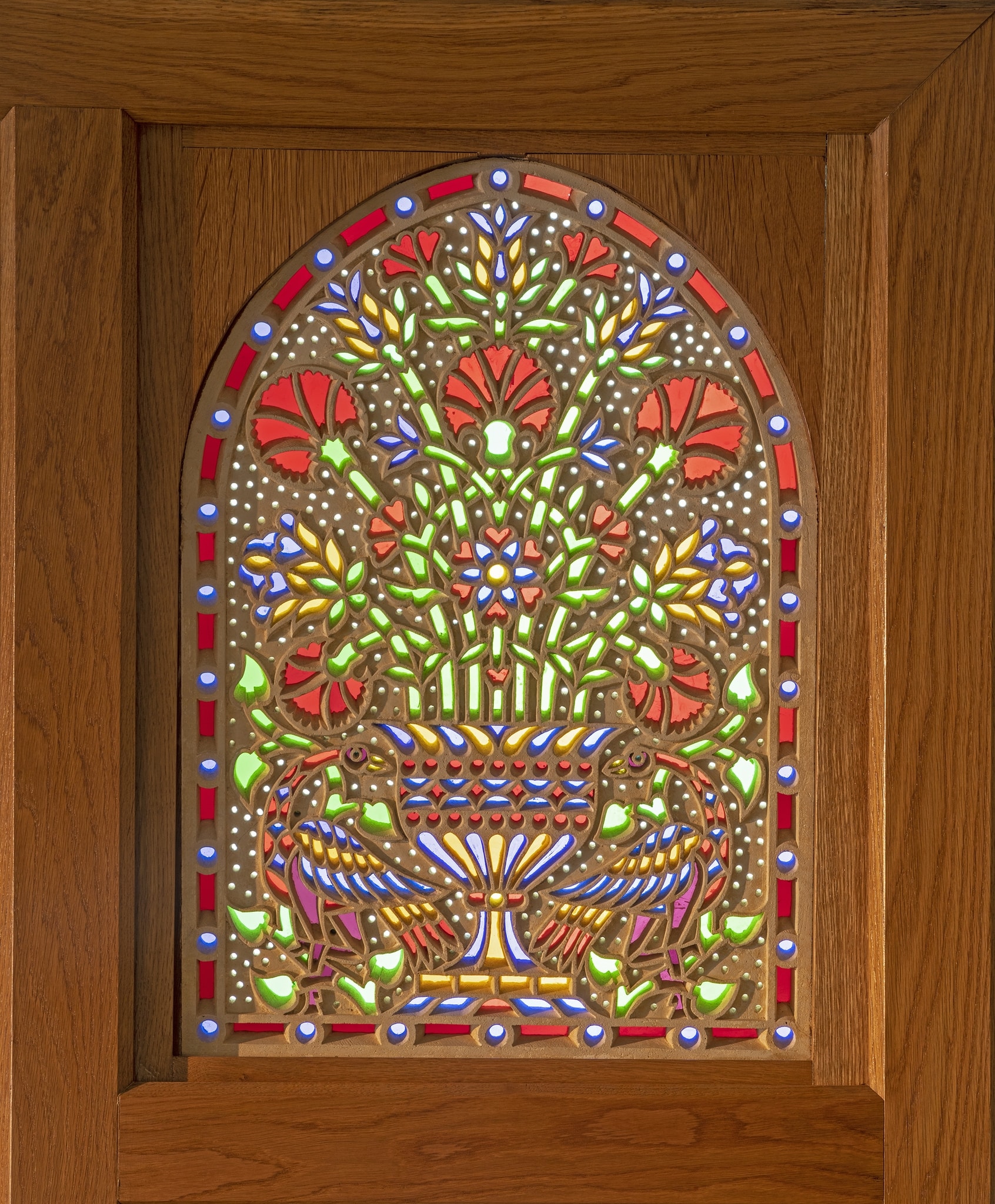
This stucco and glass window is an unconventional reinterpretation of the flower-and-vase-motif, one of the standard types of qamariyya widespread in Egypt during the Ottoman period. Windows with this motif can be found in several of the collections studied (see for instance IG_7, IG_166, IG_178, IG_255, IG_356). However, the example discussed here differs considerably from traditional stucco and glass windows of the same type, in that it combines the vase of flowers with the peacock, two motifs that usually never appear together (see Iconography).
Both the flowers in a vase and the peacock are recurrent motifs in Islamic arts. Representations of the flower-and-vase-motif can also be found in numerous other media, such as ceramics, wood panelling, wall paintings, and textiles, over a long period of time, and in both sacred and profane contexts. The motif also aroused the interest of Western artists and architects, as is attested by a significant number of book illustrations, sketches, and paintings (see for instance IG_43, IG_118, IG_149, IG_153, IG_437, IG_443, IG_461), as well as by replicas of stucco and glass windows installed in Arab-style interiors across Europe (IG_54–IG_59, IG_64, IG_91, IG_431).
The peacock is also a widely used motif across media and time (Daneshvari, 1994; Viré/Bear, 2012). However, in traditional stucco and glass windows (see for instance IG_183, IG_259) as well as in 19th-century depictions of such windows by the British architect James William Wild (1814–1892) (IG_447, IG_449), peacocks are only rarely represented in pairs. They are usually shown individually, from the side, and with the tail spread.
Due to the unusual combination of motifs and stylistic features, we assume that the window was designed by a Western architect, or that it was made according to the specific wishes of a Western client. The fact that two peacocks flank the richly decorated vase is no coincidence: the enthusiasm for the bird’s exotic beauty and colourful plumage reached a peak in the Western arts of the 19th and early 20th centuries, where the peacock became one of the main motifs of Art Nouveau stained glass (Michel, 1986, p. 84).
The unusual design as well as the good state of preservation of the window – even before its restoration in 2003 – suggest that it was produced sometime between the late 19th and early 20th century. The window was made according to the traditional technique used in the manufacture of qamariyyāt in Egypt to this day (see Technique).
Another criterion in favour of the proposed date of manufacture is the fact that pieces of glass show the characteristics of cylinder-blown sheet glass, a technique that was uncommon in the Islamic world at that time and more commonly used in Europe. Interestingly, the Hungarian architect Max Herz (1856–1819) states in 1902 that sheet glass was imported to Egypt from Europe from the 19th century, because local sheet-glass production had come to a standstill (Herz, 1902, p. 53).
In 1973, the Benaki Museum in Athens acquired the window along with IG_335 from Ioannis Krystalidis (life dates and biography unknown).
late 13th–first half of 14th centuries AH / late 19th–early 20th centuries CE (?)