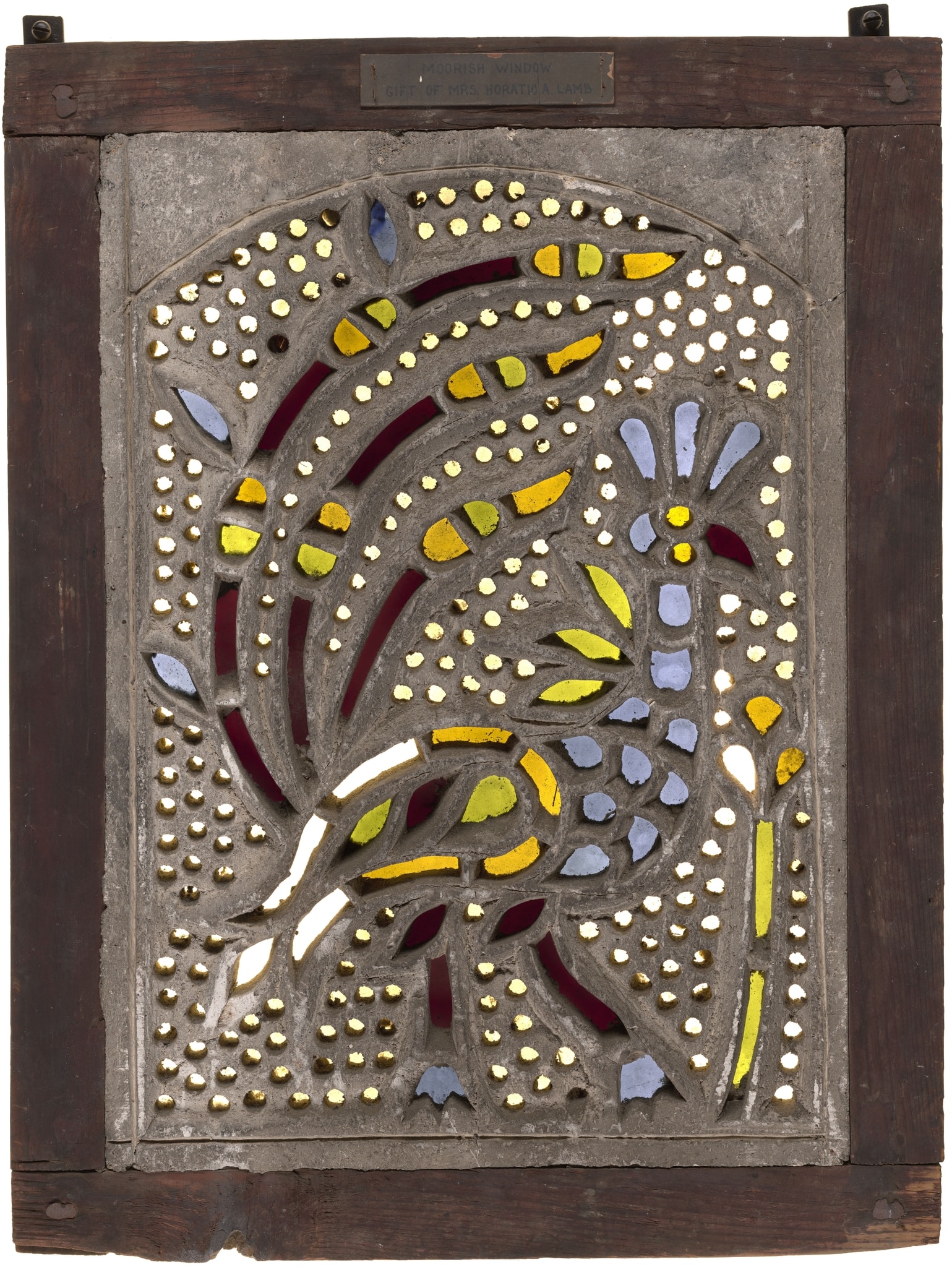
This stucco and glass window is one of the few examples conserved in Western museum collections representing a peacock. The bird’s colourful plumage and its association to royalty and paradise make it one of the most popular motifs of art across time and cultures (Dittrich, 2005, pp. 348–360; Riese, 2007, pp. 328–329). The peacock is also a recurring motif in Islamic art (Daneshvari, 1994; Viré/Bear, 2012).
The enthusiasm for the bird’s exotic beauty and colourful plumage reached a peak in the Western arts of the 19th and early 20th centuries, where the peacock became one of the main motifs of Art Nouveau stained glass (Michel, 1986, p. 84).
This interest in the peacock motif is also manifest when it comes to stucco and glass windows. This is attested by sketches and paintings of qamariyyāt representing a peacock by John Frederick Lewis (1805–1876) and James William Wild (1814–1892). As in the window discussed here, they show the bird from the side (IG_118, IG_119, IG_122, IG_125, IG_447, IG_449). The peacock motif was also reinterpreted in stucco and glass windows designed in the late 19th and early 20th centuries in the Ottoman empire (IG_334) and in Europe (VMR_1387).
Although qamariyyāt depicting peacocks are rare today, the window discussed here finds a close counterpart in a specimen acquired in Cairo in 1890 and held today at The Metropolitan Museum of Art (IG_183). Both windows show the peacock in profile. The depiction of its head and tail, as well as the flower stem placed in front of the bird, show surprising similarities. However, due to differences in the way in which the design was conceived, the two windows were not necessarily made in the same workshop.
From a technical and iconographic point of view, it can be assumed that this window was made in an Egyptian workshop during the late Ottoman period. This hypothesis is supported by the results of the analysis of several stucco fragments from this window: both the stucco lattice and the top layer in which the pieces of glass are embedded (see Technique) are made of a relatively coarse-grained gypsum plaster with many inclusions, including charcoal and brick particles. The properties of the plaster suggest artisanal production in smaller workshops like those that still exist in Egypt and the Maghreb today. The assumption of an Egyptian provenance is further confirmed by the results of the chemical analysis of one piece of coloured glass from this window. The olive-green piece of glass analysed showed relatively high concentrations of magnesium and potassium, suggesting that plant ash was used as a fluxing agent. The use of plant in glass production was particularly common in the Islamic world. In Europe, industrial soda ash was the usual flux in the production of sheet glass from the 18th century onwards. Somewhat contradictory, however, is the fact that several coloured pieces of glass show the characteristics of cylinder-blown sheet glass, a technique that was unusual in artisanal glass production in Egypt, but widely used by the European glass industry. It is therefore possible that some of the coloured sheet glass used in this window was produced in a European glass-house. Interestingly, the Hungarian architect Max Herz (1856–1819) states in 1902 that sheet glass was imported to Egypt from Europe from the 19th century, because local sheet glass production had come to a standstill (Herz, 1902, p. 53).
According to the MIT Libraries’ records, this window was acquired by the Boston architect Arthur Rotch (1850–1894) together with three other qamariyyāt (IG_258, IG_260, IG_261) in the 1860s or 1870s. However, since he was still of a young age in the 1860s, we assume that he bought the windows at a later date. All four windows show the incised segmental arch and undecorated spandrels. These similarities support the assumption that they once formed a group of windows that were probably made in the same workshop. Traces of weathering on the surface of the latticework suggests that the window was exposed to the elements.
Arthur Rotch studied at the Massachusetts Institute of Technology (MIT) from 1872 to 1873, when the American architect William Robert Ware (1832–1915) was head of the newly created Architectural School. Just as other MIT students, Rotch was a trainee at his teacher’s architectural firm, and he continued working at Ware & Van Brunt as a draftsman after completion of his studies in 1874 (Chewning, 1979, p. 26). Interestingly, William Robert Ware also had a collection of stucco and glass windows. He had purchased them in 1890 on the art market in Cairo. In 1893, he donated 17 qamariyyāt to the Metropolitan Museum of Art (see IG_169, IG_171–IG_186). Due to the lack of documentation, it can only be assumed that the one knew about the other’s collection. It also remains unclear where Arthur Rotch’s enthusiasm for stucco and glass windows came from. After Rotch’s death, his sister Annie Lawrence Rotch (1850–1926), wife of Horatio Appleton Lamb, donated all four windows to the Department of Architecture at MIT as part of the Rotch Art Collection.