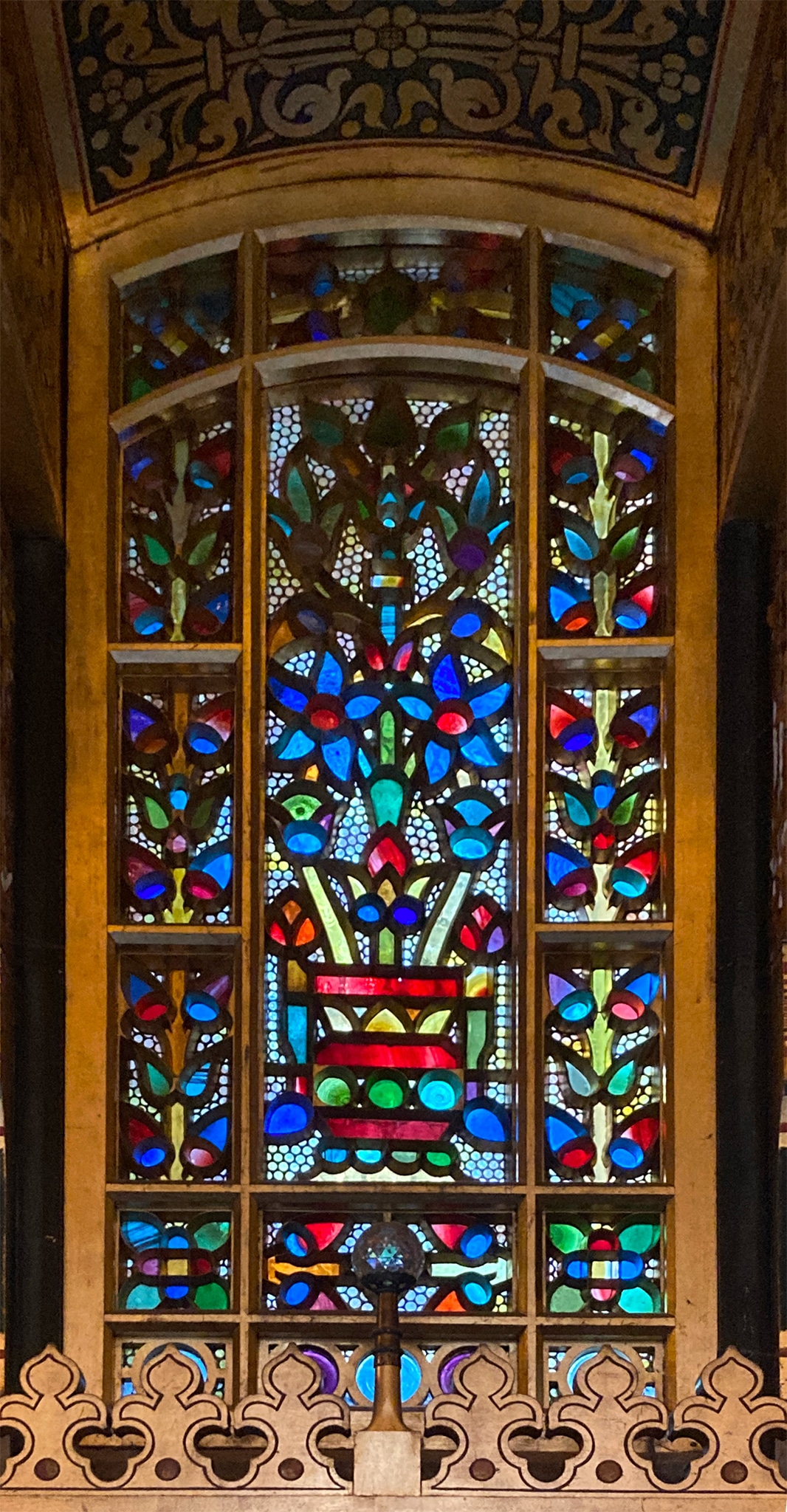
The window discussed here is one of four almost identical replicas (two pairs) installed in the upper part of the Arab Room of Cardiff Castle in Wales (IG_484–487). It forms a pair with IG_484, located at the south side of the Arab Room, which has the same composition and colour distribution. Both replicas are reminiscent of one of the standard types of qamarīya documented in the Ottoman empire. The representation of flowers in a vase is a widespread motif in Islamic decorative arts. It can be found in numerous other media, such as ceramics, wood panelling, wall paintings, and textiles, over a long period of time, and in both sacred and profane contexts.
In the 19th century, stucco and glass windows with the vase motif aroused the interest of Western artists and architects, as is attested by a significant number of book illustrations, sketches, and paintings (see for instance IG_43, IG_118, IG_149, IG_153, IG_437, IG_443, IG_461). Together with the replicas at the Arab Hall at Leighton House in London (IG_54–57), the Mosque at Maison Loti in Rochefort (IG_431), the Arab Rooms of the MAK (IG_264) and the Wien Museum (IG_371–375) in Vienna, and the fumoir arabe of Henri Moser-Charlottenfels (IG_64), the window discussed here testifies to the success of the motif among European architects and collectors, who integrated their replicas in Arab-style interiors. Matthew Williams even suggests that the Arab Hall of Burges’s friend Frederic Leighton (1830–1896) on Holland Park Road in Kensington, executed between 1877–1881 and located in Burges’s London neighbourhood, may have inspired his design for Cardiff Castle (Williams, 2019, p. 150). Just like Leighton’s Arab Hall, Burges’s interior is reminiscent of the Islamicate architecture of Norman Sicily.
Stucco and glass windows with flowers in a vase are also represented in several of the collections studied (see for instance IG_7, IG_166, IG_178, IG_255, IG_356). However, all the examples cited were made in Egypt, whereas the replica discussed here finds its closest parallels in Turkey, where some of the most sophisticated examples of this type can be found, in the apartments of the Crown Prince at the Topkapı Sarayı (early 17th century CE, date of the windows uncertain) and in the Sultan’s Lodge (Hünkâr Kasrı) of the Yeni Cami (1661–1663 CE, date of the windows uncertain), both in Istanbul (see also Arseven, 1939, pp. 207–211; Arseven, [c.1952], pp. 182–189).
This attribution is supported by biographical data on the British architect and designer William Burges (1827–1881), who conceived Cardiff Castle’s Arab Room and its four windows on behalf of John Patrick Crichton-Stuart, 3rd Marquess of Bute (1847–1900). Burges had travelled to Istanbul in the summer of 1857, when he visited various mosques, among them the Süleymaniye Camii, with its refined stucco and glass windows (Burges, 1858, p. 89, see IG_189). During his stay, Burges made colour drawings of the windows. One of the drawings was published in 1904 by Burges’s friend George Aitchison (1825–1910) to illustrate the Islamic tradition of stucco and glass windows in his contribution on ‘Coloured Glass’, issued in the XIth volume of The Architecture Journal (Aitchison, 1904, fig. 1; IG_91). When compared with the replicas at Cardiff Castle, we find clear references to the depicted window. Moreover, the use of a second exterior panel with a much simpler design, placed on the outside of the window opening at Cardiff Castle, distinguishes the four replicas from the windows in the lower part of the Arab Room. It finds its closest parallels in Ottoman windows from Turkey, as described in 1858 by Burges in his travel report mentioned above (see also Arseven, 1939, pp. 209–211; Arseven, [c.1952], pp. 183–184).
Four designs for the Cardiff windows held at Glamorgan Archives in Cardiff and attributed to Burges document the design process (IG_501–504). Whereas IG_501, IG_502, and IG_504 represent the window discussed here, IG_503 shows the slightly different version of IG_485 and IG_487. As in Ottoman examples, the composition is arranged along a central axis, surrounded by a background that imitates the perforated surface of stucco and glass windows (see IG_504). The vase motif is placed in the centre field, surrounded on all four sides by rectangular and square panels, which together form a border.
At Burges’s death in April 1881, the Arab Room was unfinished and the British architect and brother-in-law of William Burges, Richard Popplewell Pullan (1825–1888), completed the work in 1882, including the execution of the windows according to Burges’s designs (Newman, 1995, p. 205). This is attested by a detailed design of the vase of IG_484 and IG_486 with handwritten instructions by Pullan for fixing the glass into the wooden lattice (IG_505), conserved at the Glamorgan Archives in Cardiff.
According to an undated report by Erfyl Ogwen Parry, assistant curator at Cardiff Castle, the windows of the Arab Room were probably executed by Worrell & Co., who in 1880 had taken over the glass firm Saunders & Co. from Burges’s old associate William Gualbert Saunders (1837–1923) (Parry, s.d., p. 5). Unlike the replicas mentioned above designed by Burges’s friend George Aitchison (1825–1910) for Leighton’s Arab Hall at Leighton House in London, the lattices of the Cardiff windows were made of wood. Parry states that the wooden grilles were most probably made together with the muqarnas ceiling and the mashrabīya shutters in the Bute Workshops, which had moved from Tyndall Street to Cardiff Castle in 1879 (Parry, s.d., p. 6).
The use of wood instead of stucco for the lattice is the most significant difference compared to examples from Turkey. A similar ‘material transfer’ from stucco to wood can be observed 20 years later, in the windows of the Arab Room mentioned above made in Vienna for the Austrian entrepreneur Anton Johann Kainz-Bindl (1879–1957) and held today at the Wien Museum (IG_371–375). It is not known if it was Burges who planned the windows to be executed in wood – despite his observations concerning the materials used in Istanbul –, or if it was Pullan who replaced the stucco lattice with a wooden grille.