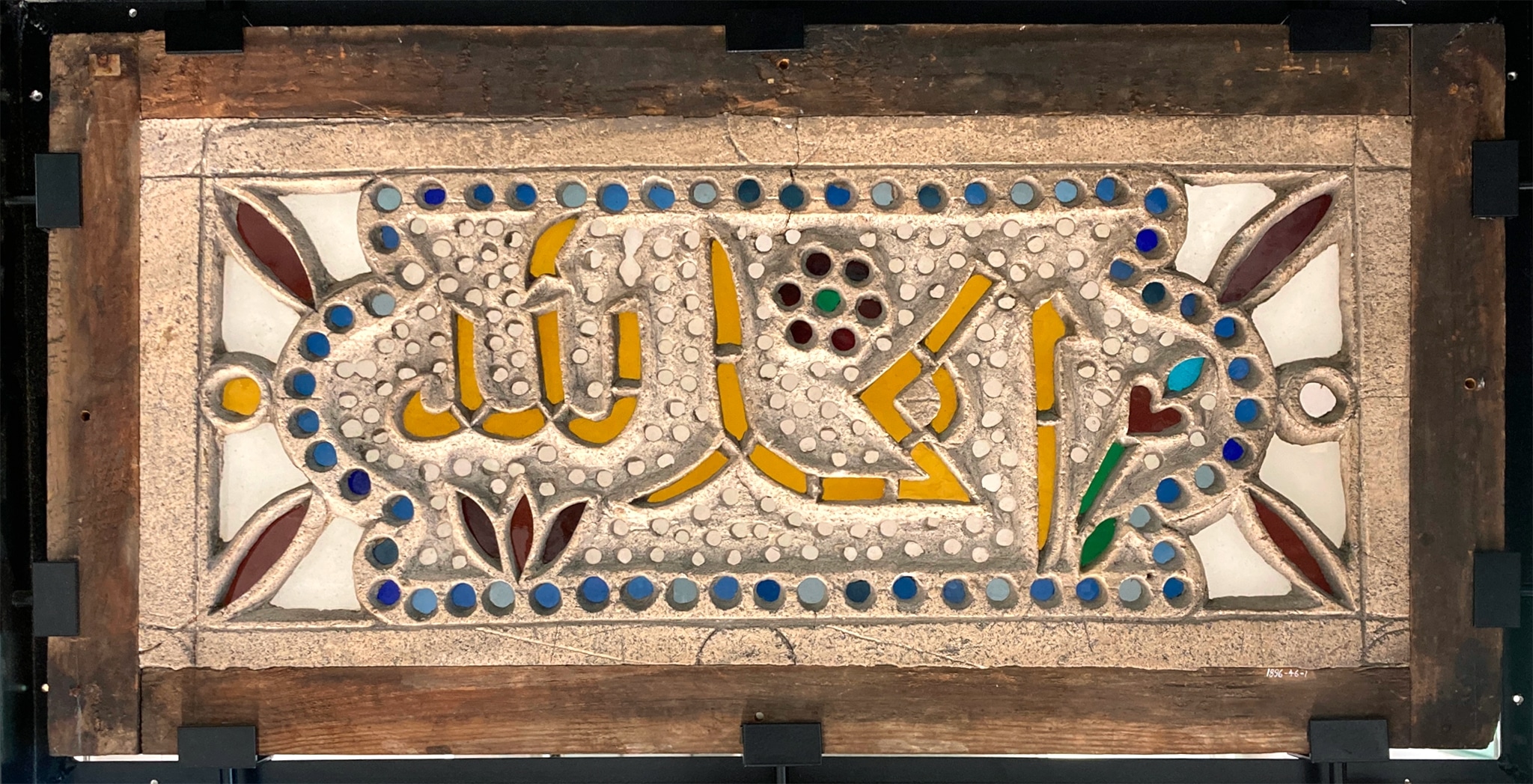
This stucco and glass panel shows all the characteristic features of Arabic inscriptions integrated in qamariyyāt: the use of yellow glass for the letters, the framing cartouche, and the perforated background.
The words al-ḥamdu li-’llāh can be translated as ‘praise be to God’. They form a phrase called taḥmīd, meaning ‘praising’, also known as ḥamdala. The second āyah (verse) of the first chapter (Sura) of the Qurʾan consists of a longer version of it (al-ḥamdu li-’llāhi rabbi l-ʿālamīn, ‘praise be to God, Lord of the worlds’). Besides the phrase’s central importance for Muslims, it is also commonly used by speakers of Arabic in general.
Most of the inscriptions preserved in museum collections today (see for instance IG_174, IG_493, IG_494, IG_495, IG_496) were originally part of composite stucco and glass windows consisting of several individual panels. This may also have been the case with the panel discussed here. Inscriptions made of glass and stucco and integrated into large-format windows were documented by 19th-century architects and archaeologists, among them Pascal Coste (IG_130, IG_294), James William Wild (IG_436), Jules Bourgoin (IG_461, IG_462), and Melchior de Vogüé (IG_71–73).
The window discussed here forms part of a lot of six qamariyyāt (IG_288–293) acquired by the Glasgow Museums in London in 1896 from the Pre-Raphaelite painter, writer, and collector Henry Wallis (1830–1916). Wallis was an expert in Islamic art and especially ceramics, as several of his publications attest (see for instance Wallis 1885, Wallis 1893, Wallis 1894, Wallis 1899). Due to the lack of documentation, it is not possible to clarify where Wallis acquired the windows. However, the motif, the stylistic features and the manufacturing technique suggest that the window was probably made in Egypt.
According to the museum records, this stucco and glass window dates to the 19th century. The structure of the glass and a statement by the Hungarian architect Max Herz (1856–1819) provide clues that indirectly support this dating: the glass shows the characteristics of cylinder-blown sheet glass, commonly known as broad sheet. This technique was uncommon in the Islamic world, but widely used in Europe to produce window glass. European glassworks were among the largest producers of broad sheet in the 19th century. According to Herz, European flat glass was exported to Egypt from the 19th century onwards, as the glass industry there had come to a standstill (Herz, 1902, p. 53).