
Image commandée

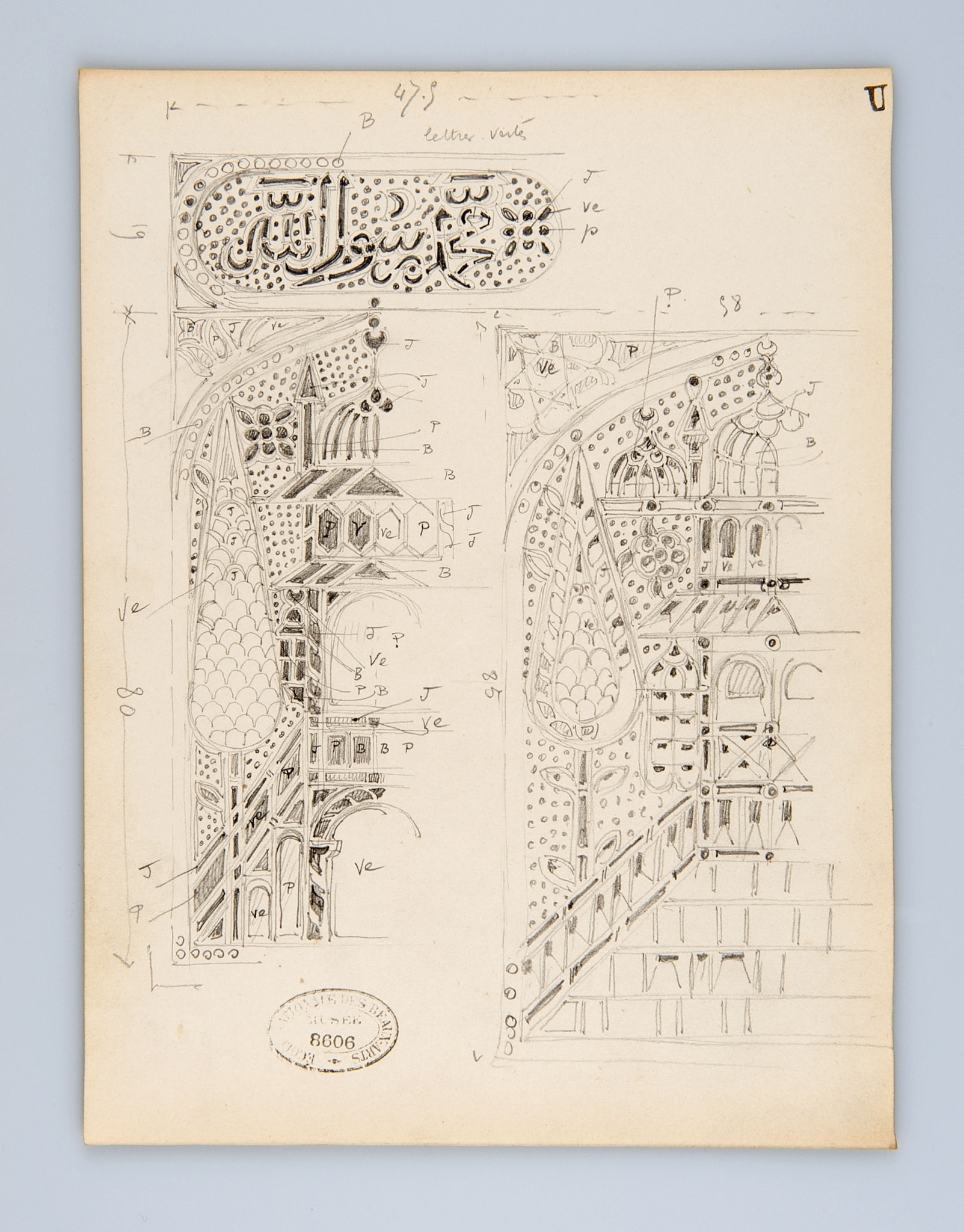
IG_462: Mosaïques (détails). Inscription, cyprès et mosquées
(FRA_Paris_EcoleNationaleSuperieureDesBeauxArts_IG_462)

Coordonnées

Prière de compléter le champ "Prénom".
Prière de compléter le champ "Nom".
Prière de compléter le champ "E-Mail".
Votre adresse e-mail n'est pas valide.

Veuillez s’il vous plaît indiquer autant d’informations que possible (titre de la publication, base de données, éditeur, nombre d’exemplaires, année de parution, etc.)

Le Vitrocentre Romont ne peut mettre à votre disposition que ses propres images. Nous ne pouvons malheureusement pas vous fournir des images de tiers. Si votre commande concerne des photographies de tiers, nous vous enverrons volontiers l'adresse de contact où vous pourrez obtenir les images.

Les données personnelles que vous avez indiquées dans ce formulaire sont utilisées par le Vitrocentre Romont exclusivement pour le traitement de votre commande d'images. La correspondance relative à la commande est archivée à des fins de traçabilité interne. Les données ne seront utilisées à aucune autre fin que celles énumérées ici, ni transmises à des tiers. En envoyant un formulaire de commande, vous acceptez tacitement cette utilisation de vos données personnelles.

Pour toute question complémentaire, veuillez contacter info@vitrosearch.ch.

Titre

Drawing of two stucco and glass windows with mosques

Type d'objet
Dimensions
22 x 16.5 cm
Artiste
Datation
1881–1884
Lieu
Numéro d'inventaire
EBA7900-0455
Projet de recherche
Auteur·e et date de la notice
Sarah Tabbal 2024; Sarah Keller 2025

Iconographie

Description

This fine and detailed pencil drawing by the French architect Jules Bourgoin (1838–1908) shows two rectangular stucco and glass windows with stylized architecture in a landscape setting. The windows feature stylized mosque architecture with elements of domes and minarets, flanked by a cypress tree on each side. Bourgoin concentrated on the left halves of these symmetrical windows, executing only the left side of the stylized architecture and one cypress tree. He also depicted the Islamic inscription, its calligraphy in naskh script in a cartouche, in the upper part of the left window in its entirety. The inscription is the second statement of the shahādah.
Although the two windows bear the same motif, they differ slightly from each other in details. Furthermore, the stucco and glass window on the right side has no cartouche with inscription. In both windows however, as well as in the cartouche, Bourgoin indicated the perforations in the stucco with many small dots. He also hatched some pieces of glass in pencil, giving the impression of depth, but left the drawing uncoloured. The colour of the windows nevertheless plays an important role here: Bourgoin added pencil notes (capital letters abbreviating the names of colours) to some of the pieces of glass in the window. He also drew a scale and gave detailed information about the sizes of the different parts of the windows. This approach – depicting stucco and glass windows in great detail with supplementary information regarding size and colour – is evidence of Bourgoin’s interest in the details of Islamic material culture and architecture.

Code Iconclass
12I61 · temple, lieu saint ~ Islam
25G3(CYPRESS) · arbres : cyprès
48C14 · représentations architecturales en général
49L142 · écriture arabique
49L8 · inscription
Mot-clés Iconclass
Inscription

Muḥammadun rasūlu ʾllāh (Muhammad is the messenger of God)

Matériaux, technique et état de conservation

Technique

Pencil on paper.

Historique de l'oeuvre

Recherche

The stucco and glass window depicted on the right side is still preserved in the Museum of Arab Art (Musée d’art arabe), later the Museum of Islamic Art (MIA), in Cairo (inv. 2/794). Like another window (IG_461), Bourgoin studied it between 1881 and 1884, when the museum’s collection was newly displayed in the ruined Al-Hakim Mosque. The location of the window on the left side is not known. It probably belonged also the Museum of Arab Art. Gustave Le Bon published a photograph of the same window in La civilisation des Arabes in 1884 (ill. 207, IG_191), and the following illustration (208) definitely shows a window from the museum’s collection (IG_77).
Bourgoin depicted in its entirety an Islamic inscription in a cartouche in the upper part of the left stucco and glass window. The calligraphy, written in naskh script, gives the second statement of the shahādah: Muḥammadun rasūlu Allāh (‘Muhammad is the messenger of God’, Quʿran, Surah 48:29).
Bourgoin’s great interest in stucco and glass windows is evident in his intensive exploration of this architectural element, witnessed, for example, in his publication Les Arts arabes (Paris: A. Vve A. Morel, 1867–1873, p. 92; IG_88) and in several drawings held at the École nationale supérieure des Beaux-Arts (ENSBA) in Paris (EBA7900-0313, EBA7900-0272, EBA7900-0274, EBA7900-0315). A further very detailed depiction of a stucco and glass window, in this case one with the motif of a vase of stylized flowers, can be seen in another pencil drawing (IG_461).

Datation
1881–1884
Période
1881 – 1884
Sites liées
Lieu de production

Bibliographie et sources

Bibliographie

Bourgoin, J. (1867–1873). Les Arts arabes. Paris: A. Vve A. Morel.

Informations sur l'image

Nom de l'image
FRA_Paris_EcoleNationaleSuperieureDesBeauxArts_IG_462
Crédits photographiques
© Beaux-Arts de Paris, Dist. GrandPalaisRmn / image Beaux-arts de Paris

Proposition de citation

Tabbal, S., & Keller, S. (actualisé) (2025). Drawing of two stucco and glass windows with mosques. Dans Vitrosearch. Consulté le 5 décembre 2025 de https://vitrosearch.ch/objects/2713306.

Informations sur l’enregistrement

Numéro de référence
IG_462