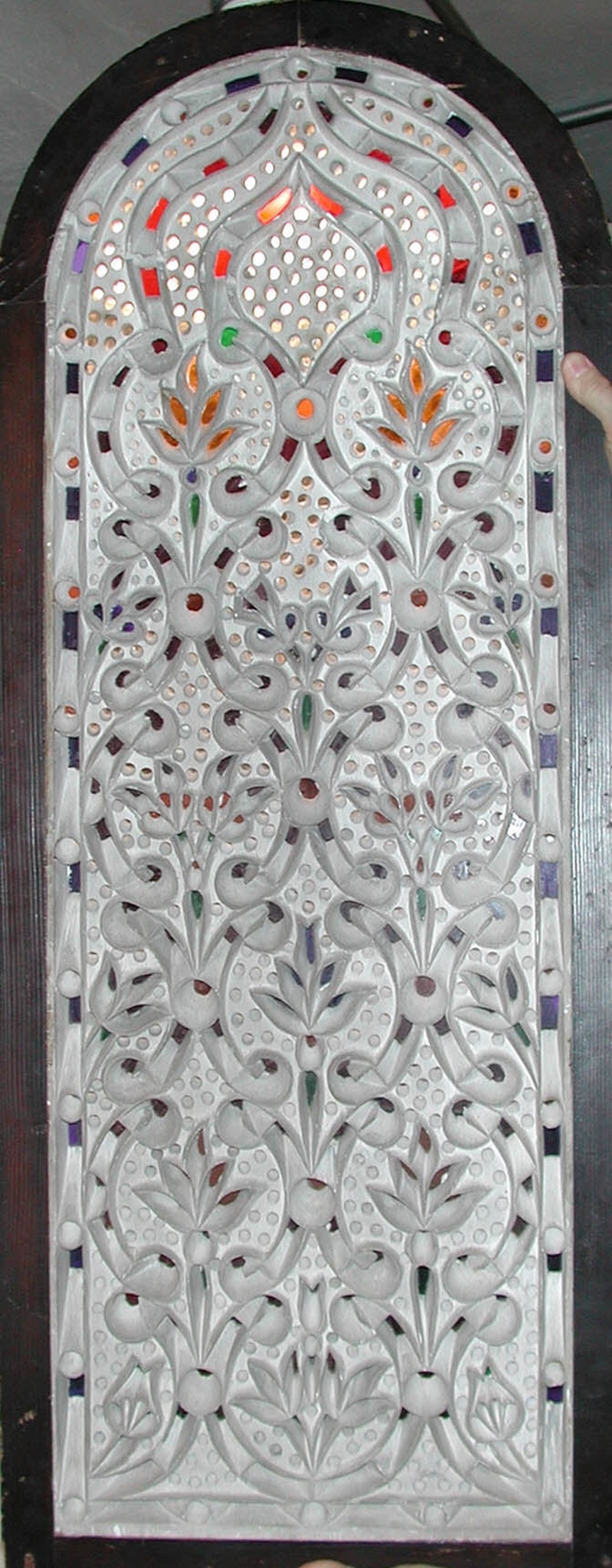
This stucco and glass window was produced according to the traditional method used in the manufacture of qamariyyāt in North Africa to this day (see Technique) and represents of motif that was widespread in Egypt during the Ottoman period. Ornamental patterns with convexly and concavely arranged curlicues and flowers are a recurring motif in Islamic stucco and glass windows. There are numerous variations of this motif, which differ in the number of rows and the type of flowers.
Windows with this motif can be found in several of the collections studied (IG_15, IG_41, IG_254, IG_257). This type of window is also prominently depicted in Arthur Melville’s painting An Arab Interior of 1881 (IG_93). Common to all these windows is the symmetrical distribution of curlicues and flowers that create a repeating ornament.
The window discussed here is composed of two vertical rows of curlicues, just as the windows held at the Musée du Louvre in Paris (IG_41), the Musée des Beaux-Arts and the Musée des Confluences in Lyon (IG_254, IG_257) and the Victoria and Albert Museum in London (ME. 1–2005). An almost identical qamariyya was documented by the German architect Julius Franz (1831–1915) in the second edition of his Die Baukunst des Islam of 1896 (IG_164). The Italian photographer Beniamino Facchinelli (1839–1895) documented another example at the Museum of Arab Art in Cairo (IG_205). It is possible that the window discussed here was copied from the one displayed at the Cairene Museum.
According to the museum records, the window dates to the 18th century. However, there are some indications that point to a later production date: firstly, the good state of preservation of the stucco lattice, which would have shown clearer signs of weathering if it had been installed and exposed to the elements for a longer period of time, and secondly, the use of cylinder-blown flat glass (also called broad-sheet). In the Islamic world, sheet glass was usually produced using the crown-glass process, while in Europe, the broad sheet-method was the dominant technique to make flat glass. The Hungarian architect Max Herz (1856–1919) states that sheet glass was imported to Egypt from Europe from the 19th century, because local production had come to a standstill (Herz, 1902, p. 53).
A hand-written letter dated 22 May 1893 to Luigi Palma di Cesnola (1832–1904), the then director of The Metropolitan Museum of Art in New York, provides information on the provenance of the window. The author of this letter, the American architect William Robert Ware (1832–1915), writes that he had acquired this and various other windows in the spring of 1890 from several well-known art and antiquity dealers in Cairo. He mentions [Gaspare] Giuliana, [E. M.] Malluk, [Nicolas?] Tano, and [Panayotis] Kyticas (on their commercial activities see Volait, 2021, pp. 60–64). In his letter, Ware further states that he was told that the windows ‘had been taken from old houses’ and ‘from old mosques, that had been dismantled’, but that he was not able to get ‘any precise information as to their original places’ (Ware, 1893).
In 1893, Ware donated this window as part of a lot of 17 qamariyyāt (IG_169, IG_171–186) to The Metropolitan Museum of Art (Ware, 1893).