Image commandée

IG_371: Replica of stucco glass window with flowers in a vase
(AUT_Wien_WienMuseum_IG_371_1)

Coordonnées

Prière de compléter le champ "Prénom".
Prière de compléter le champ "Nom".
Prière de compléter le champ "E-Mail".
Votre adresse e-mail n'est pas valide.

Veuillez s’il vous plaît indiquer autant d’informations que possible (titre de la publication, base de données, éditeur, nombre d’exemplaires, année de parution, etc.)

Le Vitrocentre Romont ne peut mettre à votre disposition que ses propres images. Nous ne pouvons malheureusement pas vous fournir des images de tiers. Si votre commande concerne des photographies de tiers, nous vous enverrons volontiers l'adresse de contact où vous pourrez obtenir les images.

Les données personnelles que vous avez indiquées dans ce formulaire sont utilisées par le Vitrocentre Romont exclusivement pour le traitement de votre commande d'images. La correspondance relative à la commande est archivée à des fins de traçabilité interne. Les données ne seront utilisées à aucune autre fin que celles énumérées ici, ni transmises à des tiers. En envoyant un formulaire de commande, vous acceptez tacitement cette utilisation de vos données personnelles.

Pour toute question complémentaire, veuillez contacter info@vitrosearch.ch.

Titre

Replica of a stucco and glass window with flowers in a vase

Type d'objet
Dimensions
62.5 x 47.5 cm (entire panel including ornamental border on three sides); 40 x 28 cm (floral ornament in centre); 41.8 x 42.4 cm (sheet glass)
Artiste
Lieu de production
Datation
1901
Lieu
Numéro d'inventaire
HWM 239702/21
Projet de recherche
Auteur·e et date de la notice
Francine Giese, Sophie Wolf 2025

Iconographie

Description

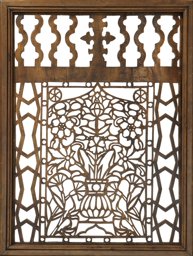
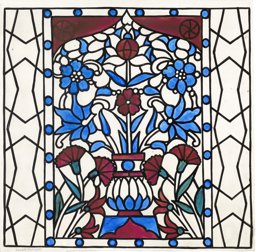
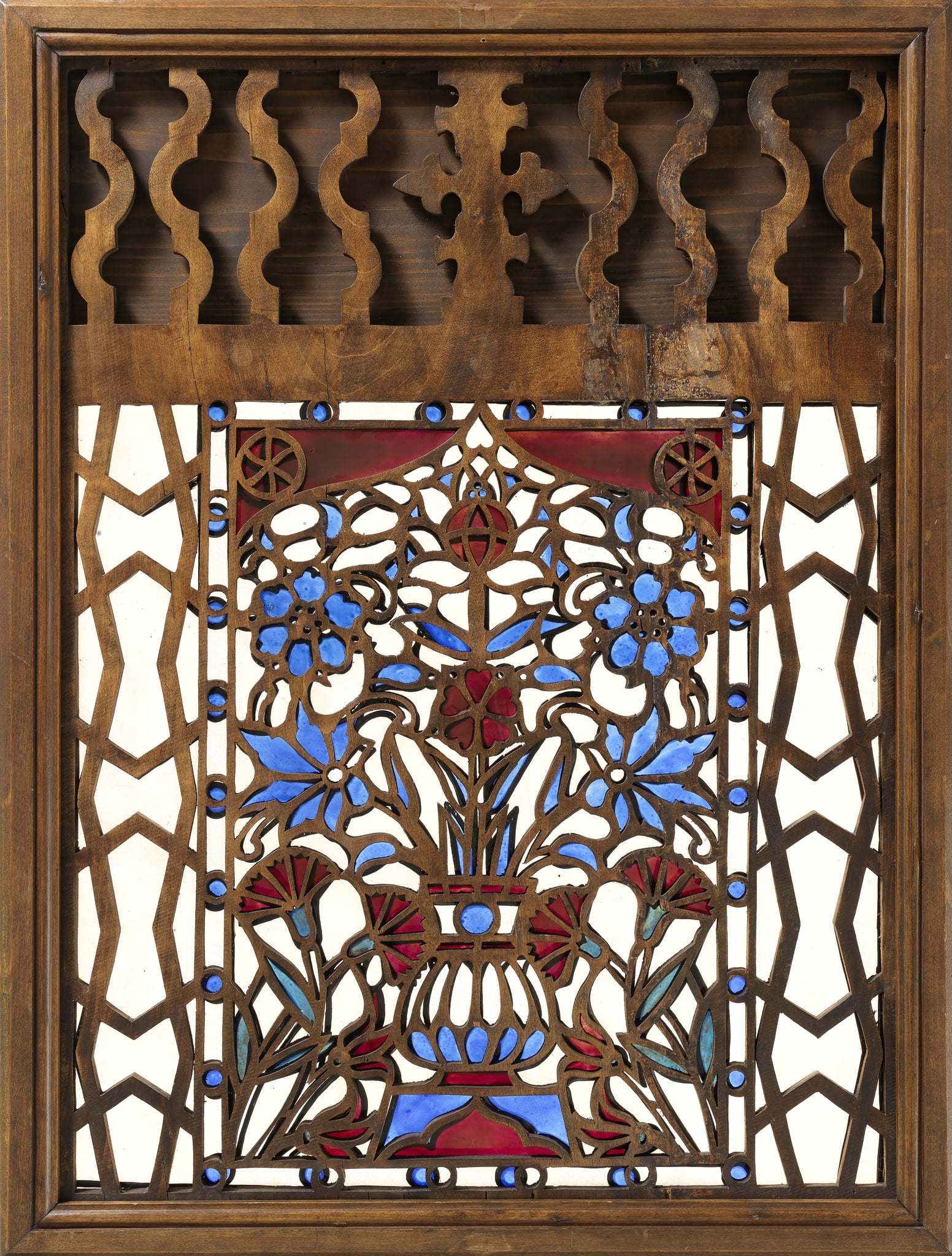
This wooden replica of a rectangular stucco and glass window with a motif of flowers in a vase is incorporated in a wooden mashrabiyya. The flowers are arranged symmetrically along the central axis. The representation of the flowers is more naturalistic than in Islamic stucco and glass windows with the same motif. Despite the naturalistic rendering of the flowers, it is not possible to determine the species. The vase sits on a low base (a small table or stool) and is flanked by tulips and carnations. The flowers-in-a-vase motif is framed by an ogee arch. Stylizised six-petalled flowers adorn the spandrels above the arch. A rectangular double frame decorated with blue dots surrounds the entire motif.

The replica is flanked by an ornamental pattern of horizontal and vertical zig-zag lines.

Code Iconclass
25G41 · fleurs
25G41(CARNATION) · fleurs : oeillet
25G41(TULIP) · fleurs : tulipe
41A6711 · fleurs dans un vase
Mot-clés Iconclass
bouquet · fleur · oeillet · tulipe · vase

Matériaux, technique et état de conservation

Matériaux

Wood (maybe beech plywood); colourless sheet glass; grisaille, silver stain, red and blue enamel.

Technique

Rectangular wooden latticework backed with enamel-painted sheet glass. The latticework has an average thickness of 8–10mm and is painted with brown paint and varnish.

The rectangular glass sheet is not attached to the grille, but loosely placed behind; it is held in place with wooden strips. The glass is 1.5–3mm thick and has an uneven surface. The glass sheet was probably produced using the broad-sheet method.

The motif is painted on the front of the glass. Black grisaille (or enamel) was used for the contour lines, red and blue enamel for the flower and the vase. To achieve the green in the leaves of the carnations, silver stain (applied on the back) has been combined with blue (applied on the front). Silver stain – again applied on the back – has also been used to enhance the colour of the red enamel.

A white wash was applied on the colourless background; the wash is stippled in places.

Etat de conservation et restaurations

The wooden latticework is slightly warped and shows minor losses on the back. The painted glass is intact.

Historique de l'oeuvre

Recherche

In terms of typology, this replica corresponds to one of the standard types of qamariyya widespread in Egypt during the Ottoman period. The representation of flowers in a vase is a popular motif in Islamic arts that can be found across media and time. Similar windows have survived in several of the collections studied (see e.g. IG_7, IG_166, IG_178, IG_255, IG_356). The motif of flowers in a vase also aroused the interest of Western artists and architects, as is attested by a significant number of book illustrations, sketches, and paintings (see for instance IG_43, IG_118, IG_149, IG_153, IG_437, IG_443, IG_461), as well as by the replicas of such windows installed in Arab-style interiors across Europe (IG_54IG_59, IG_64, IG_431, IG_484IG_487).

The window discussed here shows a traditional composition arranged along a central axis. However, the naturalistic, but unspecific representation of the flowers distinguish this work from Islamic stucco and glass windows of the same motif. The most significant difference however, when comparison is made with examples from Egypt, is the use of wood instead of stucco. A similar ‘material transfer’ from stucco to wood can be observed in the windows for the Arab Room of Cardiff Castle in Wales designed by the British architect William Burges (1827–1881) (IG_484IG_487). Like these windows, the replica here, as well as four similar replicas in the Wien Museum collection (IG_372IG_375), was probably made in a local (Austrian) workshop.

While William Burges was drawing on his first-hand knowledge of Islamic stucco and glass windows acquired during his journey to Turkey in 1856/1857, the unknown designer of this and the four other replicas took the windows of the Arab Room of the k.k. Österreichisches Museum für Kunst und Industrie in Vienna (today the MAK – Museum für angewandte Kunst) (IG_264) as a direct model. These windows were designed by the Bohemian architects František Schmoranz (1845–1892) and Johann Machytka (1844–1887) and made between 1881 and 1883.

Like the windows of the Arab Room, the lattices of the (later) Wien Museum replicas are not backed with individual pieces of colourless and coloured glass, but with a single sheet of glass painted with enamels. It is therefore the third link in the history of reception that goes back to the stucco and glass window OR 3607 (IG_361), which was moved from the collection of the Orientalisches Museum in Vienna (from 1886 the Handelsmuseum) to the k.k. Österreichisches Museum für Kunst und Industrie in 1907.

On display until 1931, Schmoranz and Machytka’s Arab Room can be considered an important reference point for Austrian architects and patrons, among them the entrepreneur Anton Johann Kainz-Bindl (1879–1957). The latter travelled to the East shortly after marrying Maria Russleitner in April 1900. Together, they visited Egypt, the Near East, Turkey, and Bulgaria and acquired various art objects during their journey. To present these objects in a suitable setting, Kainz-Bindl had an Arab-style interior installed on the mezzanine floor of the four-storey residential and commercial building at Währinger Gürtel 166, which was designed by the Viennese architects Dehm & Olbrich. Construction work started in the spring of 1900, and the Arab Room is dated 1901 (Architektonische Rundschau, 1902, p. 71; Orosz, 2021, pp. 98, 104). With the installation of an Arab Room, Kainz-Bindl was following a trend that had become established not only in aristocratic circles, but also among the wealthy bourgeoisie, who, like the nobility, wished to present their artefacts in a specially designed Islamic-style room, thereby showcasing their cosmopolitanism (Giese, 2016; Giese, 2019).

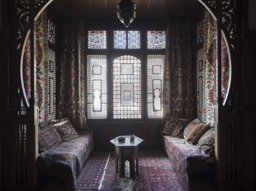
Kainz-Bindl’s Arab Room has an area of c.30m2 and is lined with wooden panelling 2.20m in height with cabinets, shelves, and cupboards for displaying Islamic objects, as well as a bay with a Secessionist entrance arch and custom-made mashrabiyyāt on three sides housing five replicas of stucco and glass windows at the top (IG_371IG_375, see also Linked objects and images, dimensions according to Orosz, 2021, p. 104). The wooden panelling was made by Portois & Fix, a company founded in Vienna in 1881 and specializing in furniture and interior design (Orosz, 2021, p. 105). It is therefore possible that the mashrabiyyāt and the wooden lattices of the windows were produced by the same firm.

The replica discussed here was originally placed directly opposite the entrance arch, to the left of IG_373. An identical replica with the same motif (IG_372) was placed to the right of IG_373, in order to respect the disposition of such windows in traditional Islamic interiors, where a central panel is usually flanked by two identical in composition to each other (see for instance IG_118, IG_119, IG_449).
The Arab Room remained unchanged in the patron’s family for over 100 years. It was then acquired by the Wien Museum from the Viennese jewellery and enamel artist Ulrike Zehetbauer (born 1934), the wife of Kainz-Bindl’s grandson, in 2015. In 2017, it was displayed in the exhibition ‘ISLAM in Österreich – Eine Kulturgeschichte’ at Schallaburg Castle (Schollach, Austria). The bay window with its five replicas has recently been reintegrated into the permanent exhibition of the Wien Museum, which reopened in 2023 at its new location on Karlsplatz in Vienna (Orosz, 2021, pp. 98–99).

Datation
1901
Lieu de production

Provenance

Propriétaire
Dès 2015: Wien Museum, Numéro d'inventaire: HWM 239702/21, Vienne (Autriche), Achat
Propriétaire précédent·e
jusque 2015: Zehetbauer, Ulrike, Vienne (Autriche), Legs. year of acquisition unclear
De 1901: Kainz-Bindl, Anton Johann, Vienne (Autriche), Achat. year of transfer uncertain

Bibliographie et sources

Bibliographie

Anon. (1902). Wohn- und Geschäftshaus Währingergürtel 166 in Wien, Architektonische Rundschau, 18(9), p. 71.

Giese, F. (2016). From Style Room to Period Room: Henri Moser’s fumoir in Charlottenfels Castle. In: S. Costa, D. Poulot, & M. Volait (Eds.), Period rooms. Allestimenti storici tra arte, gusto e collezionismo: Atti del Convegno Internazionale, Bologna, 18-19 aprile 2016 (pp. 153–160). Bologna: Bolonia University Press.

Giese, F. (2019). International Fashion and Personal Taste: Neo-Islamic Style Rooms and Orientalizing Scenographies in Private Museums. In F. Giese, M. Volait, & A. Varela Braga (Eds.), À l’orientale: Collecting, Displaying and Appropriating Islamic Art and Architecture in the Nineteenth and Early Twentieth Centuries. Arts and Archaeology of the Islamic World, 14 (pp. 92–110). Leiden/Boston: Brill.

Orosz, E.-M. (2021). Das "arabische Zimmer" im Wien Museum. Aspekte des Orientalismus im Wiener Bürgertum. In: M. Hartmuth & J. Rüdiger (Eds.), Gezimmertes Morgenland. Orientalische und orientalisierende Holzinterieurs in Mitteleuropa im späten 19. Jahrhundert Phänomenalität, Materialität, Historizität (pp. 97–107). Wien: Böhlau.

Expositions

18.03. – 05.11.2017: ISLAM in Österreich – Eine Kulturgeschichte, Schollach (Austria),Schallaburg · since 2023: permanent exhibition, Vienna, Wien Museum

Informations sur l'image

Nom de l'image
AUT_Wien_WienMuseum_IG_371_1
Crédits photographiques
@ Wien Museum, Foto Birgit und Peter Kainz

Objets et images liés

Photographies complémentaires
Replica of stucco glass window with flowers in a vase
Arabisches Zimmer, Währinger Gürtel 166
Replica of stucco glass window with flowers in a vase

Proposition de citation

Giese, F., & Wolf, S. (2025). Replica of a stucco and glass window with flowers in a vase. Dans Vitrosearch. Consulté le 5 décembre 2025 de https://vitrosearch.ch/objects/2713215.

Informations sur l’enregistrement

Numéro de référence
IG_371