Recherche
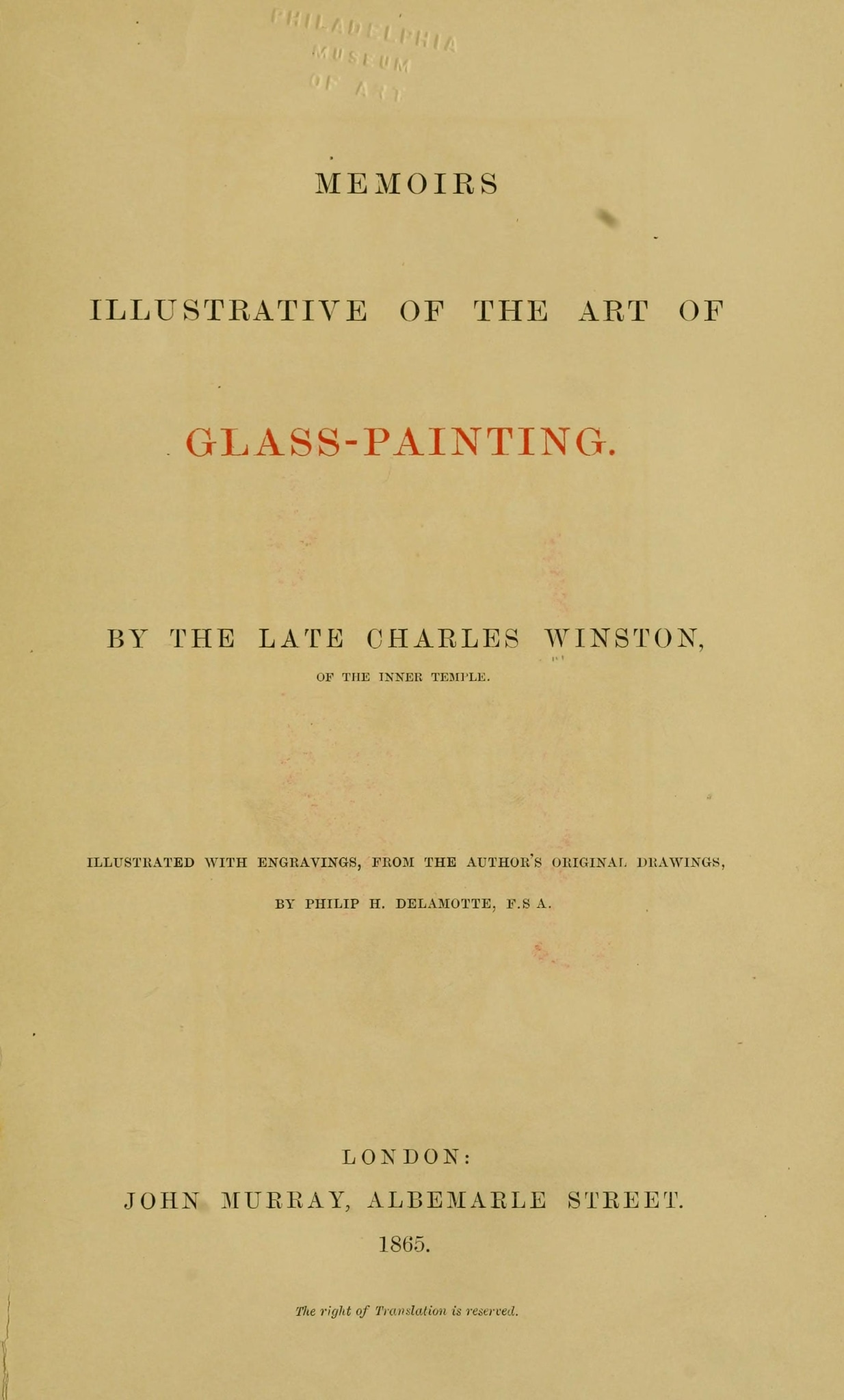
The British stained glass historian Charles Winston (1814–1864) introduced the subject of Islamic stucco and glass windows to a British audience interested in stained glass.
He first refers to the Byzantine church of Hagia Sophia in Constantinople and its coloured glazing, described by an ‘ancient writer’ (probably Silentiarius Paulus) and documented in the recent examination ‘by the architect employed by the Prussian government’ (Wilhelm Salzenberg; see Salzenberg, 1854). He also believed that painted glass originated in Constantinople, the ‘cradle of the arts’. However, owing to wartime destruction, nothing has survived except the more recent windows of the mosques. Winston observes that their manufacturing technique goes back to that of the Byzantine windows of the Hagia Sophia and is only slightly modified. He explains that his friend, the architect William Burges, who also had written about Constantinople’s windows (IG_189), had shown him a drawing of one of the windows of the Süleymaniye Mosque, dating to the 10th century AH / 16th CE (IG_91). He compares it with a window brought some years before from Cairo to London by James Spencer Bell (1818–1872), a former MP for Guildford. In 1869, this window entered the collection of the South Kensington Museum (see Thomas, p. 17), but it has not been further identified. Winston subsequently described the technique of the window and the oblique carving, emphasizing the thinness of the glass (Winston, 1865, pp. 236, 237).
Datation
1865
Période
1859 – 1865
Lieu de production