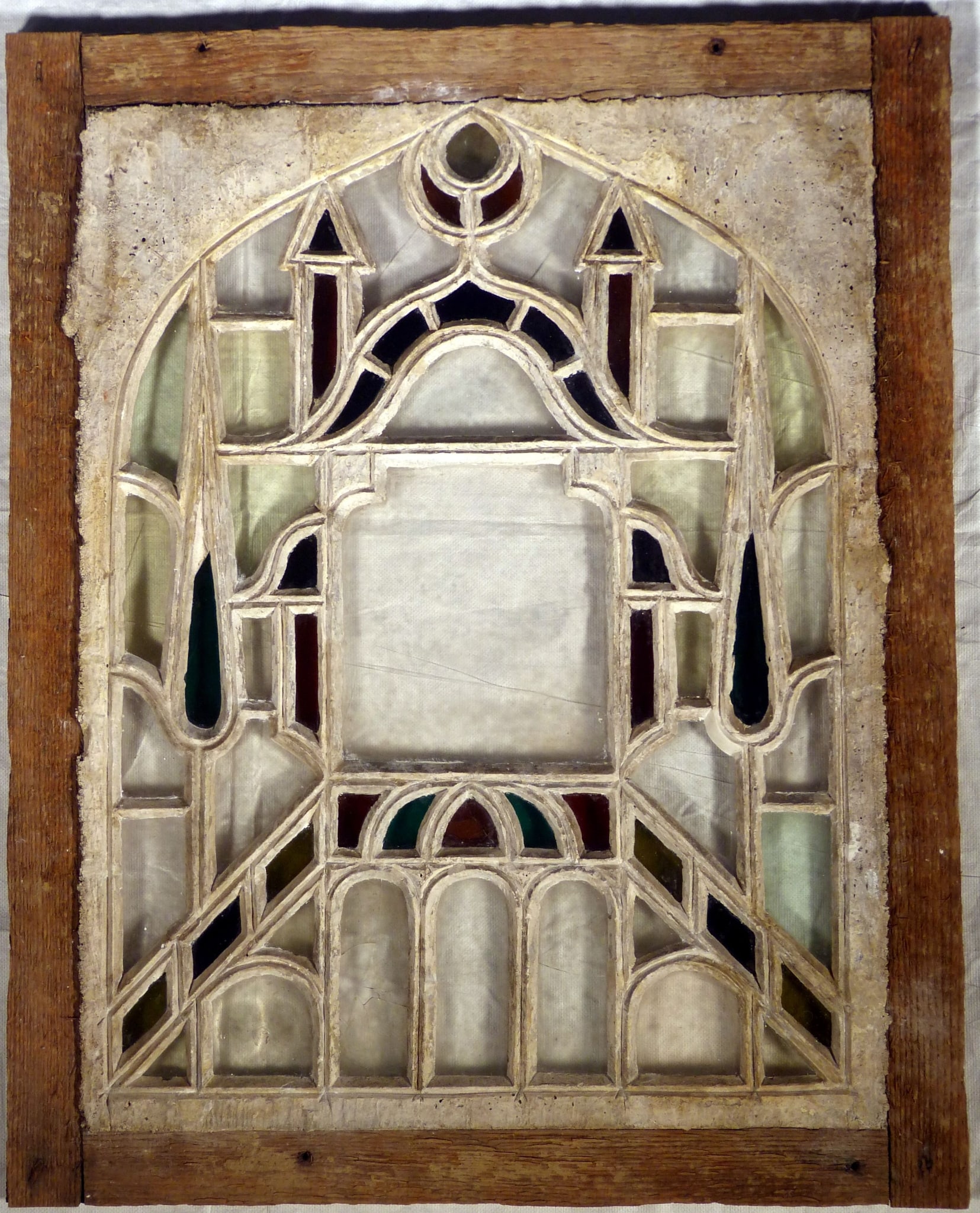
From an iconographic point of view, this stucco and glass window corresponds to one of the standard types of qamariyya widespread in the Middle East during the Ottoman period. The representation of a mosque can also be found in other media, most notably architectural ceramics of the Ottoman period (see for instance Musée du Louvre, OA 3919/556, OA 3919/558, OA 3919/559; Metropolitan Museum of Art, 2012.337; Victoria and Albert Museum, 427-1900). While in these examples specific shrines such as the Kaaba in Mecca are depicted, the mosques represented in stucco and glass windows are reduced to their main features, such as courtyard, prayer hall, dome(s), and minarets, and cannot usually be identified.
Among the stucco and glass windows from the collections analysed, the mosque motif is far less common than other motifs, such as flowers in a vase or a cypress tree. Windows with the mosque motif are held, for example, at The Metropolitan Museum of Art in New York (IG_184, IG_185) and the Benaki Museum of Islamic Art in Athens (IG_354). However, these stucco and glass windows, which most likely all come from Egypt, were produced using a different manufacturing technique than the window discussed here. The latticework of this window is cast and not carved out of a solid stucco panel, as is usually the case with stucco and glass windows produced in Egypt and the Maghreb (see Technique). The casting technique was very common in Turkey from the 18th century onwards (Arseven, 1939, pp. 207–211; Arseven, [c.1952], pp. 182–189; Özakın, 2007, pp. 95–97). The delicate structure of the cast latticework and the use of large, colourless pieces of glass document the ongoing transformation of Ottoman art and architecture, initiated in the capital in the late 16th century (Bakırer, 2001, 8–15), and reflect the ongoing process of Westernisation which culminated during the so-called Ottoman Baroque period (see for instance Rüstem, 2019). The stylistic and technical features make it likely that the window discussed here was made in a Turkish workshop.
The presumed Turkish origin of the window is also confirmed by archival information concerning its acquisition: according to the documents, the window was acquired in Turkey between 1933 and 1936 by Paul Erich Kirmse (d.1940), together with the stucco and glass window IG_385. Both windows remained within the family until 2022, when they were purchased by the Friends of the Museum of Islamic Art at the Pergamon Museum (Freunde des Museums für Islamische Kunst im Pergamonmuseum e.V.). The following year, the objects were donated to the museum (see Provenance). IG_385 and IG_386 appear to be a pair: they show the same motif, were manufactured in the same way, and probably in the same workshop.