Description
Elongated, rectangular stucco and glass window with a cypress tree surrounded by winding tendrils with three-petalled flowers. The motif is set against a perforated, slightly recessed background.
Code Iconclass
Mot-clés Iconclass

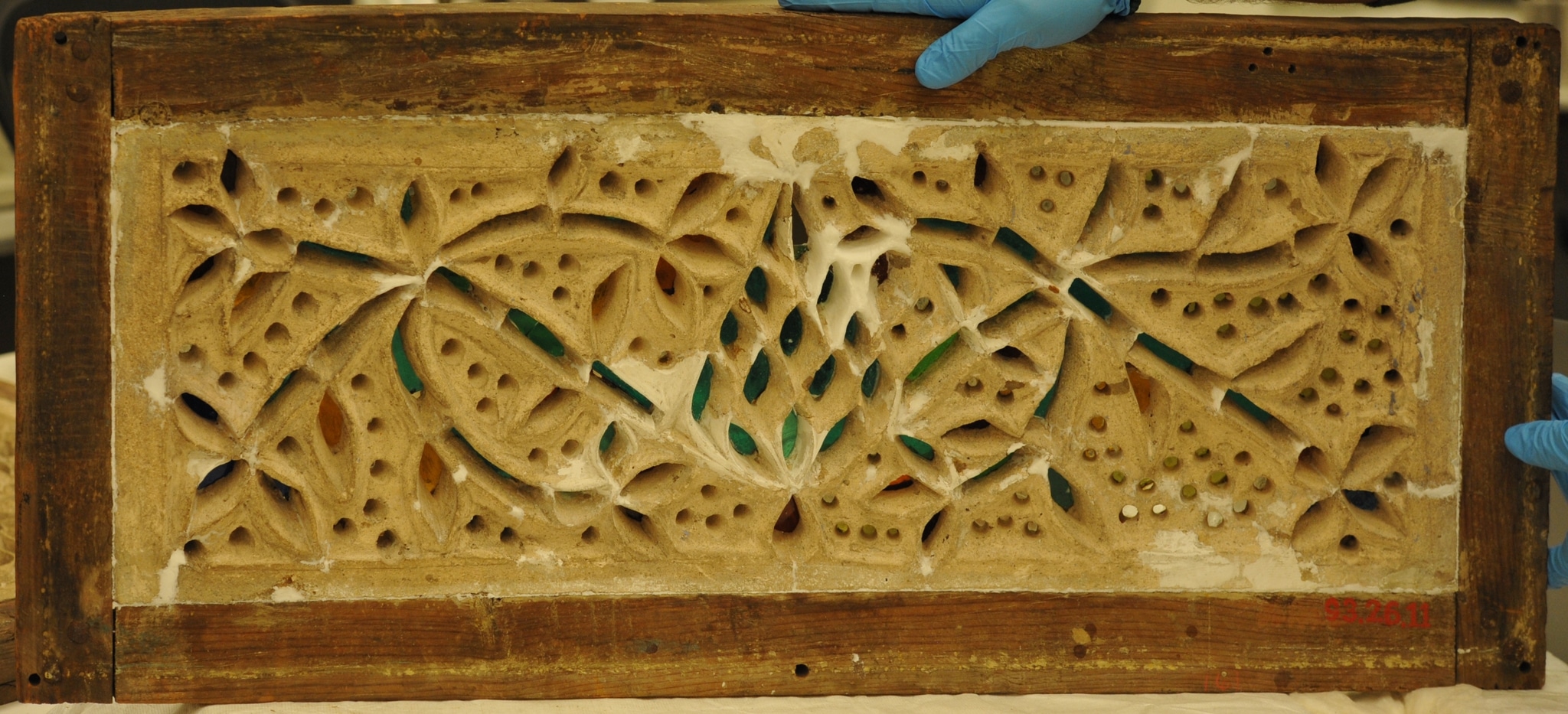
Elongated, rectangular stucco and glass window with a cypress tree surrounded by winding tendrils with three-petalled flowers. The motif is set against a perforated, slightly recessed background.
Coarse-grained gypsum plaster; colourless glass (with a greyish, greenish or purplish tint); coloured glass (two shades of blue, three shades of green, several shades of yellow including of orange, red glass with a brownish tint, probably flashed glass)
The latticework was carved into an elongated, rectangular stucco panel and inlaid with colourless and coloured sheet glass. The pieces of glass are fixed onto the back of the lattice with a 1–1.5mm-thick layer of gypsum plaster. To prevent the pieces of glass from being displaced while pouring the embedding stucco, they were fixed to the latticework with an adhesive. Traces of this animal or vegetable glue are visible in the area around the openings.
The thickness of the stucco panel is 19–20mm. The stucco panel was cast in a wooden frame measuring c.52 × 30 × 50–52mm. The wooden frame is stained dark brown.
The design of the latticework has two levels. The main motif (level 0) has been carved out of the stucco panel with sharp, knife-like tools. Traces of the incisions are still visible in some places on the front. The second level (level –1), which lies 5–8mm below level 0, shows irregularly spaced, slightly conical perforations. The holes were pierced with a metal or wooden pin in the stucco before it was fully set. They vary between 10 and 15mm in diameter and are slightly tapered towards the back. The distance between the holes is 4–9mm. All holes are backed with colourless glass. The main design and the perforations have been worked in such a way that the incident light is directed downwards into the room.
The coloured and colourless pieces of glass were cut according to the design of the latticework using a glass-cutter. The pieces of glass have thicknesses ranging between 1.5 and 2mm.
Some of the pieces of glass show uneven surfaces and elongated bubbles, suggesting that the glass sheets were mouth-blown. At least one piece of glass shows a rounded edge with a rounded profile that most likely corresponds to the original edge of the round glass sheet (or disk) produced using the crown-glass method.
The stucco latticework has been repaired. Losses were filled with a fine-grained, buff-coloured material (plaster?). The back of the window also shows repairs. The repairs involved replacing missing or broken pieces of glass and filling losses in the thin plaster layer in which the pieces of glass are embedded.
There are small traces of blue paint on the front of the latticework.
From a technical and iconographic point of view, this stucco and glass window corresponds to one of the standard types of qamariyya widespread in Egypt during the Ottoman period. Similar windows can be found in several of the collections studied (see for instance IG_18, IG_173, IG_355). The representation of a cypress tree surrounded by a flower tendril is a widespread motif in Islamic arts. It can be found in numerous other media, such as ceramics, wood panelling, wall paintings, and textiles, over a long period of time, and in both sacred and profane contexts.
Stucco and glass windows of this type are illustrated in 19th- and early 20th-century publications (see for instance IG_42, IG_47). The cypress tree motif also aroused the interest of Western artists and architects, as is attested by the significant number of sketches and paintings of the motif (IG_118, IG_136, IG_150, IG_153, IG_438, IG_439, IG_468), as well as by the existence of several replicas of windows with this motif in Arab-style interiors across Europe (IG_50, IG_59, IG_64, IG_427–430).
The window discussed here, however, stands out from most qamariyyāt of the same type due to its oblong format and the small size of the cypress tree. In contrast to the windows IG_2 or IG_258 and IG_260, which represent individual windows, the example from the MET was probably part of a composite window. The rough design and inferior technical qualities of the latticework substantiate this hypothesis.
According to the museum records, the window dates to the 17th century. However, the good state of preservation of the stucco lattice raises doubts about this early dating. If the window had actually been installed in a building in the 17th century, we would have expected to observe clearer traces of weathering.
A hand-written letter dated 22 May 1893 to Luigi Palma di Cesnola (1832–1904), the then director of The Metropolitan Museum of Art in New York provides information on the provenance of the window. The author of this letter, the American architect William Robert Ware (1832–1915), writes that he had acquired this and various other windows in the spring of 1890 from several well-known art and antiquity dealers in Cairo. He mentions [Gaspare] Giuliana, [E. M.] Malluk, [Nicolas?] Tano, and [Panayotis] Kyticas (on their commercial activities see Volait, 2021, pp. 60–64). In his letter, Ware further states that he was told that the windows ‘had been taken from old houses’ and ‘from old mosques, that had been dismantled’, but that he was not able to get ‘any precise information as to their original places’ (Ware, 1893).
In 1893, Ware donated this window as part of a lot of 17 qamariyyāt (IG_169, IG_171–186) to The Metropolitan Museum of Art (Ware, 1893).
Herz, M. (1902). Le musée national du Caire. Gazette des Beaux-Arts, 3. Pér. 28, 45–59, 497–505.
Volait, M. (2021). Antique Dealing and Creative Reuse in Cairo and Damascus 1850–1890. Leiden: Brill.
Ware, W. R. (1893, May 22). [Letter to Luigi Palma di Cesnola]. MET Archives (W 229), New York City, NY, United States.