Image commandée

IG_170: Stucco and glass window
(FRA_Grenoble_MuseeDeGrenoble_IG_170_1)

Coordonnées

Prière de compléter le champ "Prénom".
Prière de compléter le champ "Nom".
Prière de compléter le champ "E-Mail".
Votre adresse e-mail n'est pas valide.

Veuillez s’il vous plaît indiquer autant d’informations que possible (titre de la publication, base de données, éditeur, nombre d’exemplaires, année de parution, etc.)

Le Vitrocentre Romont ne peut mettre à votre disposition que ses propres images. Nous ne pouvons malheureusement pas vous fournir des images de tiers. Si votre commande concerne des photographies de tiers, nous vous enverrons volontiers l'adresse de contact où vous pourrez obtenir les images.

Les données personnelles que vous avez indiquées dans ce formulaire sont utilisées par le Vitrocentre Romont exclusivement pour le traitement de votre commande d'images. La correspondance relative à la commande est archivée à des fins de traçabilité interne. Les données ne seront utilisées à aucune autre fin que celles énumérées ici, ni transmises à des tiers. En envoyant un formulaire de commande, vous acceptez tacitement cette utilisation de vos données personnelles.

Pour toute question complémentaire, veuillez contacter info@vitrosearch.ch.

Titre

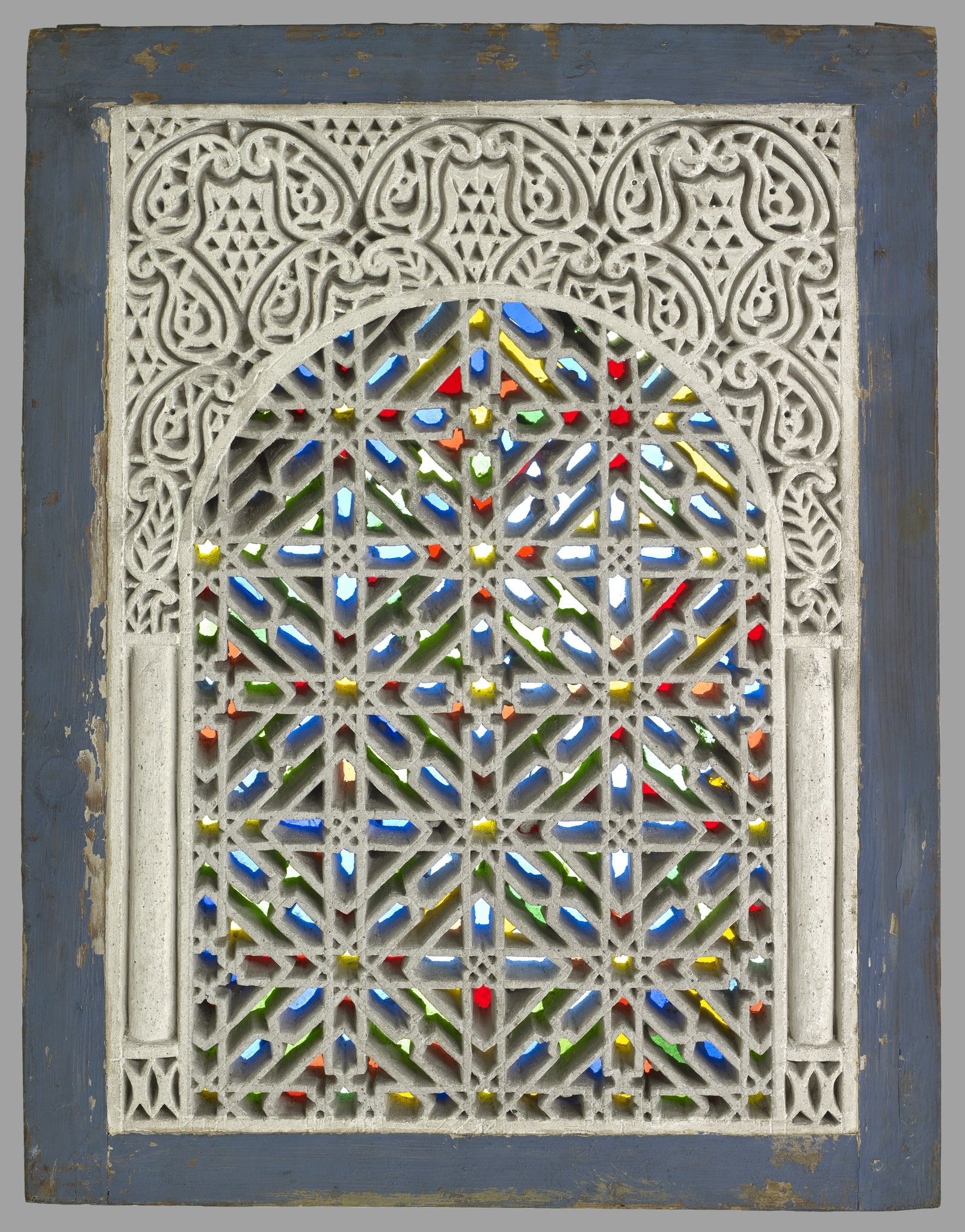
Stucco and glass window with interlaced star-and-knot ornamentation

Type d'objet
Dimensions
56 x 43.5 x 3.5 cm (with frame) ; 48.5 x 35 x 3.5 (without frame)
Artiste
Lieu de production
Datation
early 13th–early 14th century AH / late 19th–early 20st century CE
Lieu
Numéro d'inventaire
MG 2013-0-99
Projet de recherche
Auteur·e et date de la notice
Francine Giese, Sophie Wolf 2025

Iconographie

Description

Rectangular stucco and glass window with geometric ornamentation composed of eight-pointed stars and knots. The interlaced stars and knots are symmetrically arranged and form a continuous grid. The ornament is framed by a semicircular arch supported by two columns. The spandrels above the arch are adorned with stylized leaves. The spaces between the leaves are decorated with small, incised triangles. The columns, the arch, and the spandrels are carved out in relief, but not perforated, and are therefore not backed with coloured glass.

The window is preserved in its original frame. The frame is reinforced by two wooden struts running diagonally across the upper corners of the frame. Two metal frame hangers are fixed with nails in the frame’s upper corners. The front and the sides of the frame are painted blue.

Code Iconclass
48A981 · ornement ~ motifs géométriques
48A9815 · ornement ~ formes étoilées
48A983 · ornement dérivé de formes végétales
48A9878 · entrelacs, tresse ~ ornement
48A98781 · entrelacs abstrait, noeud ~ ornement
Mot-clés Iconclass

Matériaux, technique et état de conservation

Matériaux

Coarse-grained gypsum plaster; coloured glass (two shades of green, two shades of blue, two shades of yellow, purple, and red flashed glass); wood; metal; blue paint

Technique

Latticework carved into a rectangular stucco panel and inlaid with colourless and coloured pieces of glass.

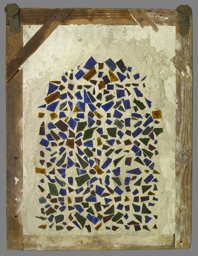
The stucco panel was made by pouring plaster into a wooden frame, which consists of four slats joined at the corners and fixed with nails. Two wooden struts in the upper corners reinforce the structure. The panel is c.35mm thick. The pieces of glass were fixed onto the back of the lattice by embedding them in a thin layer of gypsum plaster. The plaster was applied unevenly; it varies between 2 and 10mm in thickness, and its surface is rough. Not all the openings were completely covered in the process. In several places, the material ran into the openings in the stucco lattice. This all suggest a rather fast, and maybe careless execution.

The design of the latticework was carved out of the stucco panel with sharp, knife-like tools following a template incised in the surface of the panel. Traces of these incisions are still visible in some places on the front. The main design has been worked in such a way that the incident light is directed sharply downwards into the room. Only the main field is perforated and backed with glass. The framing arch and the side columns were worked out in relief, but not perforated, and are therefore not backed with glass.

The pieces of glass are not laid out evenly and do not follow the completely regular and symmetrical ornament of the latticework. The coloured pieces of glass vary greatly in size, ranging from 5 to 38mm; they are 1–2mm thick. Elongated bubbles in the glass suggest that the glass sheets, from which the pieces were cut, were mouth-blown. Some of the blue glass shows many bubble inclusions. Several pieces have scratch marks along the edges, indicating that the pieces of glass were cut with a glass-cutter.

Etat de conservation et restaurations

The window is in good condition and shows no signs of previous restoration.

The surfaces of the window are clean; there are hardly any dust deposits. There are no visible signs of weathering on either the front or the back of the window. The blue colour on the frame has flaked off in places.

Historique de l'oeuvre

Recherche

This stucco and glass window corresponds iconographically to one of the standard types of shamsiyyāt widespread in the Maghreb during the Ottoman period. The interlaced star-and-knot ornamentation is a recurring element in Islamic arts across time and media (see for instance, Broug, 2013; Azzam, 2021, pp. 68–127). However, there are several formal characteristics, especially the purely geometric design, the complex interlaced pattern, and the framing arch supported by two columns, that indicate that the window must originate from Tunisia. This geographical classification is supported by the description and illustration of a similarly designed window by the French architect Henri Saladin (1851–1923), who in his 1908 publication Tunis et Kairouan reports on a visit to a workshop in Tunis (Saladin, 1908, p. 75), where he commissioned several stucco and glass windows for the Tunisian pavilion at the 1889 Exposition Universelle in Paris (IG_248, see also IG_92).

The Grenoble window finds close parallels in two of the stucco and glass windows of assumed Tunisian origin held at the MAK – Museum für angewandte Kunst in Vienna (see IG_363, IG_364), as well as in the stucco and glass windows made for the Tunisian pavilion at the 1867 Exposition Universelle of Paris (see IG_270, IG_271).

Shamsiyyāt with geometric star-and-knot ornamentation from the Maghreb are represented in Orientalist paintings by European artists, although much less frequently than stucco and glass windows with figurative motifs from Egypt or Turkey. Among the few examples are an undated oil painting by the Vienna-born Orientalist painter Rudolf Ernst (1854–1932) (see IG_137) and the oil painting Après le bain (1894) by the French Orientalist painter Paul-Louis Bouchard (1853–1937) (see IG_148).

The window discussed here was made according to the traditional technique used in the manufacture of shamsiyyāt in the Maghreb up to this day (see Technique). As with the stucco and glass windows mentioned above held at the MAK (IG_363, IG_364), its wooden frame was reinforced by wooden struts running diagonally across the corners on the panel’s back. This type of reinforcement is not observed in the technically similar stucco and glass windows from Egypt; it could therefore be a Tunisian peculiarity.

Although this window was produced using the same technique as the windows in the MAK collection, it differs significantly from them in terms of the quality of the design and finish. Compared to the MAK windows, it is rather poorly crafted, and the design of the pillars and spandrels is very basic.

Windows of this type were traditionally installed in the upper parts of walls. To direct the light downwards into the room, the openings in the stucco lattice were cut out of the stucco panel at a downwards-pointing angle. The star-and-knot ornaments in the main field of this window are cut at a very sharp angle, which could indicate that the window was installed very high up. However, the lack of traces of weathering on the back, i.e., the outside, of the stucco lattice casts doubt on whether the window was ever installed in a house. It is more likely that it was made directly for the art market, as we suspect with other examples studied as part of the project (see for instance IG_254, IG_255, IG_256, IG_257).

According to the museum records, the window was acquired by the French collector Léon Marie Eugène de Beylié (1849–1910), who was the main patron of the Musée de Grenoble. As an officer in the French colonial army between 1884 and 1910, Léon de Beylié was mainly active in Indochina. However, in 1898, he carried out short missions in Tunisia and Algeria. Between 1908 and 1909, he supervised the excavations at the Qalʿa of Beni Hammad in Algeria. It can therefore be assumed that de Beylié bought this window towards the end of the 19th or the beginning of the 20th century during one of his North African missions, most probably in Tunisia, and donated it sometime between 1898 and his death in 1910 to the Musée de Grenoble. It is not known when the wooden frame was painted blue.

Datation
early 13th–early 14th century AH / late 19th–early 20st century CE
Période
1898 – 1910
Sites antérieures
Lieu de production

Provenance

Propriétaire
Dès 1898: Musée de Grenoble, Numéro d'inventaire: MG 2013-0-99, Grenoble (France). date of donation unknown, most probably between 1898–1910
Propriétaire précédent·e
De 1898 (ca.) jusque 1910: Beylié, Léon Marie Eugène de

Bibliographie et sources

Bibliographie

Azzam, K. (ed.) (2021). Arts & Crafts of the Islamic Lands. Principles, Materials, Practice. London.

Broug, E. (2013). Islamic Geometric Design. London.

Informations sur l'image

Nom de l'image
FRA_Grenoble_MuseeDeGrenoble_IG_170_1
Crédits photographiques
Ville de Grenoble / Musée de Grenoble – J.L. Lacroix
Copyright
Public Domain

Objets et images liés

Photographies complémentaires
Stucco and glass window

Proposition de citation

Giese, F., & Wolf, S. (2025). Stucco and glass window with interlaced star-and-knot ornamentation. Dans Vitrosearch. Consulté le 5 décembre 2025 de https://vitrosearch.ch/objects/2713014.

Informations sur l’enregistrement

Numéro de référence
IG_170