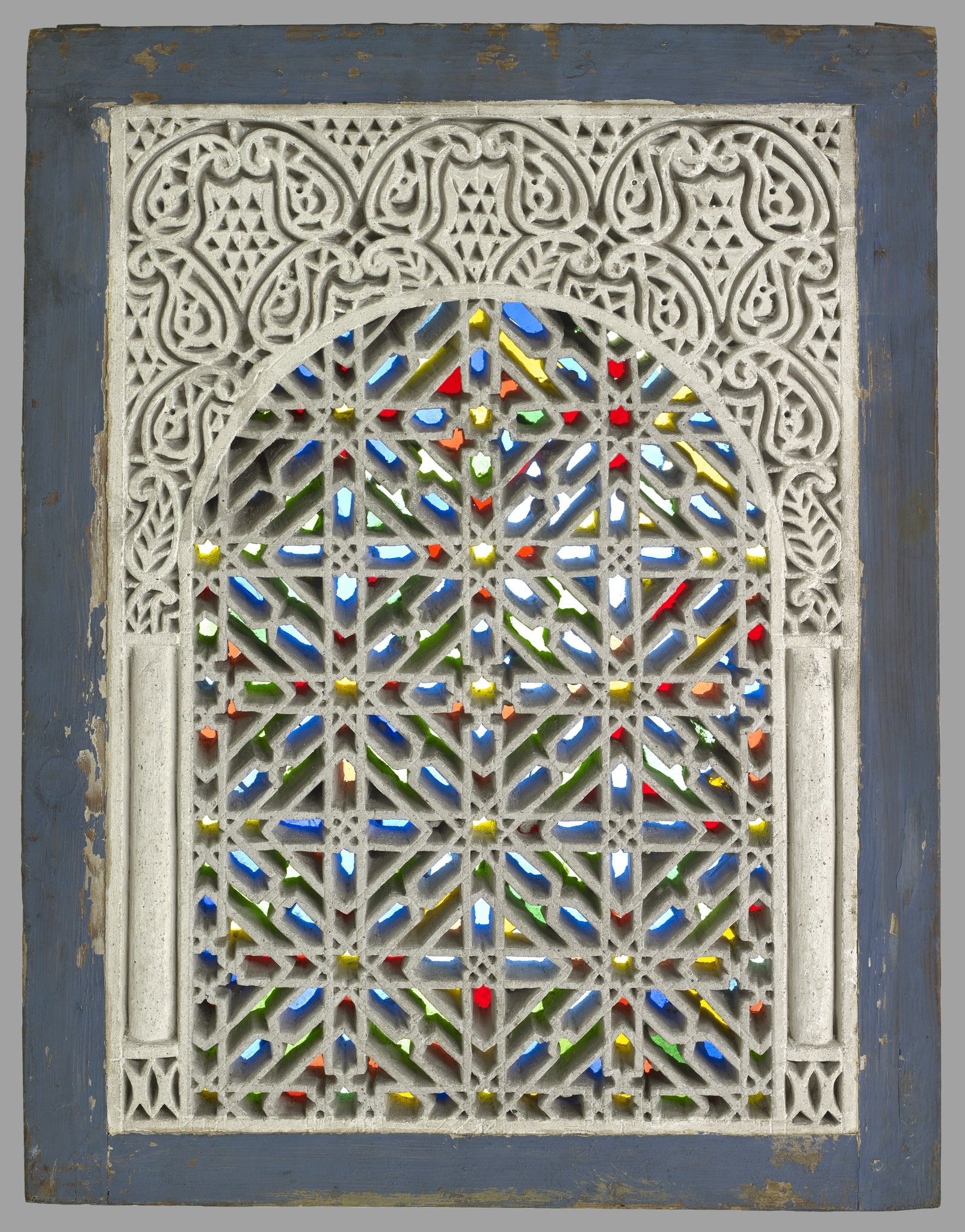
This stucco and glass window corresponds iconographically to one of the standard types of shamsiyyāt widespread in the Maghreb during the Ottoman period. The interlaced star-and-knot ornamentation is a recurring element in Islamic arts across time and media (see for instance, Broug, 2013; Azzam, 2021, pp. 68–127). However, there are several formal characteristics, especially the purely geometric design, the complex interlaced pattern, and the framing arch supported by two columns, that indicate that the window must originate from Tunisia. This geographical classification is supported by the description and illustration of a similarly designed window by the French architect Henri Saladin (1851–1923), who in his 1908 publication Tunis et Kairouan reports on a visit to a workshop in Tunis (Saladin, 1908, p. 75), where he commissioned several stucco and glass windows for the Tunisian pavilion at the 1889 Exposition Universelle in Paris (IG_248, see also IG_92).
The Grenoble window finds close parallels in two of the stucco and glass windows of assumed Tunisian origin held at the MAK – Museum für angewandte Kunst in Vienna (see IG_363, IG_364), as well as in the stucco and glass windows made for the Tunisian pavilion at the 1867 Exposition Universelle of Paris (see IG_270, IG_271).
Shamsiyyāt with geometric star-and-knot ornamentation from the Maghreb are represented in Orientalist paintings by European artists, although much less frequently than stucco and glass windows with figurative motifs from Egypt or Turkey. Among the few examples are an undated oil painting by the Vienna-born Orientalist painter Rudolf Ernst (1854–1932) (see IG_137) and the oil painting Après le bain (1894) by the French Orientalist painter Paul-Louis Bouchard (1853–1937) (see IG_148).
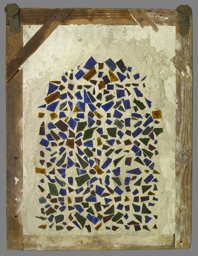
The window discussed here was made according to the traditional technique used in the manufacture of shamsiyyāt in the Maghreb up to this day (see Technique). As with the stucco and glass windows mentioned above held at the MAK (IG_363, IG_364), its wooden frame was reinforced by wooden struts running diagonally across the corners on the panel’s back. This type of reinforcement is not observed in the technically similar stucco and glass windows from Egypt; it could therefore be a Tunisian peculiarity.
Although this window was produced using the same technique as the windows in the MAK collection, it differs significantly from them in terms of the quality of the design and finish. Compared to the MAK windows, it is rather poorly crafted, and the design of the pillars and spandrels is very basic.
Windows of this type were traditionally installed in the upper parts of walls. To direct the light downwards into the room, the openings in the stucco lattice were cut out of the stucco panel at a downwards-pointing angle. The star-and-knot ornaments in the main field of this window are cut at a very sharp angle, which could indicate that the window was installed very high up. However, the lack of traces of weathering on the back, i.e., the outside, of the stucco lattice casts doubt on whether the window was ever installed in a house. It is more likely that it was made directly for the art market, as we suspect with other examples studied as part of the project (see for instance IG_254, IG_255, IG_256, IG_257).
According to the museum records, the window was acquired by the French collector Léon Marie Eugène de Beylié (1849–1910), who was the main patron of the Musée de Grenoble. As an officer in the French colonial army between 1884 and 1910, Léon de Beylié was mainly active in Indochina. However, in 1898, he carried out short missions in Tunisia and Algeria. Between 1908 and 1909, he supervised the excavations at the Qalʿa of Beni Hammad in Algeria. It can therefore be assumed that de Beylié bought this window towards the end of the 19th or the beginning of the 20th century during one of his North African missions, most probably in Tunisia, and donated it sometime between 1898 and his death in 1910 to the Musée de Grenoble. It is not known when the wooden frame was painted blue.