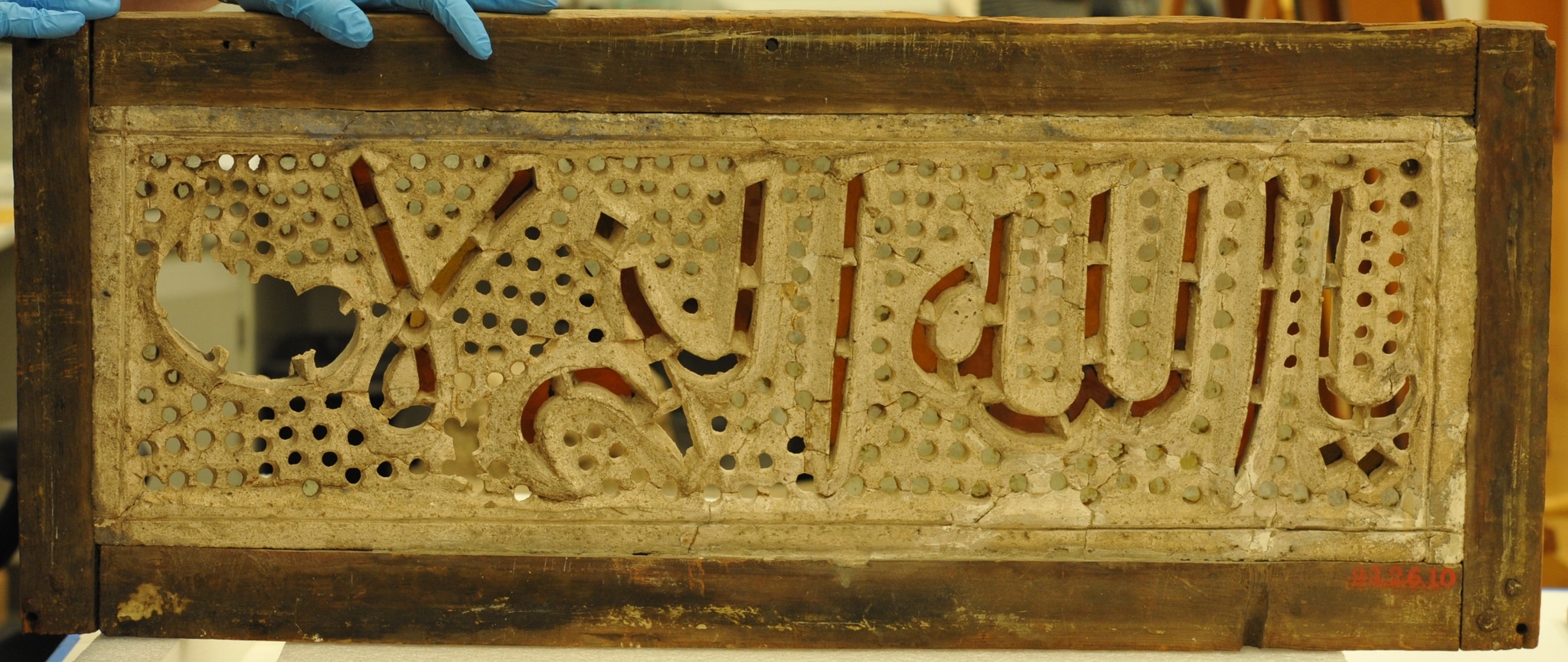
The stucco and glass panel shows all the characteristic features of Arabic inscriptions integrated into qamariyyāt: the cursive script, the use of yellow glass for the letters, and the perforated background.
In contrast to the inscriptions preserved today in museum collections as isolated panels, most of them were originally part of a larger stucco and glass window composed of several individual panels, as documented by 19th-century architects and archaeologists, among them Pascal Coste (IG_130, IG_294), James William Wild (IG_436), Jules Bourgoin (IG_461, IG_462), and Melchior de Vogüé (IG_71–73).
The formula Allāh alladhī lā [ilāha illā huwa] represented in this panel, appears verbatim in the Qurʾan (20:98, 59:22, 59:23). Though parts of the quotation are missing, the artisan certainly intended to refer to them. This religious formula is of great importance within the Islamic belief system, as it emphasizes the unity and oneness of God. In a slightly modified form, it forms the first part of the shahāda, the Islamic testimony of faith. Besides that, it is also featured in various religious practices. For example, it is pronounced repeatedly as part of dhikr, a practice performed by Muslims (particularly Sufis) to remember and worship God.
The panel is produced according to the traditional method used in the manufacture of qamariyyāt in Egypt during the Ottoman period (see Technique). Just as most of the Islamic stucco and glass windows made in Egypt and examined within this project, the pieces of glass were cut out of mouth-blown sheet glass in the shapes of the openings of the latticework and fixed to the back by a thin layer of plaster.
According to the museum records, the window dates to the 17th century. However, the good state of preservation of the stucco lattice raises doubts about this early dating. If the window had actually been installed in a building in the 17th century, we would expect to observe clearer traces of weathering.
A hand-written letter dated 22 May 1893 to Luigi Palma di Cesnola (1832–1904), the then director of The Metropolitan Museum of Art in New York provides information on the provenance of the window. The author of this letter, the American architect William Robert Ware (1832–1915), writes that he had acquired this and various other windows in the spring of 1890 from several well-known art and antiquity dealers in Cairo. He mentions [Gaspare] Giuliana, [E. M.] Malluk, [Nicolas?] Tano, and [Panayotis] Kyticas (on their commercial activities see Volait, 2021, pp. 60–64). In his letter, Ware further states that he was told that the windows ‘had been taken from old houses’ and ‘from old mosques, that had been dismantled’, but that he was not able to get ‘any precise information as to their original places’ (Ware, 1893).
In 1893, Ware donated this window as part of a lot of 17 qamariyyāt (IG_169, IG_171–186) to The Metropolitan Museum of Art (Ware, 1893).