Recherche
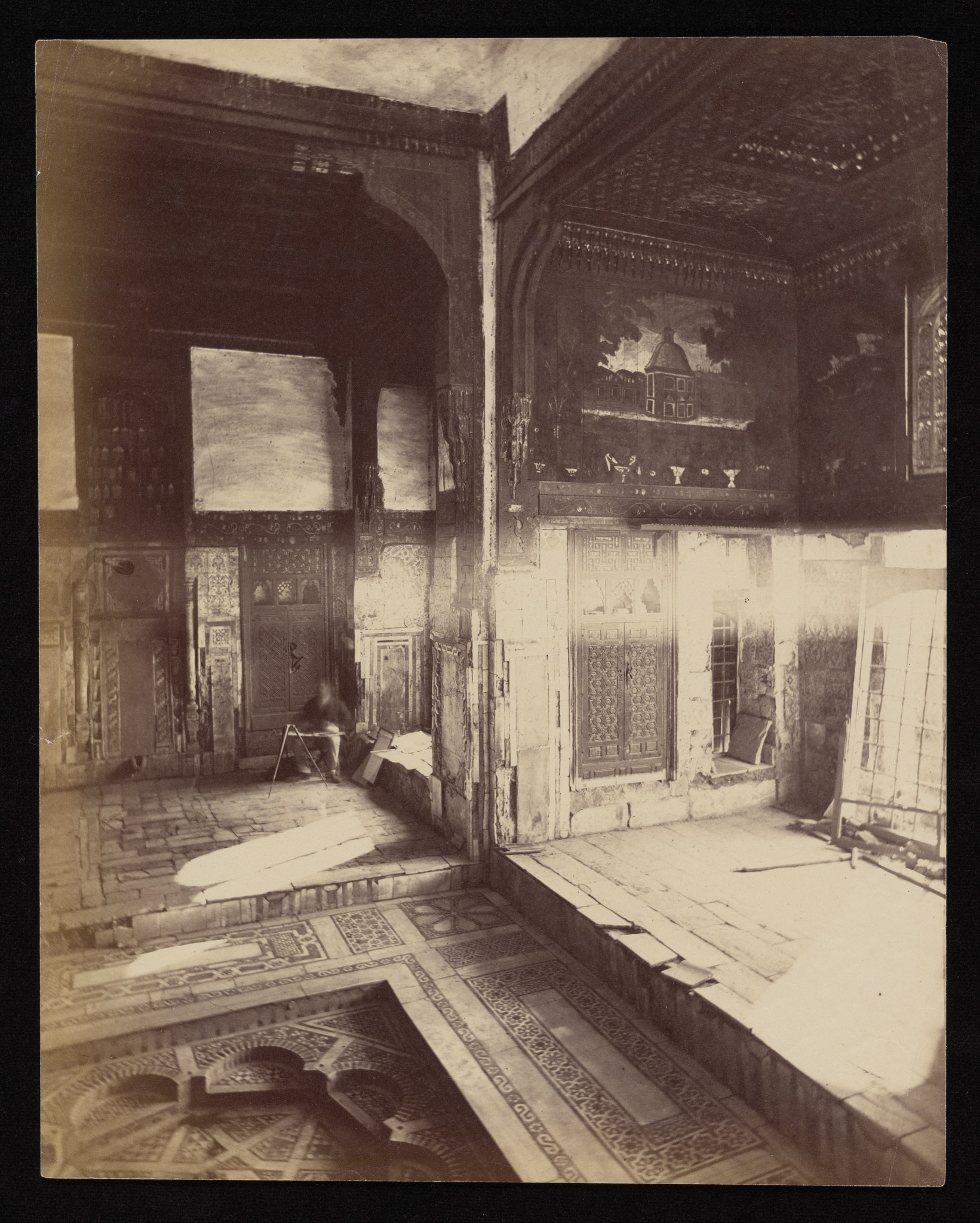
This interior is the mandarah of the ‘House of the Mufti’ in Cairo – so named because it was owned by the supreme mufti of Egypt, Sheikh Muhammad al-ʿAbbasi al-Mahdi (1827–1897) between 1847 and 1886 (Llewellyn, 1998, p. 154). During the 19th century, Europeans had become familiar with the term mandarah through Edward William Lane: ‘In general, there is, on the ground-floor, an apartment called a mun’dar’ah, in which male visitors are received’ (Lane, 1836, p. 11). According to Mercedes Volait, the ‘House of the Mufti’ was built at the beginning of the 18th century, between 1704 and 1705 (a date that can be found on a column in the residence) and had been given to Sheikh al-ʿAbbasi when he became Grand Mufti in 1848 (Volait, 2021).
In a broader context, the ‘House of the Mufti’ became a popular painting subject for artists travelling to Egypt during the 19th century. It was painted, for example, by Frank Dillon (1832–1908) (IG_98, IG_99), the Swiss architect Theodor Zeerleder (1820–1868) (IG_471), František Schmoranz (IG_415), and Franz von Lehnbach (Palastinterieur in Kairo, 1876, oil on board, 88 × 70cm, Lenbach-Nachlass im Familienbesitz, reproduced in Baranow, 1986, p. 130).
Datation
c. 1874
Période
1860 – 1874
Sites liées
Lieu de production