Image commandée

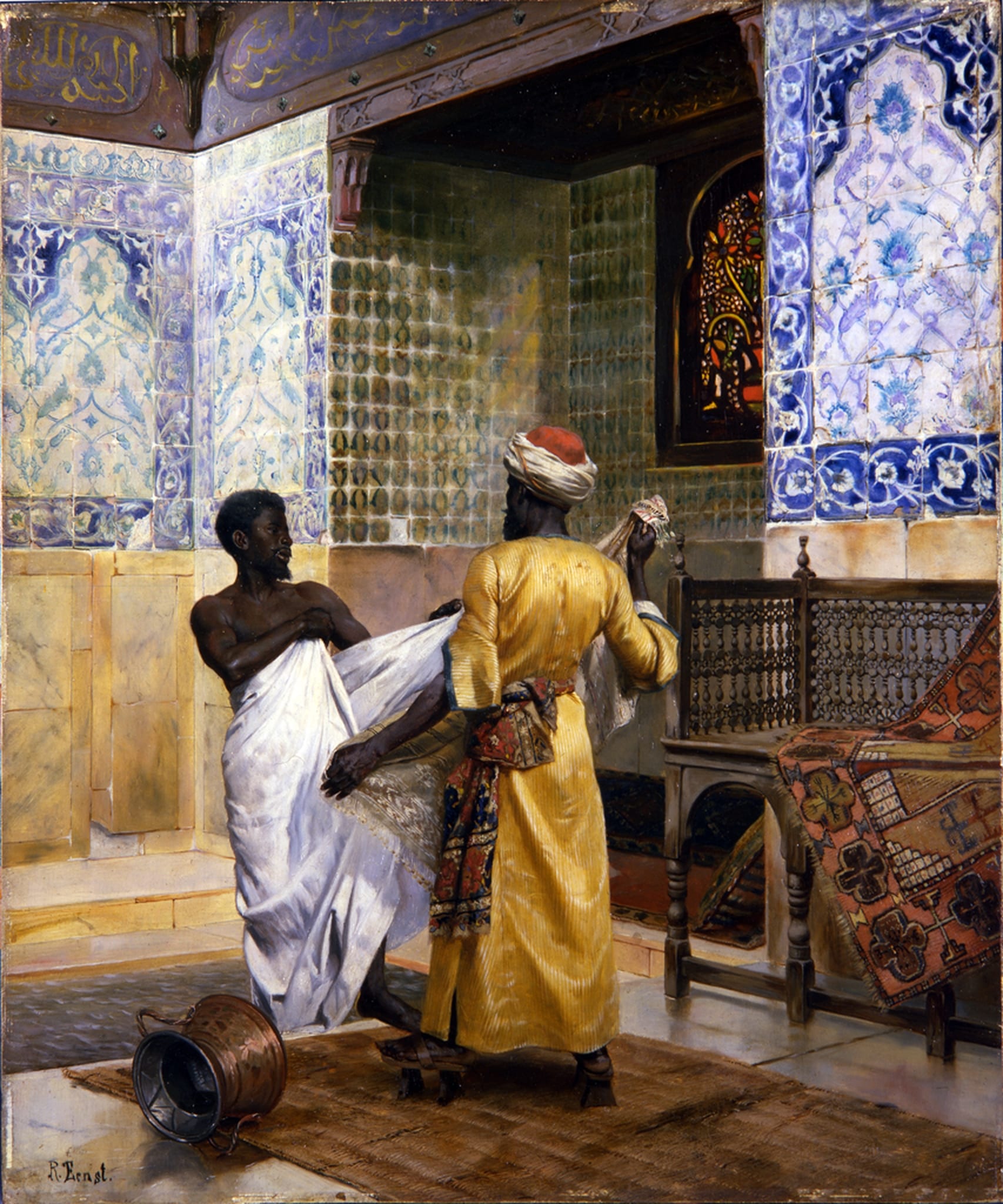
IG_141: A Moor Robing After the Bath
(USA_Milwaukee_HaggertyMuseumOfArt_IG_141)

Coordonnées

Prière de compléter le champ "Prénom".
Prière de compléter le champ "Nom".
Prière de compléter le champ "E-Mail".
Votre adresse e-mail n'est pas valide.

Veuillez s’il vous plaît indiquer autant d’informations que possible (titre de la publication, base de données, éditeur, nombre d’exemplaires, année de parution, etc.)

Le Vitrocentre Romont ne peut mettre à votre disposition que ses propres images. Nous ne pouvons malheureusement pas vous fournir des images de tiers. Si votre commande concerne des photographies de tiers, nous vous enverrons volontiers l'adresse de contact où vous pourrez obtenir les images.

Les données personnelles que vous avez indiquées dans ce formulaire sont utilisées par le Vitrocentre Romont exclusivement pour le traitement de votre commande d'images. La correspondance relative à la commande est archivée à des fins de traçabilité interne. Les données ne seront utilisées à aucune autre fin que celles énumérées ici, ni transmises à des tiers. En envoyant un formulaire de commande, vous acceptez tacitement cette utilisation de vos données personnelles.

Pour toute question complémentaire, veuillez contacter info@vitrosearch.ch.

Titre

A Moor Robing After the Bath

Type d'objet
Dimensions
53.02 x 44.45 cm
Artiste
Datation
c. 1900
Projet de recherche
Auteur·e et date de la notice
Sarah Tabbal 2024

Iconographie

Description

The painting A Moor Robing after the Bath by the Vienna-born Orientalist painter Rudolf Ernst (1854–1932) represents two men in a bath. One man, depicted from the rear and wearing a golden-yellow garment and a white and red turban, and a second man stepping out of a water basin (Carter, 2006, pp. 26–27). In a niche on the right side of the painting, a stucco and glass window with the motif of symmetrically arranged flowers in a red and green vase is partly visible.

Code Iconclass
41A33 · fenêtre
41A6711 · fleurs dans un vase
Mot-clés Iconclass

Matériaux, technique et état de conservation

Technique

Oil on panel.

Historique de l'oeuvre

Recherche

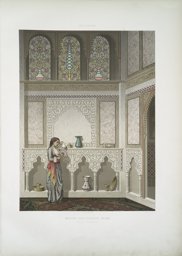
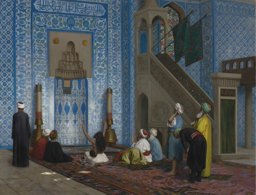
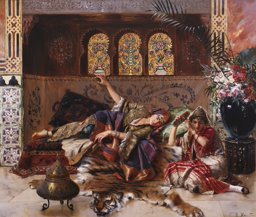
Ernst also depicted windows of this type, with stylized flowers symmetrically disposed in a green and red vase, in other Orientalist paintings: in Au harem (IG_153), three coloured stucco and glass windows are depicted in a recess, two of which show the motif of stylized vases of flowers. Another example is Ernst’s painting Tending the Lamp (oil on panel, 61 × 48cm, Sotheby’s (2018): The Orientalist Sale (Sale L18100), 24 April 2018, London, lot 14), where two windows with the motif of stylized flowers in a green and red vase are represented on the left side of the painting. Two stucco and glass windows with the motif of symmetrically arranged flowers in a red and green vase can be seen in a chromolithograph by Émile Prisse d’Avennes (IG_31) that, according to the caption, represents the upper room of the Cairene house of ‘Sidi Youçouf Adami’. The impact of Prisse d’Avennes’s chromolithograph cannot only be seen in works by Rudolf Ernst, but also in the painting Rüstem Pasha Mosque Istanbul by Jean-Léon Gérôme (IG_149).

Datation
c. 1900
Période
1885 – 1932

Provenance

Donateur·trice / Vendeur·euse

Gift of the Estate of Claire Hoff Toole

Bibliographie et sources

Bibliographie

Carter, C. (2006). Rudolph Ernst, A Moor Robing after the Bath. In Perspectives on Art at the Haggerty Museum. Milwaukee, WI: Haggerty Museum of Art.

Informations sur l'image

Nom de l'image
USA_Milwaukee_HaggertyMuseumOfArt_IG_141
Crédits photographiques
© Marquette University

Objets et images liés

Objets liés
Cairo, Maison Sidi Youçouf Adami: salon supérieur
Rüstem Pasha Mosque Istanbul
Au harem

Proposition de citation

Tabbal, S. (2024). A Moor Robing After the Bath. Dans Vitrosearch. Consulté le 5 décembre 2025 de https://vitrosearch.ch/objects/2712985.

Informations sur l’enregistrement

Numéro de référence
IG_141