Recherche
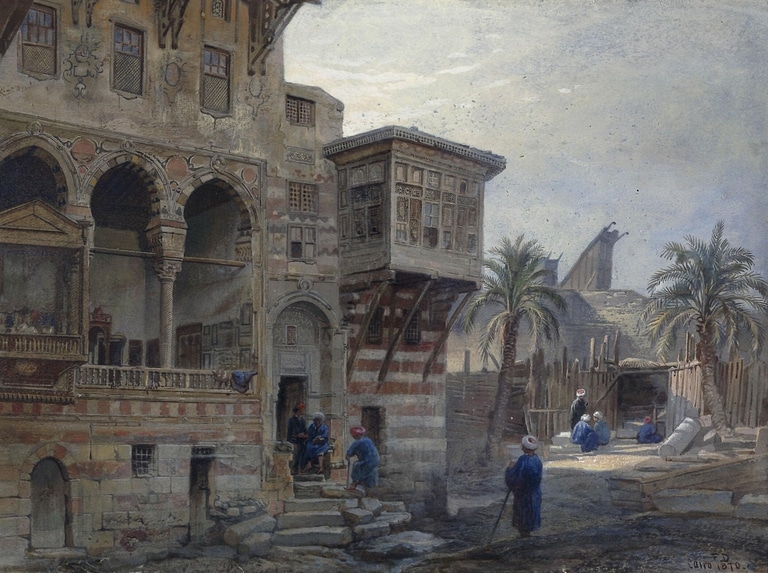
This house depicted by the British painter Frank Dillon was one of several structures built by the influential emir Radwan Bey in the mid-17th century (Llewellyn, 1998, p. 154). Radwan was a Mamluk bey and the leader of a faction known as the faqariya: he dominated political life in Cairo from 1631 to 1651. For twenty-five years, he held the post of amir al-hajj, commander in charge of the annual pilgrimage to Mecca (Williams, 2008, p. 106).
Further views of Radwan Bey’s Cairene house can be seen in other watercolours by Dillon (IG_104, and V&A, SD.331). The loggia and courtyard were also captured in a photograph taken by Lekegian (V&A, PH.1403-1896). In his article ‘The Saracenic House – II’, the British architectural historian Martin Shaw Briggs (1882–1977) tentatively dates the house to 1654–1655, adding in a footnote that Franz Pasha gives the date 1766; he further writes that the house ‘is situated in the Shoe-Bazaar, opposite the Mosque of Mahmud el-Kurdi and south of the Bab Zuweila. It was originally very expensive, but has been merged in the buildings of an elementary school, and only the ka’a and the makad are preserved’ (Briggs, 1921, p. 295). Fragments, such as the marble panelling on the walls and the mashrabiyya of Radwan’s mansion, survive to this day (Williams, 2008, p. 107). As can be seen from Dillon’s watercolour, there also appear to have been stucco and glass windows in the house.
Datation
1870
Sites liées