Image commandée

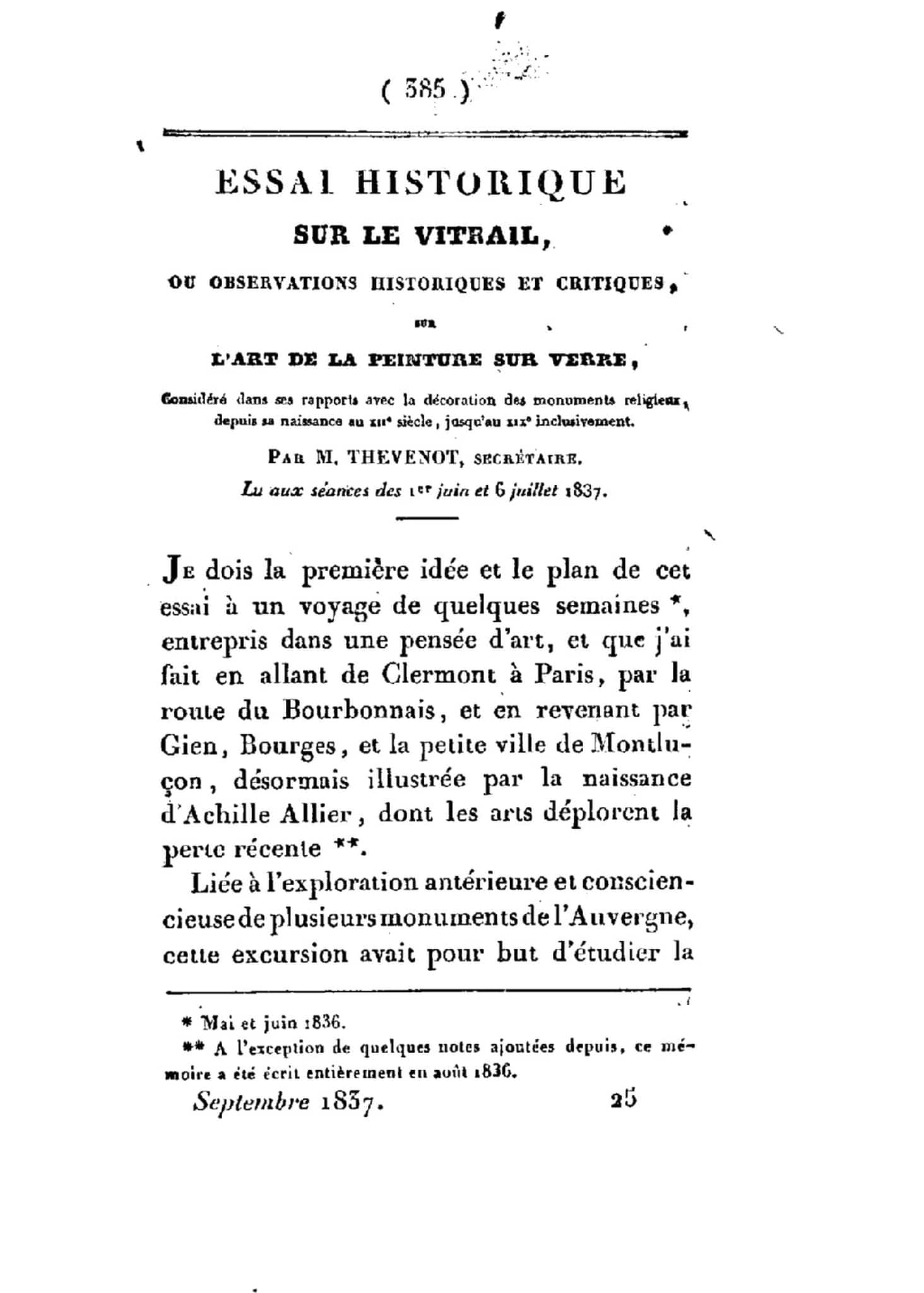
IG_90: étienne Thevenot, Essai historique sur le vitrail, 1837
(MISC_IG_Thevenot_1837_IG_90)

Coordonnées

Prière de compléter le champ "Prénom".
Prière de compléter le champ "Nom".
Prière de compléter le champ "E-Mail".
Votre adresse e-mail n'est pas valide.

Veuillez s’il vous plaît indiquer autant d’informations que possible (titre de la publication, base de données, éditeur, nombre d’exemplaires, année de parution, etc.)

Le Vitrocentre Romont ne peut mettre à votre disposition que ses propres images. Nous ne pouvons malheureusement pas vous fournir des images de tiers. Si votre commande concerne des photographies de tiers, nous vous enverrons volontiers l'adresse de contact où vous pourrez obtenir les images.

Les données personnelles que vous avez indiquées dans ce formulaire sont utilisées par le Vitrocentre Romont exclusivement pour le traitement de votre commande d'images. La correspondance relative à la commande est archivée à des fins de traçabilité interne. Les données ne seront utilisées à aucune autre fin que celles énumérées ici, ni transmises à des tiers. En envoyant un formulaire de commande, vous acceptez tacitement cette utilisation de vos données personnelles.

Pour toute question complémentaire, veuillez contacter info@vitrosearch.ch.

Titre

Essai historique sur le vitrail

Type d'objet
Artiste
Datation
1837
Projet de recherche
Auteur·e et date de la notice
Sarah Keller 2025

Iconographie

Description

The Essai historique sur le vitrail was published in 1837 as volume X of the Annales scientifiques et littéraires de l’Auvergne.
A translation of Thevenot’s essay on stained glass was published in the Kunstblatt of the Morgenblatt für gebildete Leser, 20 December 1842, no. 101, pp. 401–411.

Historique de l'oeuvre

Recherche

Thevenot’s publication Essai historique sur le vitrail appeared in 1837 and quoted the French painter Prosper Marilhat (1811–1847), who had travelled to Egypt in 1831–1833. This artist, who like Thevenot came from Auvergne, had seen the production of stucco and glass windows in Egypt. Although his detailed account is reported only in a footnote of Thevenot’s history of European stained glass, this makes his text an exception within the early historiography on stained glass. Other French authors, such as Alexandre Brogniart, Eustache-Hyacinthe Langlois, and Ferdinand de Lasteyrie, who published on the history of stained glass in the first half of the 19th century, do not mention Islamic stucco and glass windows at all.
Besides Edward Lane’s Manners and Customs of the Modern Egyptians (IG_89), Thevenot’s essay is the oldest detailed description of Islamic stucco and glass windows.

Thevenot briefly addresses the then-circulating theory of the origin of stained glass in the ‘Orient’ – in Islamic architecture – but emphasizes the independence of developments in the West and North (see Keller, 2021, p. 307). He refers to the stained glass windows of St Mark’s basilica in Venice and the Hagia Sophia in Constantinople and assumes that Byzantine art was the source of the ‘Saracens’’ preference for coloured glass. He then reports that Prosper Marilhat told him about a workshop for stucco and glass windows in Jericho and that he had seen such windows being made in Cairo, ‘d’une manière fort neuve pour un Européen’.
The manufacturing he described as follows: ‘L’ouvrier après avoir découpé les verres d’une rosace, par exemple, lie les différents morceaux entr’eux par du plâtre presque liquide, et contenu dans une espèce de sabot [wooden vessel], d’où il découle par une petite ouverture. On promène rapidement ce sabot sur les interstices des verres, et par ce moyen souvent répété, on les enchâsse dans les ouvertures de la rose; on la met ensuite en place d’une seule pièce, après avoir sculpté les reliefs des nervures en plâtre. Le plâtre fait ici à peu près l’office des plombs et des meneaux sans nombre des rosaces qui encadrent les vitraux en Occident.’ (Thevenot, 1937, p. 462, note 6).

Thevenot, following Marilhat, describes a procedure similar to the one described later by Julius Franz (IG_66) and Max Herz (IG_161). He specifies the vessel – ‘sabot’ – with which the almost liquid plaster is applied and states, in contrast to Franz and Herz, that the stucco ribs are carved after the plaster has been cast onto the pieces of glass. This procedure of sculpting the plaster ribs (on the front or back) after fixing the pieces of glass is not described by Flood (1993) in his analyses of the techniques. However, lack of clarity on this may stem from the fact that Thevenot was taking over a description and did not witness the production of windows himself.

Datation
1837
Lieu de production

Bibliographie et sources

Bibliographie

Flood, F. B. (1993). Palaces of crystal, sanctuaries of light: windows, jewels and glass in medieval islamic architecture [PhD thesis, University of Edinburg]. Edinburgh College of Art thesis and dissertation collection. Retrieved from https://era.ed.ac.uk/handle/1842/19754.

Keller, S. (2021). Oriental Carpets and Gothic Windows. Stained Glass in Neo-Moorish Architecture (pp. 303–326). In Giese, F. (ed.). Mudejarismo and Moorish Revival in Europe. Cultural Negotiations and Artistic Translations in the Middle Ages and 19th-century Historicism. Brill.

Thevenot, E. H. (1837). Essai historique sur le vitrail, ou observations historiques et critiques sur l'art de la peinture sur verre, consideré dans ses rapports avec la décoration des monuments religieux depuis le XIIe siècle jusqu'au XIXe inclusivement (pp. 385–464). In Annales scientifiques et littéraires de l’Auvergne, X. Clermont-Ferrand: Thibaud-Landriot.

Informations sur l'image

Nom de l'image
MISC_IG_Thevenot_1837_IG_90
Crédits photographiques
Thevenot, 1837, p. 25.

Proposition de citation

Keller, S. (2025). Essai historique sur le vitrail. Dans Vitrosearch. Consulté le 5 décembre 2025 de https://vitrosearch.ch/objects/2712934.

Informations sur l’enregistrement

Numéro de référence
IG_90