Image commandée

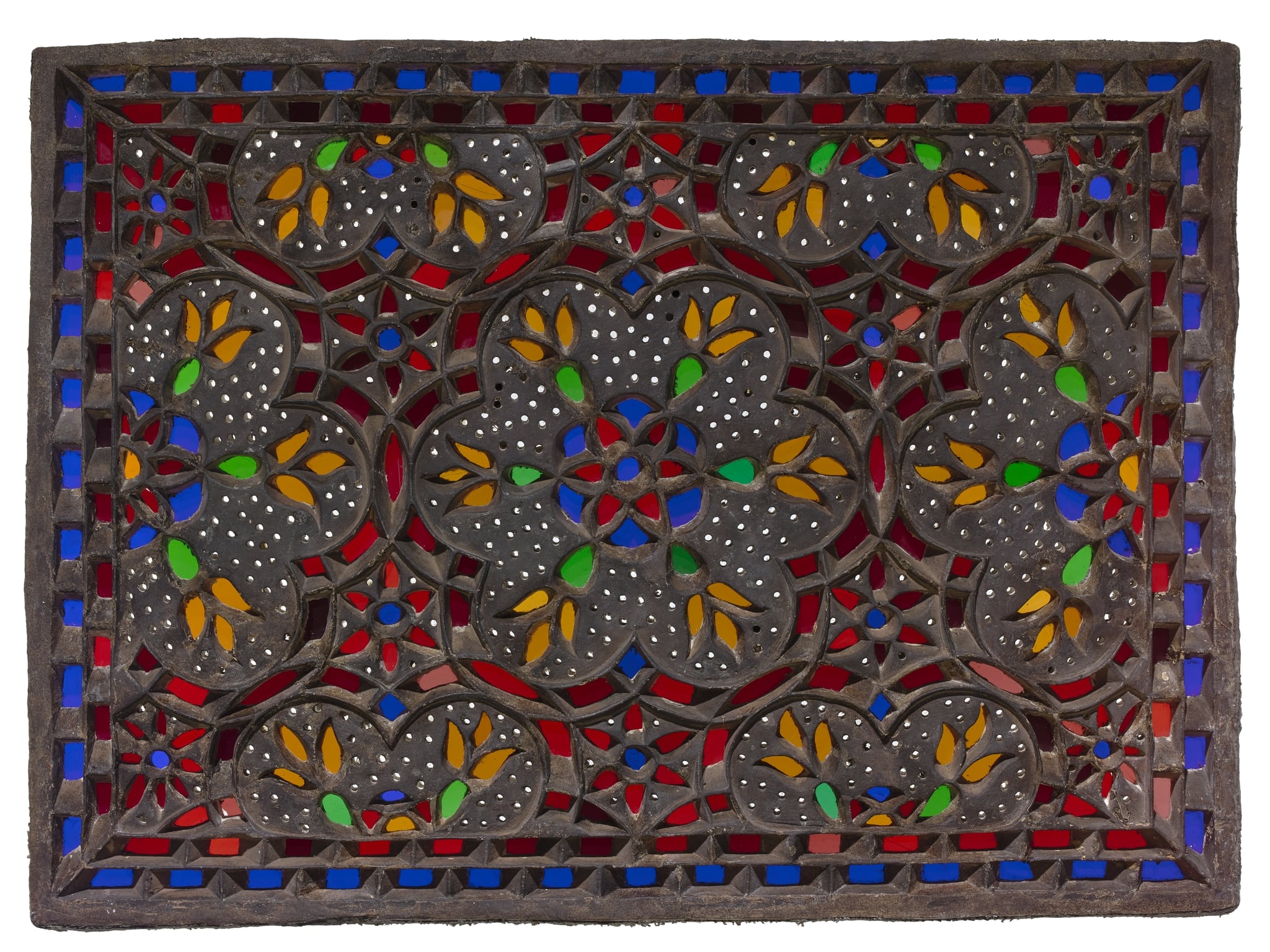
IG_25: Stucco and glass window with sixfoil ornament
(FRA_Paris_MuseeDuLouvre_IG_25)

Coordonnées

Prière de compléter le champ "Prénom".
Prière de compléter le champ "Nom".
Prière de compléter le champ "E-Mail".
Votre adresse e-mail n'est pas valide.

Veuillez s’il vous plaît indiquer autant d’informations que possible (titre de la publication, base de données, éditeur, nombre d’exemplaires, année de parution, etc.)

Le Vitrocentre Romont ne peut mettre à votre disposition que ses propres images. Nous ne pouvons malheureusement pas vous fournir des images de tiers. Si votre commande concerne des photographies de tiers, nous vous enverrons volontiers l'adresse de contact où vous pourrez obtenir les images.

Les données personnelles que vous avez indiquées dans ce formulaire sont utilisées par le Vitrocentre Romont exclusivement pour le traitement de votre commande d'images. La correspondance relative à la commande est archivée à des fins de traçabilité interne. Les données ne seront utilisées à aucune autre fin que celles énumérées ici, ni transmises à des tiers. En envoyant un formulaire de commande, vous acceptez tacitement cette utilisation de vos données personnelles.

Pour toute question complémentaire, veuillez contacter info@vitrosearch.ch.

Titre

Stucco and glass window with sexfoil ornament

Type d'objet
Dimensions
59.7 x 44.3 x 2 cm
Artiste
Lieu de production
Datation
Late 13th–early 14th centuries AH / late 19th century CE
Lieu
Numéro d'inventaire
OA 7466/24
Projet de recherche
Auteur·e et date de la notice
Francine Giese, Sophie Wolf 2025

Iconographie

Description

This stucco and glass window shows symmetrically arranged floral ornamentation within a rectangular double frame in red and blue. A six-petalled flower, composed of six three-petalled flower stems emerging from the middle, occupies the centre of this repeating floral ornamentation. The flowers are set within a perforated background. Smaller six-petalled flowers set within irregular hexagons fill the spaces between the large flowers. The outlines of flowers are worked out in relief against a perforated background.
The latticework is painted dark brown (see Research).

The window has been restored and is preserved without its original wooden frame (see Technique and Research). The window is reinforced with a layer of textile inserted between the stucco grille and the plaster layer on the back of the panel in which the pieces of glass are embedded (see This stucco and glass window shows symmetrically arranged floral ornamentation within a rectangular double frame in red and blue. A six-petalled flower, composed of six three-petalled flower stems emerging from the middle, occupies the centre of this repeating floral ornamentation. The flowers are set within a perforated background. Smaller six-petalled flowers set within irregular hexagons fill the spaces between the large flowers. The outlines of flowers are worked out in relief against a perforated background.

The latticework is painted dark brown (see Research).

The window has been restored and is preserved without its original wooden frame (see Technique and Research). The window is reinforced with a layer of textile inserted between the stucco grille and the plaster layer on the back of the panel in which the pieces of glass are embedded (see State of Preservation and Restorations).

Code Iconclass
48A981 · ornement ~ motifs géométriques
48A983 · ornement dérivé de formes végétales
48A9833 · fleurs ~ ornement
Mot-clés Iconclass

Matériaux, technique et état de conservation

Matériaux

Gypsum plaster; colourless glass; coloured glass (green, blue, two shades of dark yellow; two shades of flashed red); brown paint; textile (jute fabric)

Technique

Stucco panels are produced according to the traditional production technique described by several authors (for example, Foy 2005, pp. 152–154), by pouring gypsum plaster into a frame, which is usually made of wood and has a hollow profile. The design is usually transferred to the stucco panel using stencils and then carved as an openwork relief using various tools (gouge, serrated knife, chisel, file, etc.). Depending on the height and position of the window in the room, the openings are tapered and oriented in such a way that they direct light towards the viewer. The individual openings are then covered with pieces coloured sheet glass on the flat, rear of the panel; sometimes one glass piece covers several smaller holes. The pieces are fixed to the stucco panel by being embedded in a thin layer of gypsum plaster. Stucco and glass windows are usually mounted in window openings in their wooden frames, with the sculpted side facing the inside of the room.

The object described here is not framed. According to a detailed examination (Bailly et al., 2008), all but one of the stucco and glass windows (OA 7466/39, IG 168) in the Delort de Gléon Collection were removed from their wooden frames at an unknown date. The lack of round profiles to the now straight edges of the 18-mm-thick stucco lattice corroborates this hypothesis.

The plaster layer fixing the pieces of glass to the back of the panel is off-white (cream-coloured). The plaster layer is not original; it was applied during a restoration (date unknown) that involved the insertion of a jute fabric between the stucco panel and the glass, probably done to reinforce the fragile stucco latticework (Bailly et al., 2008, p. 32). To further stabilize the lattice, the edges of the lattice were also reinforced with strips of textile.

The latticework is laid out on two levels: the main design (level 0) was carved out of the stucco panel using a sharp, knife-like tool. There are no traces of any preparatory drawing on the front of the panel. The second level (level –1), which lies 3–4mm below level 0, shows irregularly spaced, conical perforations with diameters of c.4mm. The distances between the holes range between 6 and 8mm. The holes seem to have been pierced – rather than drilled – into the still soft (not fully set) stucco using a metal or wooden nail or pin. They are slightly tapered towards the back. The main design and the perforations have been worked in such a way that the incident light is directed downwards, indicating that the window was made to be positioned in the upper part of the wall. At an unknown date, the front of the latticework was painted brown.

The pieces of glass are of both colourless and coloured glass; the colours include cobalt blue, green, dark yellow, and red. Flashed glass, that is, glass composed of a thicker layer of transparent glass and a thinner layer of strongly coloured material, has been used for the red pieces, and maybe also for the cobalt-blue ones (see Bailly et al., 2008, p. 10). The pieces of glass were cut according to the design of the latticework using a diamond cutter, which left scratch marks on some of them. All holes are backed with colourless glass; coloured glass has been used for the main design.

Etat de conservation et restaurations

The stucco and glass window is in good condition: the plaster lattice is intact, there are only a few fissures and very small losses on the front of the latticework. The glass does not show any losses or defects.

According to the results of an in-depth examination of the stucco and glass windows in the Delort de Gléon Collection carried out in 2008, all the windows have been restored five times since their acquisition in Cairo, involving the reinforcement of the fragile plaster lattice with textile, jute fabric in this case (Bailly et al., 2008, pp. 16–25, 32). The fabric, which is perforated according to the design, was inserted between the back of the latticework and the glass and fixed to the panel with glue. In the process, the original plaster layer fixing the pieces of glass to the back of the panel was completely removed – together with the pieces of glass – and replaced with a new plaster embedding layer for the pieces of glass. There are no remains of the original plaster layer. To further stabilize the latticework, the edges of the panel were reinforced with textile bands.

The most recent restoration was carried out after this detailed examination, in 2009–2010 (Fellinger et al., 2022). In the course of this restoration, several pieces of glass were replaced; the new pieces are incised with the date ‘2010’.

Historique de l'oeuvre

Recherche

This stucco and glass window corresponds iconographically and technically to one of the standard types of qamariyya widespread in Egypt during the Ottoman period. However, sexfoil ornaments with flowers are far less common than other floral and geometric compositions. Nevertheless, a picture taken by the Italian photographer Beniamino Facchinelli (1839–1895) at the Museum of Arab Art in Cairo (IG_206) confirms the occurrence of this type of windows in the Egyptian capital. Even though the qamariyya represented on the photograph is much more elaborate than the Louvre window discussed here, both of them show a symmetrical distribution of sexfoils and flowers that create a repeating pattern.

Several qamariyyāt within the collection of the Musée du Louvre in Paris havenot only ornamentation identical to that of the window discussed here, but also an identical distribution of coloured glass (OA 7466/25, IG_26; OA 7466/26), which suggests that they were produced at the same workshop and are most probably part of a larger group. As IG_38, the three qamariyyāt of this group were installed at the centre of a window composed of several panels. The colours of the glass and the material properties of the latticework – although heavily restored – suggest that the window dates to the late 19th century. This assumption is supported by the results of an analytical study of glass from two stucco and glass windows from the Louvre collection (OA 7466/7 and OA 7466/25) conducted by a team from the Musée du Louvre (Fellinger et al., 2022).

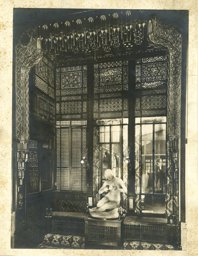
As to its provenance, the window is one of 39 qamariyyāt supposedly bought in Cairo by the architect Ambroise Baudry (1883–1906) for the French civil mining engineer and art collector Baron Alphonse Delort de Gléon (1843–1899) (Bailly et al., 2008, pp. 16–24). They adorned the Ottoman salon of Delort de Gléon’s hôtel particulier, purchased in 1883, at rue Vézelay 18 in Paris (Volait, 2005, pp. 131–134; Volait, 2009, pp. 99–104, 130–135). This is confirmed by several historical photographs preserved at the Département des Arts de l’Islam (DAI) of the Musée du Louvre, which show the windows inserted in the upper parts of wooden mashrabiyyāt (see Linked Objects and Images). The salon was designed by the baron himself in collaboration with the French architect Jules Bourgoin (1838–1908). The creation of orientalizing interiors, composed of original architectural elements and furnishings as well as replicas of the same, was a widespread practice among Western art collectors at the time (Giese, 2016; Volait, 2016; Giese, 2019).

Based on the photographs mentioned and the presumed date of the windows, one may assume that the windows were created especially for Delort de Gléon’s Arab-style interior and had never been part of a historical building in Cairo. The complete history of these windows however, including possibly multiple reuses and several restorations, is difficult to reconstruct. Based on the unpublished study by Bailly et al. (2008) and our own observations, it seems that most of the windows have been cut from their wooden frames. Extensive repairs to the stucco grille, as well as the complete replacement of the thin plaster layer for embedding the pieces of glass at the back of the panel, are proof of several restoration campaigns. It is likely that the ochre paint on the stucco lattice is not original, but was applied during restoration, with the intention of adapting the windows to new surroundings.

After the collector’s death, the stucco and glass window passed to his wife Marie Augustine Angélina Delort de Gléon, who bequeathed it as part of Delort de Gléon’s collection of Islamic art to the Musée du Louvre in 1912 (Delort de Gléon, 1914).

Datation
Late 13th–early 14th centuries AH / late 19th century CE
Période
1880 – 1899
Sites antérieures
Sites liées
Lieu de production

Provenance

Propriétaire
Dès 1912: Musee de Louvre, Paris, Numéro d'inventaire: OA 7466/24, Paris (France), Donation L1
Propriétaire précédent·e
De 1883 (ca.) jusque 1899: Delort de Gléon, Alphonse, Paris (France)
Notes de provenance
L1 Delort de Gléon, 1914

Bibliographie et sources

Bibliographie

Bailly, M., Frenkel, N., Gaymay, S., Hamadène, F., Liégey, A., Picur, V., Setton, J. M., & Tréluyer, V. (2008). Rapport d’etude concernant la collection des vitraux [unpublished research report]. Musée du Louvre, Département des arts de l’Islam.

Delort de Gléon, M. A. A. (1914, March 9). Legs de la collection de M. Delort de Gléon (Cote 20144787/17), Archives de musées nationaux (AMN), Archives nationales, Pierrefitte-sur-Seine, France.

Fellinger, G., Juvin, C., Bouquillon, A., Dallel, M., Loisel, C., Trichereau, B. & Groupement solidaire Setto (2022). Éclats de lumière : étude et restauration de vitraux égyptiennes du musée du Louvre. Technè 54, 114–125.

Giese, F. (2016). From Style Room to Period Room: Henri Moser’s fumoir in Charlottenfels Castle. In: S. Costa, D. Poulot, & M. Volait (Eds.), Period rooms. Allestimenti storici tra arte, gusto e collezionismo: Atti del Convegno Internazionale, Bologna, 18-19 aprile 2016 (pp. 153–160). Bologna: Bolonia University Press.

Giese, F. (2019). International Fashion and Personal Taste. Neo-Islamic Style Rooms and Orientalizing Scenographies in Private Museums. In Giese, F., Volait, M. and Varela Braga, A. (eds.), À l’orientale. Collecting, Displaying and Appropriating Islamic Art and Architecture in the Nineteenth and Early Twentieth Centuries (Arts and Archaeology of the Islamic World, 14), Leiden: Brill, pp. 92–110.

Volait, M. (2005). La rue du Caire. In Bacha, M. (ed.). Les Expositions Universelles à Paris, de 1855 à 1937 (pp.131-134). Paris : Action artistique de la Ville de Paris.

Volait, M. (2009). Fous du Caire. Excentriques, architectes & amateurs d’art en égypte 1863–1914. L’Archange Minotaure.

Volait, M. (2016). Les intérieurs orientalistes du comte de Saint-Maurice et d’Albert Goupil: des ‘Cluny arabes’ au Caire et à Paris à la fin du XIXe siècle. In S. Costa, D. Poulot & M. Volait (Eds.), The Period Rooms: Allestimenti storici tra arte, collezionismo e museologia (pp. 103–114). Bononia University Press.

Informations sur l'image

Nom de l'image
FRA_Paris_MuseeDuLouvre_IG_25
Crédits photographiques
© 2021 Musée du Louvre / Hervé Lewandowski
Date de la photographie
2021

Objets et images liés

Objets liés
Stucco and glass window with sexfoil ornament
Photographies complémentaires
Paris, Hôtel particulier Delort de Gléon, Ottoman salon

Proposition de citation

Giese, F., & Wolf, S. (2025). Stucco and glass window with sexfoil ornament. Dans Vitrosearch. Consulté le 5 décembre 2025 de https://vitrosearch.ch/objects/2712869.

Informations sur l’enregistrement

Numéro de référence
IG_25