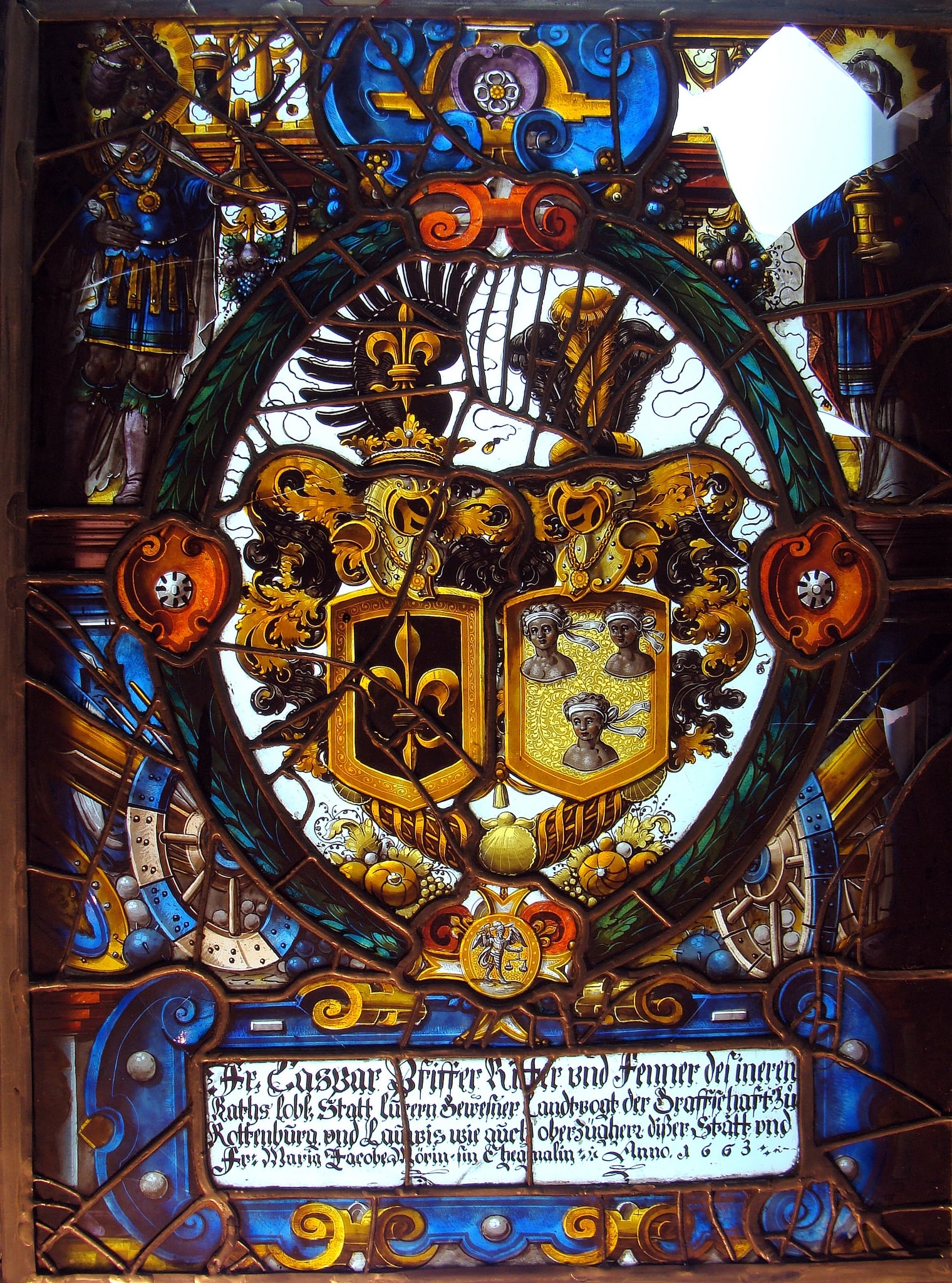
Between 1662 and 1669, a series of panels was apparently created for the Lucerne Rathaus by Jakob Geilinger the Elder (1611–1677), a prominent painter in mid-seventeenth century Lucerne (Lehmann, 1941, pp. 200–210, figs. 285, 286; Habegger, 2001, pp. 103–106). Despite the repeated format, they are lively and varied. The donors are honored by the display of lineage, and at the same time invoke piety through the presence of patron saints. The inscription names the man as a member of the Inneren Rhats (Inner Council) of the Praiseworthy City of Lucerne and a number of the families appear to be interrelated. Kaspar III Pfyffer (1609–1669) is identified with the municipality of Mauensee, thirty kilometers northwest of Lucerne and adjacent to the town of Sursee. His father Christoph was fifty-three and his mother twenty-two years of age at the time of his birth. Kaspar married Maria Jakobea Mohr in 1638. No children from this marriage are recorded. The district of Rotenburg where he was governor is adjacent to the city of Lucerne, on the north.
On the left is King Caspar, one of the three Magi. Since the fifteenth century, he was often portrayed as coming from Africa and wearing exotic dress. Here, his purple turban, dark skin, and great curving horn carried as a monstrance distinguish him from the generic kingly image of the Magus Melchior. Framed by a white cloak, Caspar’s short blue tunic is accented by yellow vertical bands dangling from the waist. He wears a yellow chain and purple boots trimmed in green. Caspar, was seen as the youngest of the three Magi, although traditions differ, and offers the infant the gift of frankincense, signifying the child’s divinity (Kehrer, 1908, p. 66; quoting Collectana et flores, Basileae 1563, vol. 3, p. 649; Réau, 1955–59, II/2, pp. 236–55, which cites the tradition of a gift of gold; Herder Lexikon, 1968–76, 6, cols. 97–98). The shield of the wife is an example of canting (speaking) arms. In German the word for moor is Mohr, in the feminine form Mohrin, and the moor heads in the shield clearly reference Maria Jakobea’s family name. Swags of fruit hang below the shields, and between them is a boss of St. Michael weighing souls.
The wife’s patron is St. Mary Jacobi, shown on the right in a blue and white robe, orange mantle, white wimple, holding a gold ointment jar. One of the three Maries who came to anoint Christ’s body while it lay in the tomb, she holds a vessel in her hands. Medieval legend associated her with Mary Magdalene, her sister Martha, brother Lazarus, priest Maximinus and seventy-two disciples from Palestine who became missionaries in Marseilles, France. The Golden Legend recounts that relics of these saints, although not specifically mentioning Mary Jacobi, were taken to Burgundy and interred in the abbey of Vézelay, to become widely honored in Western tradition (Ryan, 1993, vol. I, pp. 374–83).
A series of scallop shells, emblematic of the pilgrimage of St. James, are linked to a pendant medallion over a cross showing St. Michael with a sword raised on his right hand and set of scales in his left. The collar is a reference to the Order of St. Michael, founded by the French King Louis XI in 1469 (Bander van Duren, 1995. Portraits of Louis invariably show him wearing the collar of the Order). Jean Fouquet depicted the collar held by two angels below a scene of the members surrounding the king in the frontispiece of the Statutes of the Order of Saint-Michel (copy for Louis XI., c. 1469–1470, Paris, Bibliothèque nationale, Ms. Fr.19819; Durrieu, 1890, pp. 61–84). The original image devised for the Order shows Michael striding forward with raised sword and shield, but there were often changes to his precise stance over the years (see BS_938). See also, from slightly earlier than the Lucerne ensemble, a window honoring the French King Louis XIII in the Cloister of Muri (Hasler, 2002, pp. 100–101, 212–13). The window is dated 1625 and shows similar treatment of the collar and emblems.
Cited in:
LACMA Quarterly, 1945, pp. 5–10.
Normile, 1946, pp. 43–44.
Hayward, 1989, p. 81.
Raguin, 2024, vol. 1, pp. 246–51, 255–58.