Research
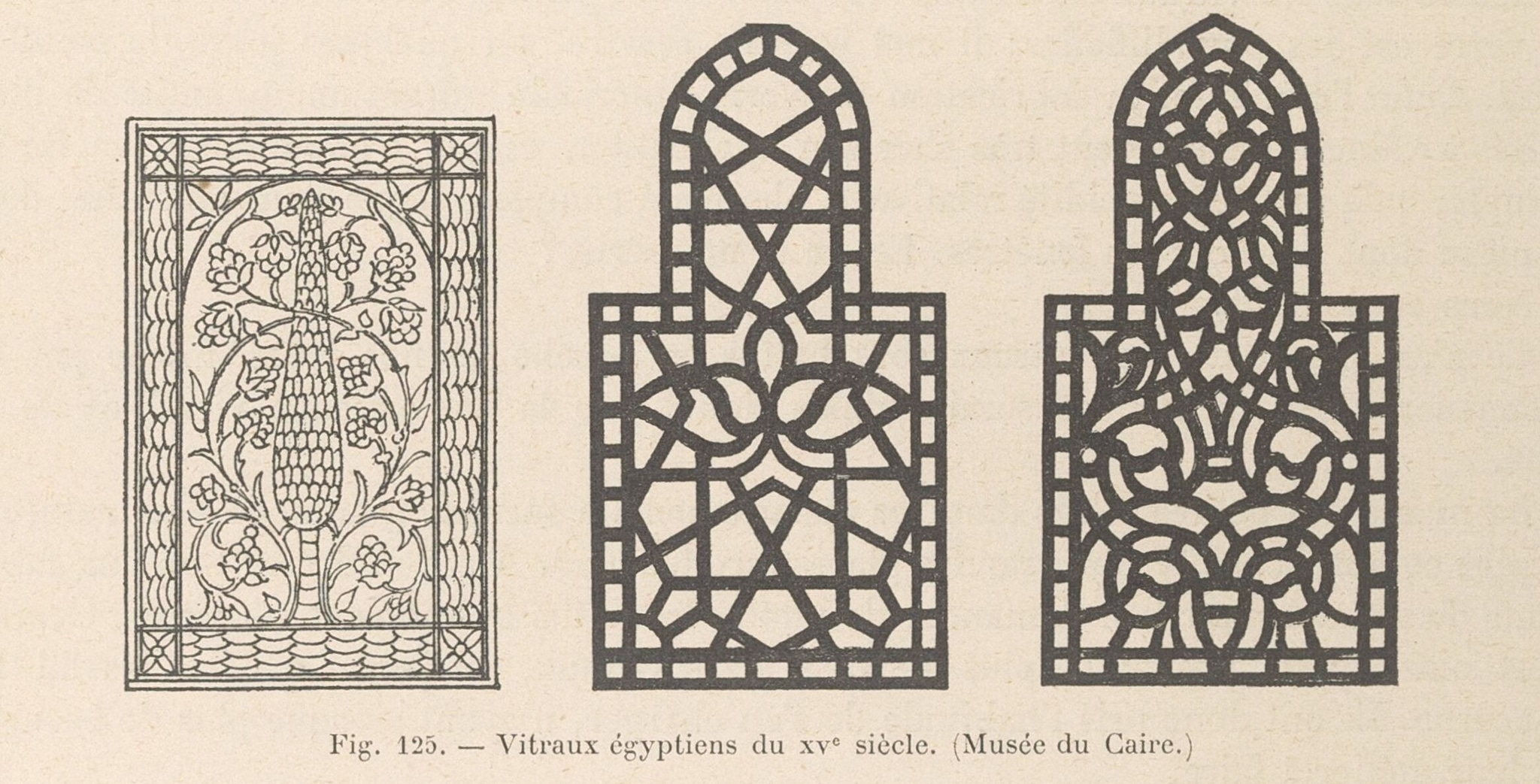
The stained glass artist Léon-Auguste Ottin (1896, pp. 102–103) dedicates a brief paragraph in his book to windows in the ‘Orient’, following a larger history of stained glass. He describes how the glass is not painted and stucco is used instead of lead cames. He then quotes from Albert Gayet’s publication on Islamic Art, L’Art arabe (1893, pp. 179, 226–227; see IG_283). The illustration comes from the same book (figs 83, 84).
In the early francophone literature on the history of stained glass, Islamic stucco and glass windows were occasionally mentioned by authors. Étienne Thevenot reported on window production in Cairo in 1837 (IG_90), and in 1863 Édouard Didron wrote about the windows in the Süleymaniye Mosque in Constantinople and the Dome of the Rock in Jerusalem (see IG_246). Eugène Viollet-le-Duc (1868, p. 374) also briefly mentions Islamic stucco and glass windows in his contribution to the Dictionnaire raisonné de l’architecture française du XLe au XVIe siècle on ‘vitrail’, while in the germanophone literature these were only first mentioned in Heinrich Oidtmann’s Die Glasmalerei. Allgemein verständlich dargestellt (1898, pp. 11–12; IG_330). Ottin, however, does not add any observations of his own, but simply adopts the text by Albert Gayet.
In 1897, Ottin took up the subject again in the Journal de la peinture sur verre. In the second part of his essay on the origins of stained glass, he discusses the continuity of coloured-glass windows from Byzantine to Islamic art. He then cites several authors: Pierre Loti’s description of stucco and glass windows in Jerusalem (Loti, 1895, pp. 72–73; see IG_426); Albert Gayet, at length; and finally Melchior de Vogüé’s publication, also on Jerusalem (see IG_70). In this way, Ottin brought the work of authors who write about Islamic art and architecture closer to an audience interested in stained glass.
Dating
1896
Related Locations
Place of Manufacture