Description
Rectangular stucco and glass window with a regular scale pattern. The motif is framed by a semicircular arch. The spandrels above the arch are each decorated with three leaves.
Iconclass Code
Iconclass Keywords

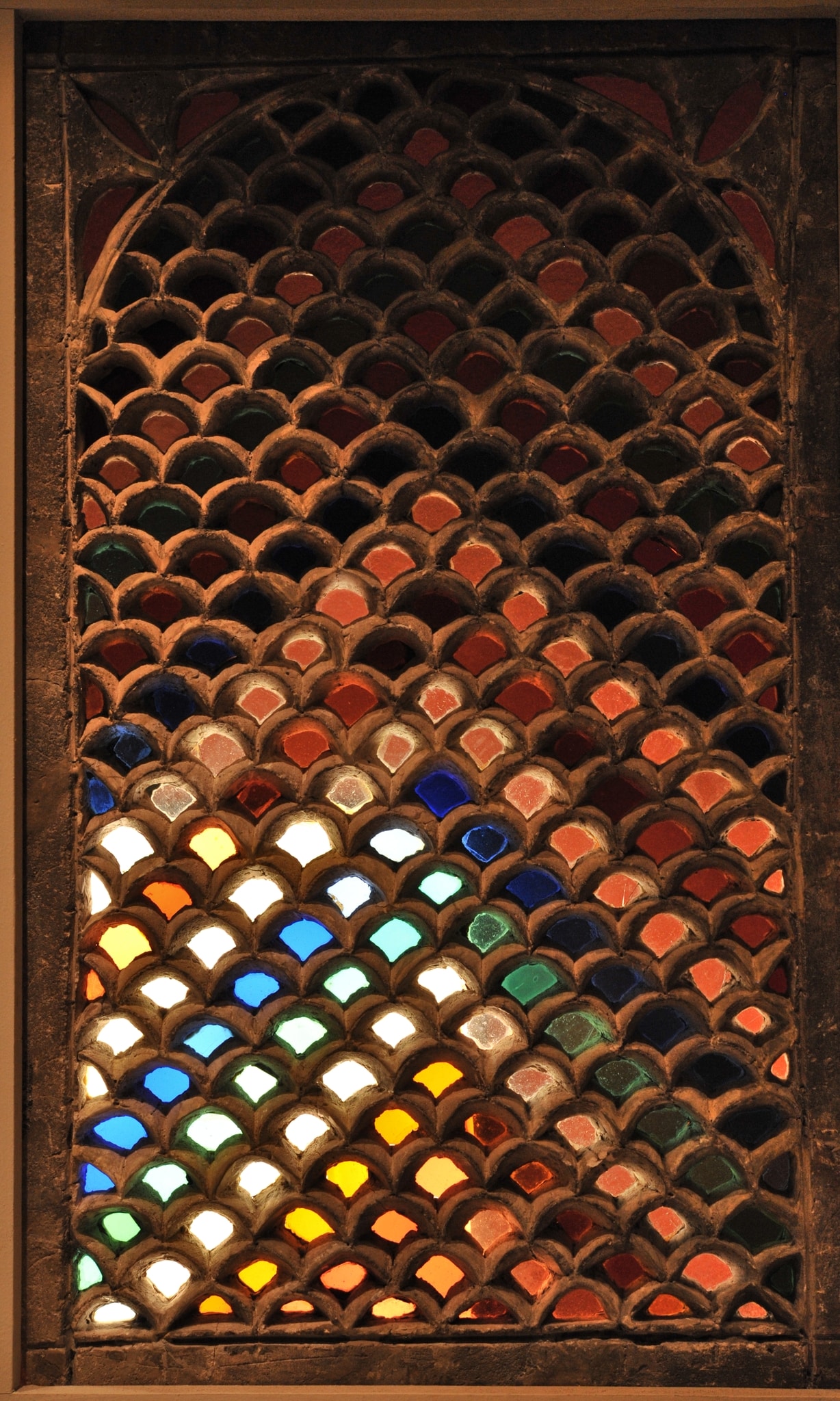
Rectangular stucco and glass window with a regular scale pattern. The motif is framed by a semicircular arch. The spandrels above the arch are each decorated with three leaves.
Gypsum plaster; colourless glass (some pieces having a greyish or greenish tint); coloured glass (two shades of blue, two shades of green, several shades of yellow including orange colour, two shades of light red, probably flashed glass)
The latticework was carved into a rectangular stucco panel with a porous surface and inlaid with colourless and coloured sheet. The pieces of glass are fixed onto the back with a thin layer of gypsum plaster.
The thickness of the stucco panel is c.28–30mm. Unlike most stucco and glass windows, this window does not have a wooden frame.
The design of the latticework has been carved out of the stucco panel with sharp, knife-like tools following a template incised in the surface of the panel. Traces of the incisions are still visible in some places on the front. The design has been worked in such a way that the incident light is directed downwards into the room.
The pieces of glass were cut according to the design of the latticework using a glass-cutter. Scratch marks along the edges of some of the pieces of glass testify to this process. The glass sheets are most likely mouth-blown. Elongated parallel bubbles suggest that the broad-sheet method was used to produce the sheet glass. The coloured glass (2.5–3mm) is slightly thicker than the colourless (c.2mm).
The stucco latticework is intact. Minor losses on the front of the latticework have been filled with a fine-grained greyish material (plaster?). The back of the window also shows repairs. The repairs involved replacing missing or broken pieces of glass and filling losses in the thin plaster layer in which the pieces of glass are embedded. In many places, the plaster layer is stained yellow to brown, suggesting that these areas were consolidated with an adhesive.
This stucco and glass window is the only example with a purely ornamental design consisting of a continuous scale pattern among the collections studied. This may have to do with the fact that collectors favoured windows with more complex compositions and figurative motifs.
The production technique of the window corresponds with the traditional method used in the manufacture of qamariyyāt in North Africa to this day (see Technique).
According to the museum records, the window probably dates to the 17th century. However, there are some indications that point to a later production date. Firstly, the good state of preservation of the stucco lattice, which would have shown clearer signs of weathering if it had been installed and exposed to the elements for a longer period of time, and secondly, the use of cylinder-blown flat glass (also called broad-sheet). In the Islamic world, sheet glass was usually produced using the crown-glass process, while in Europe, the broad-sheet method was the dominant technique to manufacture flat glass. The Hungarian architect Max Herz (1856–1819) states that sheet glass was imported to Egypt from Europe from the 19th century, because local production had come to a standstill (Herz, 1902, p. 53).
A hand-written letter dated 22 May 1893 to Luigi Palma di Cesnola (1832–1904), the then director of The Metropolitan Museum of Art in New York provides information on the provenance of the window. The author of this letter, the American architect William Robert Ware (1832–1915), writes that he had acquired this and various other windows in the spring of 1890 from several well-known art and antiquity dealers in Cairo. He mentions [Gaspare] Giuliana, [E. M.] Malluk, [Nicolas?] Tano, and [Panayotis] Kyticas (on their commercial activities see Volait, 2021, pp. 60–64). In his letter, Ware further states that he was told that the windows ‘had been taken from old houses’ and ‘from old mosques, that had been dismantled’, but that he was not able to get ‘any precise information as to their original places’ (Ware, 1893).
In 1893, Ware donated this window as part of a lot of 17 qamariyyāt (IG_169, IG_171–186) to The Metropolitan Museum of Art (Ware, 1893).
Herz, M. (1902). Le musée national du Caire. Gazette des Beaux-Arts, 3. Pér. 28, 45–59, 497–505.
Volait, M. (2021). Antique Dealing and Creative Reuse in Cairo and Damascus 1850–1890. Leiden: Brill.
Ware, W. R. (1893, May 22). [Letter to Luigi Palma di Cesnola]. MET Archives (W 229), New York City, NY, United States.