Image Ordered

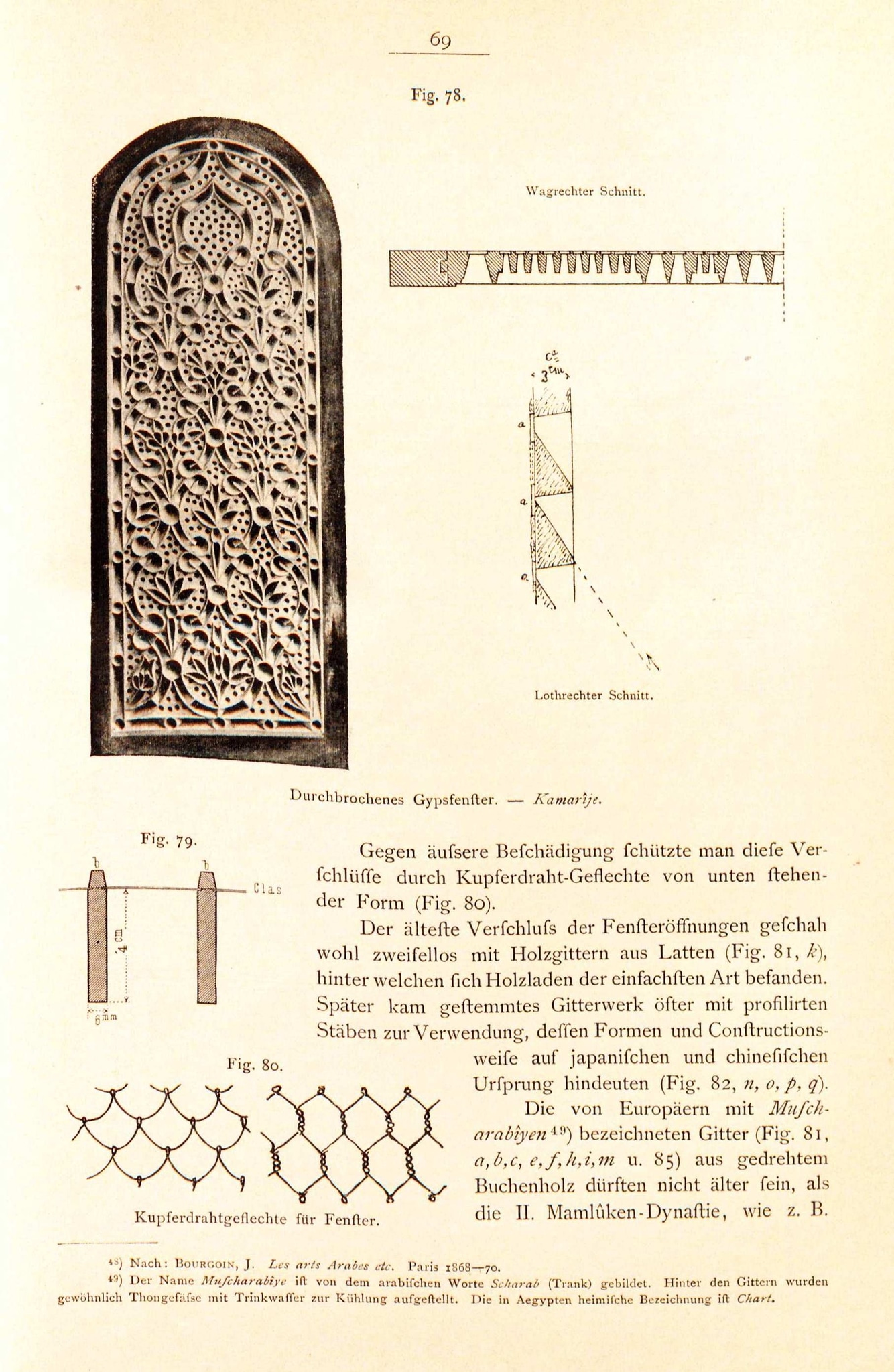
IG_164: Book illustration: Durchbrochenes Gypsfenster. – Kamarîje
(MISC_IG_Franz_1896_IG_164)

Contact Details

Please specify your first name.
Please specify your name.
Please specify your e-mail address.
The e-mail address is invalid.

Please provide as much information as possible (publication title, database, publisher, edition, year of publication, etc.).

The Vitrocentre Romont can only provide you with its own photographs. We regret that we cannot supply images from third parties to you. If your order concerns photographs from third parties, we will send you the contact address from which the images can be obtained.

The personal data you provide in this form will be used by Vitrocentre Romont exclusively for the processing of your image order. Correspondence regarding the order will be archived for internal reference. The data will not be used for purposes other than those listed here, nor will it be passed on to third parties. By sending the order form, you agree to this use of your personal data.

Should you have any questions, please send us an e-mail: info@vitrosearch.ch.

Title

‘Durchbrochenes Gypsfenster. – Kamarîje’

Type of Object
Dimensions
27 x 20 cm
Artist / Producer
Franz, Julius · Author
Dating
1896
Research Project
Author and Date of Entry
Sarah Keller 2025

Iconography

Description

Page with illustrations in Julius Franz, Die Baukunst des Islam, 2nd ed., 1896, p. 69, figs 78, 79. The illustrations show a stucco and glass window and the technique for cutting their stucco profiles.
The round-arched qamariyya shows a pattern of curlicues and flowers.

Iconclass Code
25G41 · flowers
48A9813 · ornament ~ round and curved forms
Iconclass Keywords

History

Research

This page in Julius Franz’ second edition of Die Baukunst des Islam shows four illustrations, two already known from the first edition. A new technical drawing (fig. 79) demonstrates how the pieces of coloured glass were attached by means of ‘Gypswürstchen’ (strips of plaster, marked with a ‘b’) on the reverse of the stucco plate (Franz, 1896, pp. 67–68). This method was also described by Max Herz (1895, p. 8; see IG_160), shortly before the publication of the second edition, as the older of two techniques for the production of stucco and glass windows.
Furthermore, a photograph newly added for the second edition shows a qamariyya with a pattern of curlicues and flowers. The same qamariyya appears on one of Beniamino Facchinelli’s photographs (IG_205) of the collection of the Museum of Islamic Art in Cairo, which was still located in the Al-Hakim Mosque at the time. A window with identical design is preserved in The Metropolitan Museum in New York since 1893 (IG_169).

Dating
1896
Related Locations

Bibliography and Sources

Literature

Franz, J. (1887). Die Baukunst des Islam. Handbuch der Architektur II, 3, 2 (2nd ed. 1896). Darmstadt: Arnold Bergsträsser.

Herz, M. (1895). Catalogue sommaire des monuments exposés dans le Musée national de l'art arabe. Cairo: G. Lekegian & Cie.

Image Information

Name of Image
MISC_IG_Franz_1896_IG_164
Copyright
Public Domain

Citation suggestion

Keller, S. (2025). ‘Durchbrochenes Gypsfenster. – Kamarîje’. In Vitrosearch. Retrieved December 5, 2025 from https://vitrosearch.ch/objects/2713008.

Record Information

Reference Number
IG_164