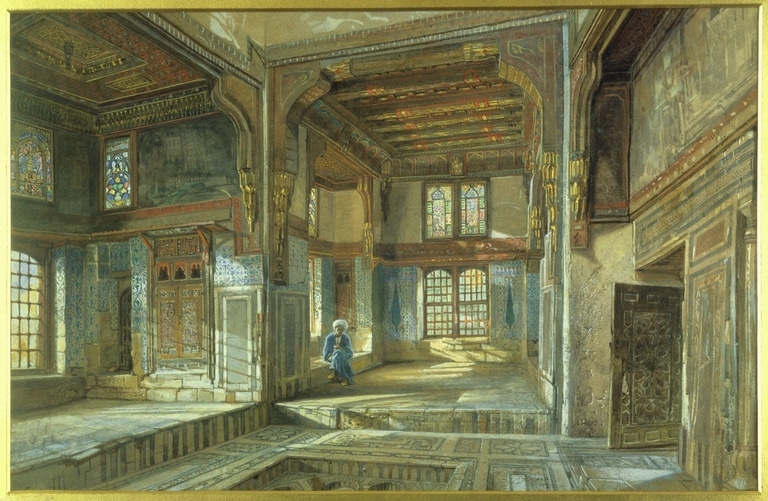
This interior depicted by Frank Dillon represents the mandarah in the ‘House of the Mufti’ in Cairo – so named because it was owned by the supreme mufti of Egypt, Sheikh Muhammad al-ʿAbbasi al-Mahdi (1827–1897) between 1847 and 1886 (Llewellyn, 1998, p. 154). During the 19th century, Europeans had become familiar with the term mandarah through Edward William Lane: ‘In general, there is, on the ground-floor, an apartment called a mun’dar’ah, in which male visitors are received’ (Lane, 1836, p. 11). According to Mercedes Volait, the ‘House of the Mufti’ was built at the beginning of the 18th century, between 1704 and 1705 (a date that can be found on a column in the residence) and had been given to Sheikh al-ʿAbbasi when he became Grand Mufti in 1848 (Volait, 2021, p. 119). Dillon travelled to Egypt several times in the 1850s to the 1870s and visited the house while he was in Cairo (Thomas, 2013, pp. 59–60). One of his drawings of the house is dated 26 December 1873 (Victoria and Albert Museum, 856-1900).
Dillon’s watercolour was reviewed by numerous contemporary art critics: the London-based The Art Journal reported on the authenticity of Dillon’s work: ‘The picture represents the liwan or daïs of a Cairo house; and every minutest detail is worked out by the painter with the strictest fidelity, which does not, however, exclude artistic management of brilliant hues of colour.’ (Anonymous, 1873, p. 239). In the London-based literary magazine The Athenaeum, Dillon’s watercolour was lauded by the Anglo-Indian official and writer Sir George Christopher Molesworth Birdwood (1832–1917): ‘Mr. F. Dillon has not before represented Oriental interiors so successfully as in House of the Mufti Sheikh el Mahadi, Cairo (37), a sunlit interior, with latticed windows, tiled walls, carpet-laden floors, couches, and the like. This is brilliantly and delicately painted, with unusual clearness and breadth of light and colour. The figures are unworthy of the rest of the work, for they are incorrectly drawn and rather clumsily painted.’ (Birdwood, 1874, p. 582). The windows in the Sheikh’s house received the attention of Dillon’s contemporary, Richard Phené Spiers (1838–1916), who described them as follows: ‘In the House of the Mufti the mandarah is lighted by windows on three sides of the principal decision, and also, in the upper portion of the durka’ah, by windows known as ‘kamareeyehs,’ which are formed of pieces of coloured glass sunk in an arabesque pattern, in which gypsum takes the place of lead, as in our leaded lights or windows.’ (Spiers, 1890, p. 236).
The watercolour was widely disseminated at the end of the 19th century: it was reproduced in 1880 with the title Mandara des Mufti (Schech el-Mahdi) as a wood engraving in Aegypten in Bild und Wort (Stuttgart and Leipzig: Hallberger 1880, vol. 2, p. 89) (IG_152) by the German Egyptologist and novelist Georg Ebers (1837–1898).
In a broader context, the ‘House of the Mufti’ became a popular painting subject for artists travelling to Egypt during the 19th century. It was painted, for example, by Theodor Zeerleder (IG_471, IG_473), František Schmoranz (IG_415), and Franz von Lehnbach (Palastinterieur in Kairo, 1876, oil on board, 88 × 70cm, Lenbach-Nachlass im Familienbesitz, reproduced in Baranow 1986, p. 130). The Sheikh’s house was also documented in a contemporary photograph by an anonymous artist, in which a stucco and glass window is partially visible on the right side of the picture (IG_476). Dillon also depicted the Sheikh’s house in another watercolour (IG_99).
c. 1873