Image Ordered

IG_15: Stucco and glass window with curlicues and flowers
(FRA_Paris_MuseeDuLouvre_IG_15)

Contact Details

Please specify your first name.
Please specify your name.
Please specify your e-mail address.
The e-mail address is invalid.

Please provide as much information as possible (publication title, database, publisher, edition, year of publication, etc.).

The Vitrocentre Romont can only provide you with its own photographs. We regret that we cannot supply images from third parties to you. If your order concerns photographs from third parties, we will send you the contact address from which the images can be obtained.

The personal data you provide in this form will be used by Vitrocentre Romont exclusively for the processing of your image order. Correspondence regarding the order will be archived for internal reference. The data will not be used for purposes other than those listed here, nor will it be passed on to third parties. By sending the order form, you agree to this use of your personal data.

Should you have any questions, please send us an e-mail: info@vitrosearch.ch.

Title

Stucco and glass window with curlicues and flowers

Type of Object
Dimensions
14 x 60 x 2 cm
Artist / Producer
Place of Manufacture
Dating
Late 13th–early 14th centuries AH / late 19th century CE
Location
Inventory Number
OA 7466/15
Research Project
Author and Date of Entry
Francine Giese, Sophie Wolf 2025

Iconography

Description

Oblong stucco and glass window with floral ornamentation that is surrounded on three sides by a bi-colour frame in green and red. Six pairs of alternating concave and convex curlicues are arranged in a line. Every pair of curlicues encloses a four-petalled flower in green. The flowers are surrounded by a perforated background, which is slightly recessed. An ornament formed of three orange leaves flanks the curlicues on both sides.

The latticework is painted with brown paint and possibly a dark varnish (see Research).

The window has been restored and is preserved without its original wooden frame (see Technique and Research).

Iconclass Code
25G41 · flowers
48A9813 · ornament ~ round and curved forms
Iconclass Keywords

Materials, Technique and State of Preservation

Materials

Gypsum plaster; colourless glass; coloured glass (green, two shades of blue, dark yellow, two shades of red flashed glass), brown paint, varnish; textile (cotton fabric).

Technique

Stucco panels are produced according to the traditional production technique described by several authors (for example, Foy 2005, pp. 152–154), by pouring gypsum plaster into a frame, which is usually made of wood and has a hollow profile. The design is usually transferred to the stucco panel using stencils and then carved as an openwork relief using various tools (gouge, serrated knife, chisel, file, etc.). Depending on the height and position of the window in the room, the openings are tapered and oriented in such a way that they direct light towards the viewer. The individual openings are then covered with pieces coloured sheet glass on the flat, rear of the panel; sometimes one glass piece covers several smaller holes. The pieces are fixed to the stucco panel by being embedded in a thin layer of gypsum plaster. Stucco and glass windows are usually mounted in window openings in their wooden frames, with the sculpted side facing the inside of the room.

The object described here is not framed. According to a detailed examination (Bailly et al., 2008), all but one of the stucco and glass windows (OA 7466/39, IG 168) in the Delort de Gléon Collection were removed from their wooden frames at an unknown date. The lack of round profiles to the now straight edges of the 18-mm-thick stucco lattice corroborates this hypothesis.

The plaster layer fixing the pieces of glass to the back of the panel is 2–3mm thick; its colour is off-white (cream-coloured). The plaster layer is not original; it was applied during a restoration that involved the insertion of a cotton fabric between the stucco panel and the glass, probably done to reinforce the fragile stucco latticework (Bailly et al., 2008, p. 32).

The latticework is laid out on two levels: the main design (level 0) was carved out of the stucco panel using a sharp, knife-like tool. The second level (level –1), which lies 4mm below level 0, shows irregularly spaced, conical perforations with diameters of c.4–5mm. The distances between the holes range between 1 and 6mm. The holes seem to have been pierced – rather than drilled – into the still soft (not fully set) stucco using a metal or wooden nail or pin. They are slightly tapered towards the back. The main design and the perforations have been worked in such a way that the incident light is directed downwards, indicating that the window was made to be positioned in the upper part of the wall. At an unknown date, the front of the latticework was painted brown.

The pieces of glass are of both colourless and coloured glass; the colours include cobalt blue, green, dark yellow, and red. Flashed glass, that is, glass composed of a thicker layer of transparent glass and a thinner layer of strongly coloured material, has been used for the red pieces, and maybe also for the cobalt-blue ones (see Bailly et al., 2008, p. 10). Some of the pieces of glass show small, elongated and parallel bubbles characteristic of mouth-blown sheet glass, probably produced using the broad-sheet method. The pieces of glass were cut according to the design of the latticework using a diamond cutter, which left scratch marks on some of them.

State of Preservations and Restorations

The stucco and glass window is in good condition: the plaster lattice is intact, and the glass does not show any losses or defects.

According to the results of an in-depth examination of the stucco and glass windows in the Delort de Gléon Collection carried out in 2008, all the windows have been restored five times since their acquisition in Cairo, involving the reinforcement of the fragile plaster lattice with textile, cotton fabric in most cases (Bailly et al., 2008, pp. 16–25, 32). The fabric, which is perforated according to the design, was inserted between the back of the latticework and the glass and fixed to the panel with glue. In the process, the original plaster layer fixing the pieces of glass to the back of the panel was completely removed – together with the pieces of glass – and replaced with a new plaster embedding layer for the pieces of glass. There are no remains of the original plaster layer.

The most recent restoration was carried out after this detailed examination, in around 2009 (Fellinger et al., 2022).

History

Research

This stucco and glass window corresponds iconographically and technically to one of the standard types of qamariyya widespread in Egypt during the Ottoman period. The representation of curlicues and flowers is a recurring motif of Islamic stucco and glass windows. Compositions can be found with arrangements of convex and concave curlicues, in one or more rows, accompanied by different types of flowers. Similar compositions are to be found in several of the collections studied (IG_10, IG_41, IG_169, IG_254) and are prominently depicted in Arthur Melville’s painting An Arab Interior of 1881 (IG_93). Common to all windows of this type is the symmetrical distribution of curlicues and flowers that create a repeating pattern.

The Louvre window discussed here differs from the other windows of this type in that the curlicues are not arranged in a vertical row, but horizontally in pairs. Owing to the oblong shape of the stucco panel, it must have been used as a framing element within a window composed of several panels, as IG_10. The colours and material properties of the glass and the stucco latticework – although heavily restored – suggest that the window dates to the late 19th century. This assumption is supported by the results of an analytical study of glass from two stucco and glass windows from the Louvre collection (OA 7466/7, OA 7466/25) conducted by a team from the Musée du Louvre (Fellinger et al., 2022).

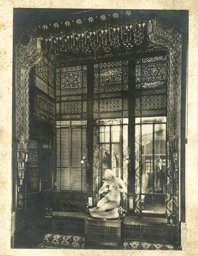
As to its provenance, the window is one of 39 qamariyyāt supposedly bought in Cairo by the architect Ambroise Baudry (1883–1906) for the French civil mining engineer and art collector Baron Alphonse Delort de Gléon (1843–1899) (Bailly et al., 2008, pp. 16–24). They adorned the Ottoman salon of Delort de Gléon’s hôtel particulier, purchased in 1883, at rue Vézelay 18 in Paris (Volait, 2005, pp. 131–134; Volait, 2009, pp. 99–104, 130–135). This is confirmed by several historical photographs preserved at the Département des Arts de l’Islam (DAI) of the Musée du Louvre, which show the windows inserted in the upper parts of wooden mashrabiyyāt (see Linked Objects and Images). The salon was designed by the baron himself in collaboration with the French architect Jules Bourgoin (1838–1908). The creation of orientalizing interiors, composed of original architectural elements and furnishings as well as replicas of the same, was a widespread practice among Western art collectors at the time (Giese, 2016; Volait, 2016; Giese, 2019).

Based on the photographs mentioned and the presumed date of the windows, one may assume that the windows were created especially for Delort de Gléon’s Arab-style interior and had never been part of a historical building in Cairo. The complete history of these windows however, including possible multiple reuses and several restorations, is difficult to reconstruct. Based on the unpublished study by Bailly et al. (2008) and our own observations, it seems that most of the windows have been cut from their wooden frames. Extensive repairs to the stucco grille, as well as the complete replacement of the thin plaster layer for embedding the pieces of glass at the back of the panel, are proof of several restoration campaigns. It is likely that the brown paint on the stucco lattice is not original, but was applied during restoration, with the intention of adapting the windows to new surroundings. The varnish is probably also the result of a restoration campaign, possibly before the Louvre exhibition in 1977, and may have been applied to match the colour of the wooden mashrabiyya in which the windows were displayed.

After the collector’s death, the stucco and glass window passed to his wife Marie Augustine Angélina Delort de Gléon, who bequeathed it as part of Delort de Gléon’s collection of Islamic art to the Musée du Louvre in 1912 (Delort de Gléon, 1914).

Dating
Late 13th–early 14th centuries AH / late 19th century CE
Period
1880 – 1899
Previous Locations
Related Locations
Place of Manufacture

Provenance

Owner
Since 1912: Museum of the Louvre, Inventory Number: OA 7466/15, Paris (France), Donation L1
Previous Owner
From 1883 (ca.) until 1899: Delort de Gléon, Alphonse, Paris (France)
Provenance Footnotes
L1 Delort de Gléon, 1914

Bibliography and Sources

Literature

Bailly, M., Frenkel, N., Gaymay, S., Hamadène, F., Liégey, A., Picur, V., Setton, J. M., & Tréluyer, V. (2008). Rapport d’etude concernant la collection des vitraux [unpublished research report]. Musée du Louvre, Département des arts de l’Islam.

Delort de Gléon, M. A. A. (1914, March 9). Legs de la collection de M. Delort de Gléon (Cote 20144787/17), Archives de musées nationaux (AMN), Archives nationales, Pierrefitte-sur-Seine, France.

Fellinger, G., Juvin, C., Bouquillon, A., Dallel, M., Loisel, C., Trichereau, B. & Groupement solidaire Setto (2022). Éclats de lumière : étude et restauration de vitraux égyptiennes du musée du Louvre. Technè 54, 114–125.

Giese, F. (2016). From Style Room to Period Room: Henri Moser’s fumoir in Charlottenfels Castle. In: S. Costa, D. Poulot, & M. Volait (Eds.), Period rooms. Allestimenti storici tra arte, gusto e collezionismo: Atti del Convegno Internazionale, Bologna, 18-19 aprile 2016 (pp. 153–160). Bologna: Bolonia University Press.

Giese, F. (2019). International Fashion and Personal Taste. Neo-Islamic Style Rooms and Orientalizing Scenographies in Private Museums. In Giese, F., Volait, M. and Varela Braga, A. (eds.), À l’orientale. Collecting, Displaying and Appropriating Islamic Art and Architecture in the Nineteenth and Early Twentieth Centuries (Arts and Archaeology of the Islamic World, 14), Leiden: Brill, pp. 92–110.

Volait, M. (2005). La rue du Caire. In Bacha, M. (ed.). Les Expositions Universelles à Paris, de 1855 à 1937 (pp.131-134). Paris : Action artistique de la Ville de Paris.

Volait, M. (2009). Fous du Caire. Excentriques, architectes & amateurs d’art en égypte 1863–1914. L’Archange Minotaure.

Volait, M. (2016). Les intérieurs orientalistes du comte de Saint-Maurice et d’Albert Goupil: des ‘Cluny arabes’ au Caire et à Paris à la fin du XIXe siècle. In S. Costa, D. Poulot & M. Volait (Eds.), The Period Rooms: Allestimenti storici tra arte, collezionismo e museologia (pp. 103–114). Bononia University Press.

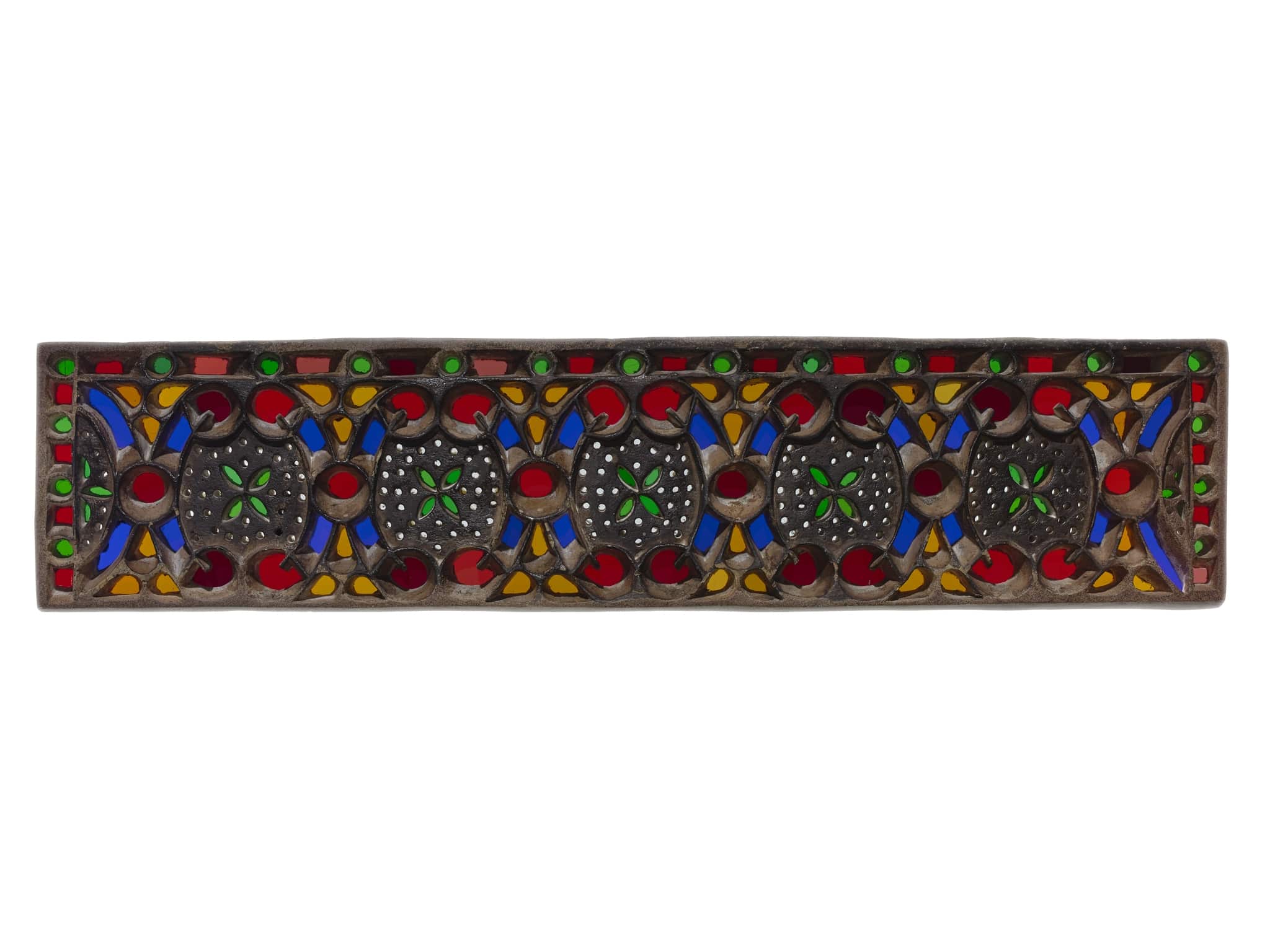
Image Information

Name of Image
FRA_Paris_MuseeDuLouvre_IG_15
Credits
© 2021 Musée du Louvre / Hervé Lewandowski
Date
2021

Linked Objects and Images

Additional Images
Paris, Hôtel particulier Delort de Gléon, Ottoman salon

Citation suggestion

Giese, F., & Wolf, S. (2025). Stucco and glass window with curlicues and flowers. In Vitrosearch. Retrieved December 5, 2025 from https://vitrosearch.ch/objects/2712859.

Record Information

Reference Number
IG_15