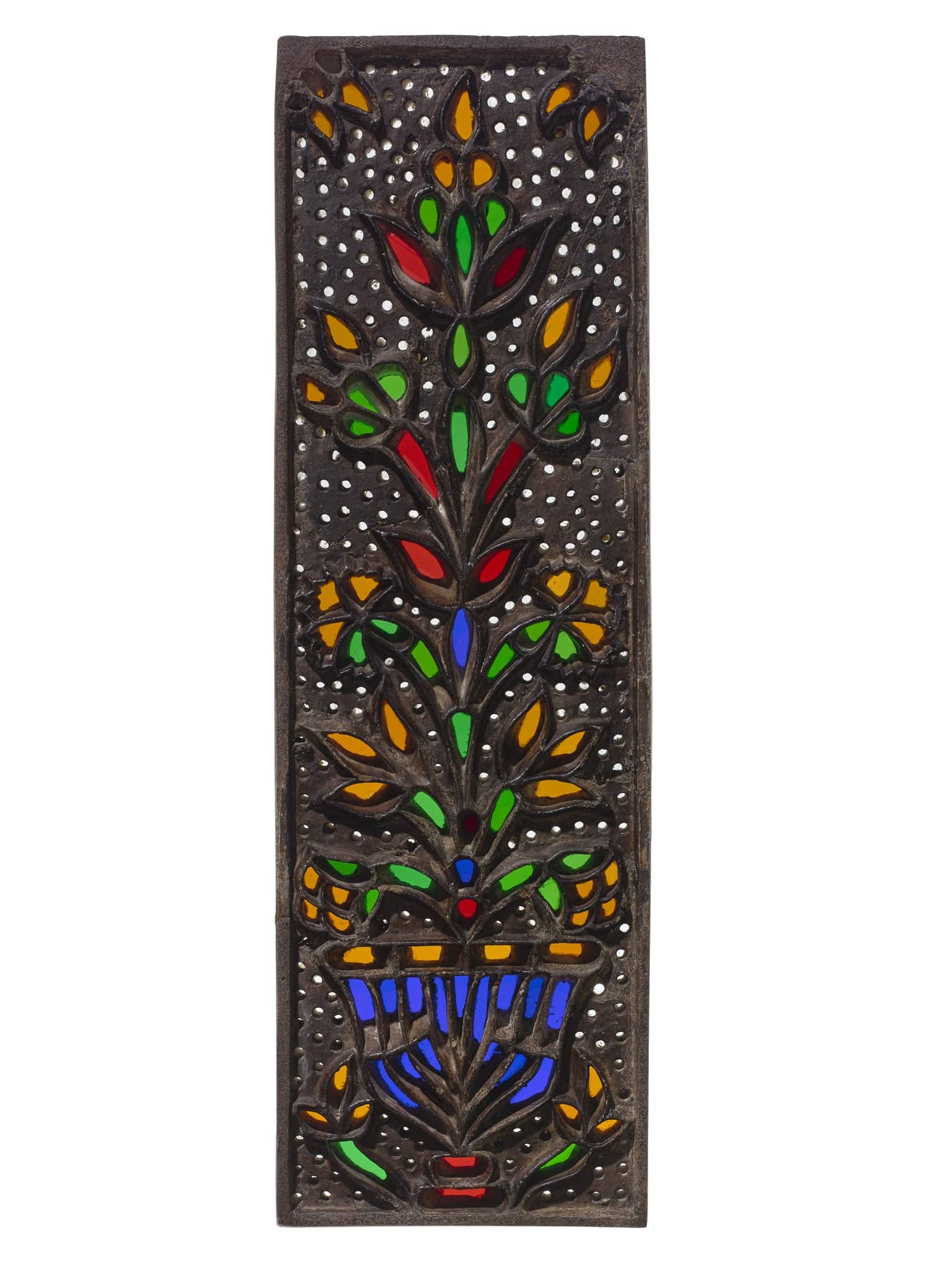
This stucco and glass window corresponds iconographically and technically to one of the standard types of qamariyya widespread in Egypt during the Ottoman period. Similar windows have survived in several of the collections studied (see for instance IG_7, IG_166, IG_178, IG_255, IG_356). The representation of flowers in a vase is a widespread motif in Islamic arts that can be found across numerous media, such as ceramics, wood panelling, wall paintings, textiles, and stucco and glass windows, over a long period of time, in both sacred and profane contexts. Depending on the quality of the representation, the flower species are not always recognizable. Among the most sophisticated examples are the stucco and glass windows from the apartments of the Crown Prince at the Topkapı Serail (early 17th century CE, date of the windows uncertain) and the Sultan’s Lodge (Hünkâr Kasrı) of the Yeni Cami (1661–1663 CE, date of the windows uncertain), both in Istanbul.
Windows of this type also aroused the interest of Western artists and architects, as is attested by a significant number of book illustrations, sketches, and paintings (see for instance IG_43, IG_118, IG_149, IG_153, IG_437, IG_443, IG_461), as well as by the replicas of such windows installed in Arab-style interiors across Europe (IG_54–IG_59, IG_64, IG_431, IG_484–IG_487).
The Louvre window discussed here differs from other windows of the same type because of its elongated shape, which indicates its use as a framing element for a central stucco and glass panel. This explains why, instead of a bouquet of several flowers, only one vertical flower stem in bloom is depicted. An almost identical composition can be found in the stucco and glass window OA 7466/28 (IG_29), also held at the Musée du Louvre, which was most probably made at the same workshop. The colours and material properties of the glass and the stucco latticework – although heavily restored – suggest that the window dates to the late 19th century. This assumption is supported by the results of an analytical study of glass from two stucco and glass windows from the Louvre collection (OA 7466/7, OA 7466/25) conducted by a team from the Musée du Louvre (Fellinger et al., 2022).
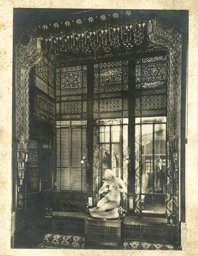
As to its provenance, the window is one of 39 qamariyyāt supposedly bought in Cairo by the architect Ambroise Baudry (1883–1906) for the French civil mining engineer and art collector Baron Alphonse Delort de Gléon (1843–1899) (Bailly et al., 2008, pp. 16–24). They adorned the Ottoman salon of Delort de Gléon’s hôtel particulier, purchased in 1883, at rue Vézelay 18 in Paris (Volait, 2005, pp. 131–134; Volait, 2009, pp. 99–104, 130–135). This is confirmed by several historical photographs preserved at the Département des Arts de l’Islam (DAI) of the Musée du Louvre, which show the windows inserted in the upper parts of wooden mashrabiyyāt (see Linked Objects and Images). The salon was designed by the baron himself in collaboration with the French architect Jules Bourgoin (1838–1908). The creation of orientalizing interiors, composed of original architectural elements and furnishings as well as replicas of the same, was a widespread practice among Western art collectors at the time (Giese, 2016; Volait, 2016; Giese, 2019).
Based on the photographs mentioned and the presumed date of the windows, one may assume that the windows were created especially for Delort de Gléon’s Arab-style interior and had never been part of a historical building in Cairo. The complete history of these windows however, including possible multiple reuses and several restorations, is difficult to reconstruct. Based on the unpublished study by Bailly et al. (2008) and our own observations, it seems that most of the windows have been cut from their wooden frames. Extensive repairs to the stucco grille, as well as the complete replacement of the thin plaster layer for embedding the pieces of glass at the back of the panel, are proof of several restoration campaigns. It is likely that the brown paint on the stucco lattice is not original, but was applied during restoration, with the intention of adapting the windows to new surroundings. The brown varnish is probably also the result of a restoration campaign, possibly before the Louvre exhibition in 1977, and may have been applied to match the colour of the wooden mashrabiyya in which the windows were displayed.
The installation of orientalizing interiors made of original pieces and replicas was a widespread practice among Western art collectors at the time (Giese, 2016; Volait, 2016; Giese, 2019).
After the collector’s death, the stucco and glass window passed to his wife Marie Augustine Angélina Delort de Gléon, who bequeathed it as part of Delort de Gléon’s collection of Islamic art to the Musée du Louvre in 1912 (Delort de Gléon, 1914).