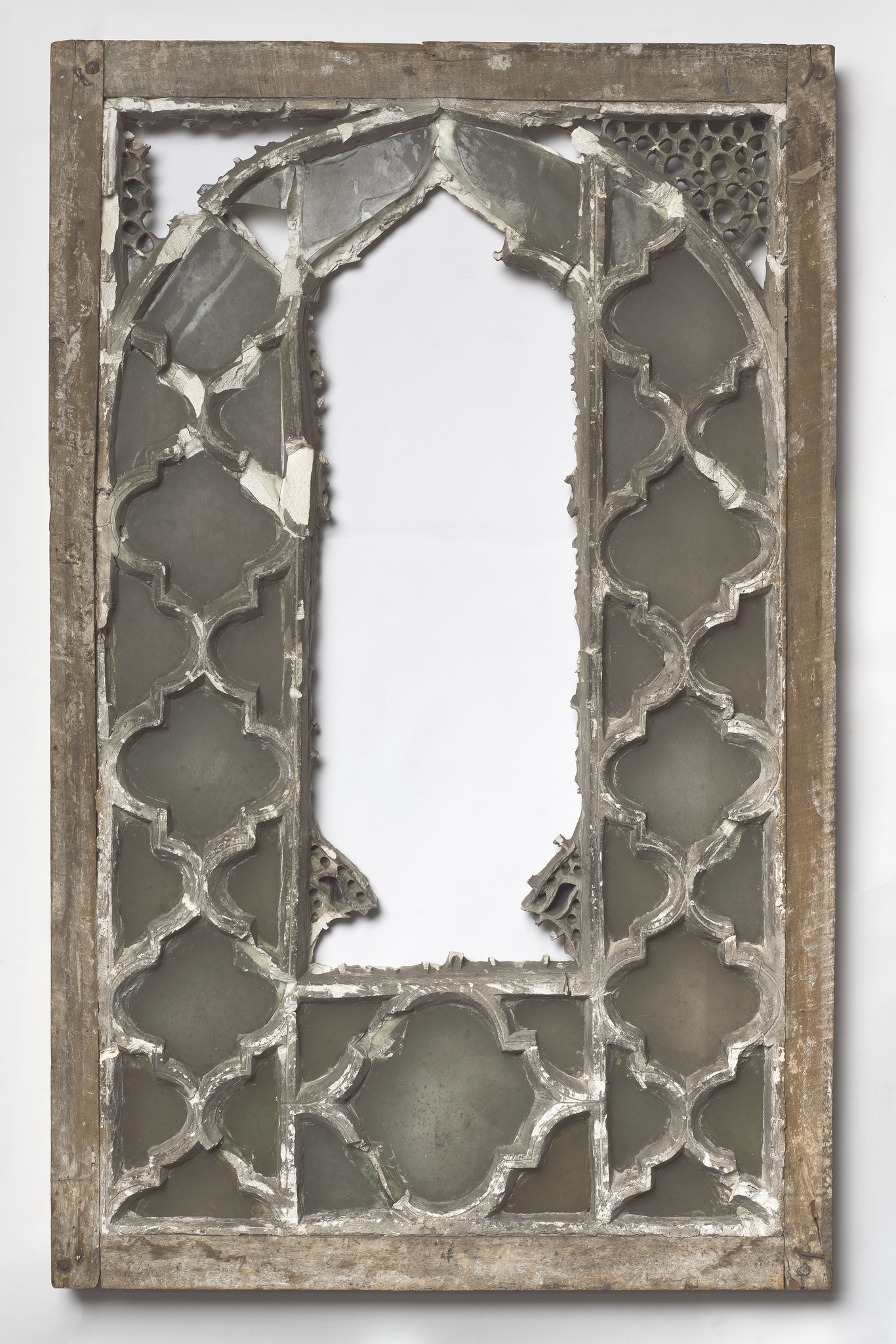
The presumed depiction of flowers in a vase in the main field of this window is one of the standard types of qamariyya widespread in the Middle East during the Ottoman period. Similar windows can be found in several of the collections studied (see for instance IG_7, IG_166, IG_178, IG_255, IG_356).
The representation of flowers in a vase is a widespread motif in Islamic arts. It can be found in numerous other media, such as ceramics, wood panelling, wall paintings, and textiles, over a long period of time, and in both sacred and profane contexts.
Among the most sophisticated examples of stucco and glass windows with the vase motif are those in the apartments of the Crown Prince at the Topkapı Sarayı (early 17th century, date of the windows uncertain) and those in the Sultan’s Lodge (Hünkâr Kasrı) of the Yeni Cami (1661–1663, date of the windows uncertain), both in Istanbul.
Western artists and architects took an interest in stucco and glass windows with the flowers-and-vase motif, as is attested by a significant number of book illustrations, sketches, and paintings (see for instance IG_43, IG_118, IG_149, IG_153, IG_437, IG_443, IG_461), as well as by the replicas of such windows installed in Arab-style interiors across Europe (see for instance IG_54–56, IG_58–59, IG_64, IG_371–372, IG_431, IG_484).
The window discussed here differs from most of these examples on account of its large ornamental frame, which documents the ongoing transformation of Ottoman art and architecture, initiated in the capital in the late 16th century (Bakırer, 2001, pp. 8–15). Comparable ornamentation can be observed, for example, in one of the exterior stucco and glass windows (dişlık) that the Turkish painter, writer, and politician Celal Esad Arseven (1875–1971) illustrated in his influential publication Les arts decoratifs turcs (Arseven, [c.1952], pp. 183–184, fig. 453.4, see also fig. 458) and attributed to the so-called Tulip Period (‘lâle devri’, 1718–1730). Although the combination of a figurative motif with perforated background in the main field and an ornamental frame with large pieces of colourless glass is rare, it can nevertheless be assumed that this window was made in a workshop in Turkey. This assumption is supported by the manufacturing technique. Unlike windows made in Egypt or the Maghreb, the stucco lattice of this window was cast and not carved. Using clay or wooden moulds shaped to match the design of the window, the pieces of glass are clamped between the mouldings of the stucco grille (Arseven, 1939, pp. 207–211; Arseven, [c.1952], pp. 182–189; Özakın, 2007, pp. 95–97). This technique was widespread in Turkey from the 18th century, as was the use of larger, often colourless pieces of glass, reminiscent of the developments in Baroque stained glass. It is therefore very probable that this window was made in the Ottoman capital.
Due to the lack of documentation, the date on which the window entered a museum collection and its provenance are unknown. What is clear so far is that it formed part of the collection of the Orientalisches Museum in Vienna, founded in 1874 (from 1886 the Handelsmuseum), and was subsequently transferred, together with other stucco and glass windows, to the k.k. Österreichisches Museum für Kunst und Industrie (today the MAK – Museum für angewandte Kunst) in 1907, on the initiative of Arthur von Scala (1845–1909), who in 1897 became the new director of the k.k. Österreichisches Museum für Kunst und Industrie (Wieninger, 2012).