Beschreibung
Published in the weekly journal The Builder, vol. XVI, no. 783–784, pp. 88–90, 104–108.
The British architect William Burges describes the mosques of Constantinople as well as their stucco and glass windows.

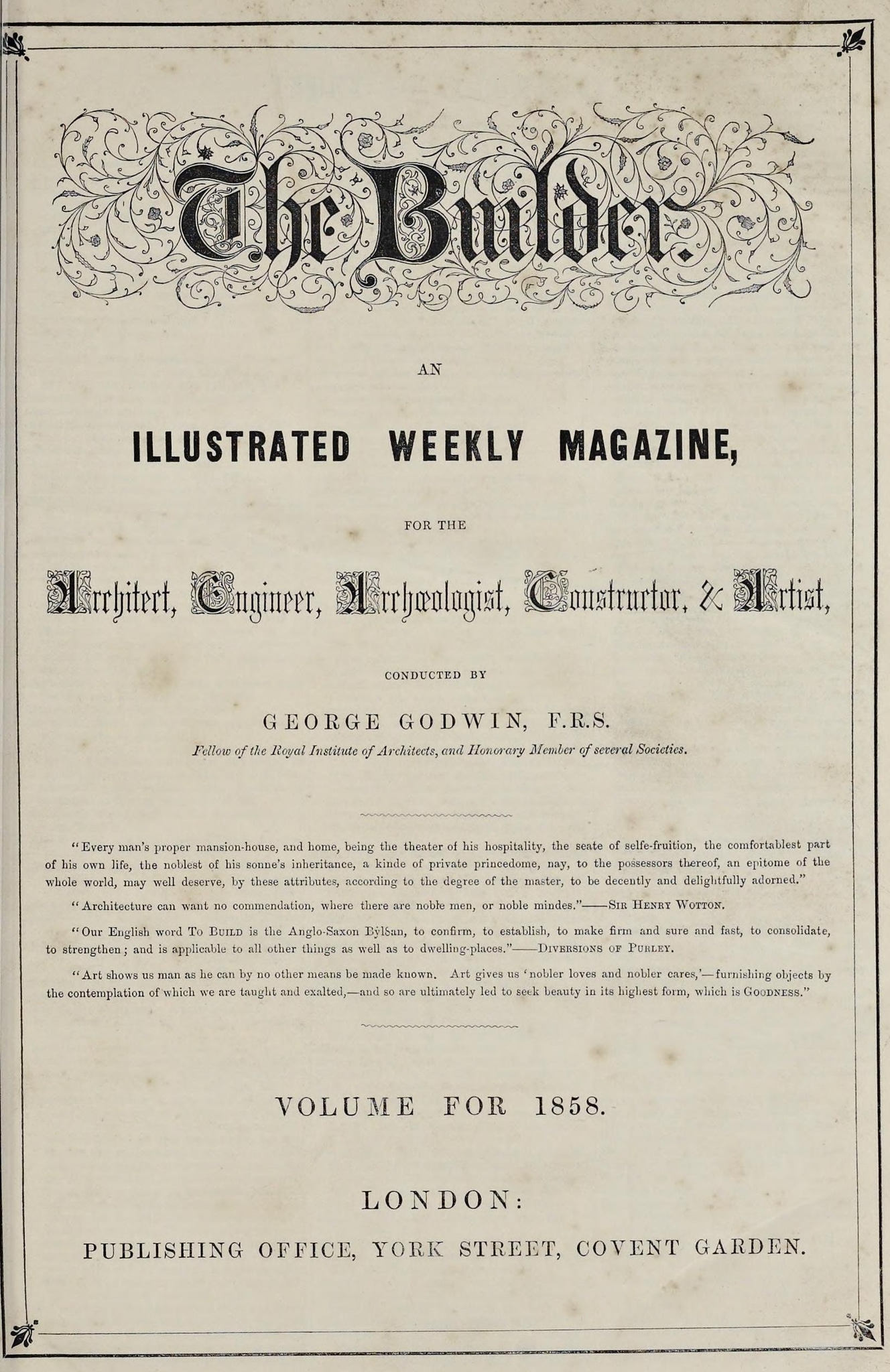
Published in the weekly journal The Builder, vol. XVI, no. 783–784, pp. 88–90, 104–108.
The British architect William Burges describes the mosques of Constantinople as well as their stucco and glass windows.
In 1856–1857, the British architect William Burges travelled to Constantinople, where he worked on designs for the Crimea Memorial Church. He brought a small notebook with him (London, RIBA Archive, SE38/19) and in 1858, in one of his regular pieces for the journal The Builder, he describes several mosques of Constantinople. The windows of the Süleymaniye Mosque, which he describes as the most beautiful, receive special attention.
Burges describes their double glazing, with an outer and an inner window, and their manufacture. Praising their excellent colour effect they impart and fearing that the ‘most famous windows of the [European] Middle Ages would suffer by the comparison’, he explains that their effect is due firstly to the double glazing, which subdues and diversifies the light, and secondly to the projecting stucco grille, which produces a different view of the window with every change of standpoint. Burges also briefly mentions a possible origin of this type of window, from Persia; refers to its prevalence in Egypt and Syria; and comes to the conclusion that they represent a further development from the windows of the Byzantine period, as in the Hagia Sophia (Burges, 1858, p. 89).
In September of the same year, Burges’s essay on Constantinople was translated to German, and a paraphrase of it was published in the Organ für christliche Kunst, 17 (1 September 1858, pp. 196–198).
In 1858, a drawing of the window at the east end of the Mosque of Sultan Suleiman, made on the spot by Burges, was shown at the Architectural Exhibition at Suffolk Street in London (The Builder, 9 January 1858, p. 23). It is probably the same as published by George Aitichison in 1904 as a black and white illustration to his article “Coloured glass” in The Architectural Journal (of the Royal Institute of British Architects, p. 57, fig. 1, see IG_91). A partial replica of a window made by Nathaniel Wood Lavers (1828–1911) and produced under the direction of Burges and Charles Winston was placed in the lantern of the exhibition room (The Builder, 9 January 1858, p. 23, for Winston, see IG_329). Lavers was the co-founder of the stained glass manufactory of Lavers, Barraud & Westlake, and was previously employed at the workshops of James Powell & Sons. The latter workshops had also made replicas of Islamic stucco and glass windows, after drawings by James William Wild (see IG_435; Giese, 2021, p. 97).
As Burges specifies, the window he drew has a pattern in white, which ‘takes the form of a thin flowing line bursting out into leaves of pearls’. He mentions a second drawing, of the central part of a window, with a more intricate pattern, in which the white is applied as ‘a powdering of flowers more or less frequent in various parts’ (Burges, 1858, p. 90).
Although many of William Burges’s drawings and notebooks are preserved at the RIBA Archive in London, the drawings of windows mentioned have not been located to date.
In 1865, Burges started working on the transformation of Cardiff Castle into a neo-Gothic mansion for the Marquess of Bute, including an Arab room. This neo-Islamic interior has four windows that copy the design of Egyptian stucco and glass windows with vases of flowers. Several designs have been conserved (Glamorgan Archives, Drawings collections, William Burges, 13.76, 76a/b, 77, 79). One of the designs is signed by the architect Richard Popplewell Pullan (1825–1888), Burges’s brother-in-law.
Aitchison, G. (1904). Coloured Glass. The Architectural Journal XI(3), 53–65.
Baudri, F. (1858). Die Moscheen Konstaninopels II. In Organ für christliche Kunst, 17, 1. September 1858, 196–198.
Burges, W. (1858). Architectural experiences at Constantinople. The Builder, vol. XVI, n° 783–784, 88–90, 104–108.
Giese, F. (2021). Eastern Light: Western Fascination for Islamic Colored Glass Windows. Manazir Journal, 3, 93–109. https://doi.org/10.36950/manazir.2021.3.7.
Parry, Erfyl ([2023]). Arab Room. Cardiff Castle. Unpublished manuscript. Cardiff Castle.