Research
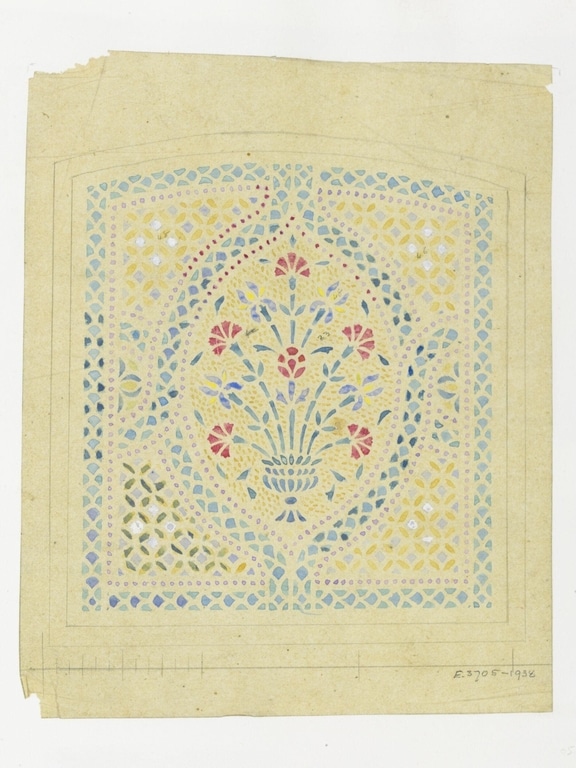
This design by the British architect James William Wild (1814–1892) served as a model for the production of a stucco and glass window in ‘Arab style’ for the Oriental Courts of the South Kensington Museum in London. The London-based firm James Powell & Sons executed the window after Wild’s draft. Records indicate that Wild was not paid for his Oriental Court Arab window until eleven years after the original commission (Physick, 1982, p. 82; Thomas, 2013, pp. 54–56; Giese, 2021, p. 97).
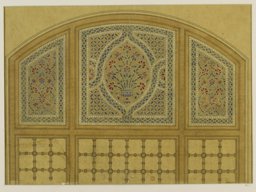
A drawing made by Henry Young Darracott Scott (1822–1883) and dated 1866 shows the same window installed above a mashrabīya screen, with a further, ornamental stucco and glass panel on each side (Victoria and Albert Museum, 8411, IG_425). Colonel (and later Mayor-General) Scott was appointed Director of New Works of the South Kensington Museum in 1865 and therefore responsible for the further expansion of the museum. Wild was working as one of his architects, designing several parts of the new buildings (Bethnal Green Museum, Science Schools, Architectural Courts; Physick, 1982, pp. 145, 148, 157).
Wild had seen and drawn similar windows, with the same almond-shaped frames and carnations, in the Beyt Hassan Pasha in Cairo (IG_440, IG_441). What distinguishes the window for the Oriental Courts from the ones made in Cairo is its shape, which is not rectangular, but ending in a segmental arch.
Dating
1865–1866
Period
1865 – 1866
Place of Manufacture