
Image Ordered

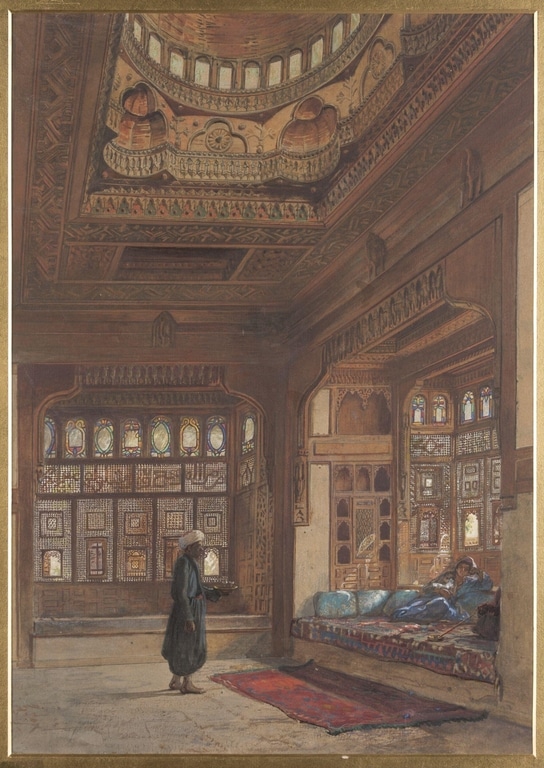
IG_101: An apartment in the harem of the Sheikh Sadat [sic], Cairo
(GBR_London_VAM_IG_101)

Contact Details

Please specify your first name.
Please specify your name.
Please specify your e-mail address.
The e-mail address is invalid.

Please provide as much information as possible (publication title, database, publisher, edition, year of publication, etc.).

The Vitrocentre Romont can only provide you with its own photographs. We regret that we cannot supply images from third parties to you. If your order concerns photographs from third parties, we will send you the contact address from which the images can be obtained.

The personal data you provide in this form will be used by Vitrocentre Romont exclusively for the processing of your image order. Correspondence regarding the order will be archived for internal reference. The data will not be used for purposes other than those listed here, nor will it be passed on to third parties. By sending the order form, you agree to this use of your personal data.

Should you have any questions, please send us an e-mail: info@vitrosearch.ch.

Title

An apartment in the harem of the Sheikh Sadat, Cairo

Type of Object
Artist / Producer
Dating
c. 1873
Location
Inventory Number
862-1900
Research Project
Author and Date of Entry
Sarah Tabbal 2024

Iconography

Description

The watercolour An Apartment in the Harem of the Sheikh Sadat, Cairo by the British painter Frank Dillon (1832–1908) depicts a genre scene in an interior in the ‘house of Sheikh Sadat’. The artist visualizes the residence’s reception chamber (qā*ʿa), with the lattices of a wooden oriel (mashrabiyya*) and colourful stucco and glass windows with geometric motifs. He included some staffage in his painting to give scale (Tromans, 2008, p. 129): a clothed woman resting on a divan, and a barefoot man with a tray in his left hand serving her.

Iconclass Code
41A2 · interior of the house
41A33 · window
41A382 · bay-window, oriel
42Z11 · harem
48C1412 · interior ~ representation of a building
Iconclass Keywords

Materials, Technique and State of Preservation

Technique

Watercolour drawing.

History

Research

Dillon campaigned passionately for the preservation of Islamic architecture when the wave of modernisation imposed by Europe and the local dynasty in the mid-19th century threatened to destroy ‘old Cairo’ (Arnhold, 2008, p. 235). With a view to protecting and recording the city’s ancient buildings, Dillon produced accurate paintings of Cairene domestic interiors in the 1870s. The Cairene house of Sheikh Sadat was also portrayed in several other watercolours by Dillon (IG_100, V&A, 859-1900) and in a pencil drawing (IG_105). One of the watercolours (V&A, 859-1900) is dated 1873.
It was also recorded in contemporary photographs: an outside view of the courtyard taken by the French photographer Félix Bonfils in the 1870s (IG_477) captures the central window of the mashrabiyya of the building on the right, showing it to be largely broken. A photograph with a similar view of the house was taken by the Italian photographer Beniamino Facchinelli (1839–1895) (IG_478). In Dillon’s watercolour however, there is no indication of breakage, as the angle at which the interior is viewed does not reveal this central stucco and glass window.

Dating
c. 1873
Period
1873 – 1874
Related Locations

Provenance

Bibliography and Sources

Literature

Arnhold, H. (2008). Orte der Sehnsucht. Mit Künstlern auf Reisen. Regensburg: Schnell & Steiner.

Volait, M. (2021). Antique Dealing and Creative Reuse in Cairo and Damascus 1850–1890. Leiden: Brill.

Image Information

Name of Image
GBR_London_VAM_IG_101
Credits
© Victoria and Albert Museum, London
Link to the original photo

Citation suggestion

Tabbal, S. (2024). An apartment in the harem of the Sheikh Sadat, Cairo. In Vitrosearch. Retrieved December 5, 2025 from https://vitrosearch.ch/objects/2712945.

Record Information

Reference Number
IG_101