
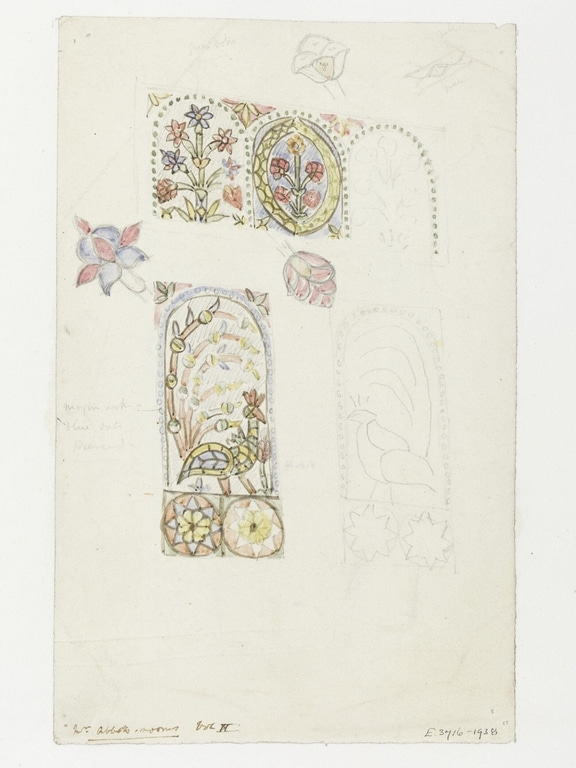
This pencil and watercolour drawing by the British architect James William Wild (1814–1892) shows five rectangular stucco and glass windows in two rows. Only three of the windows were executed completely in colour: the others are only indicated in fine pencil lines.
In the lower row, a rectangular window can be seen, consisting of a rectangle with two squares below. The rectangle shows the motif of a stylized peacock within an arch, and each of the two squares a star and stylized blossom within a circle. On the right-hand side, Wild has drawn a window with the same motif, but not coloured it. The two peacocks face each other in mirror image.
In the upper row, there are three windows with the motif of stylized flowers. The arrangement appears to be symmetrical around the vertical axis of the central window, which represents flowers within an oval form. This is flanked by a window on the left, which shows flowers within an arch, and one on the right indicated in a pencil drawing with colour only for the perforation in the arch (green) and the left-hand corner (yellow and red). The pencil outline and the symmetrical arrangement indicate that the right-hand window bore the same motif as that on the left.
The space around the windows has been used for enlarged details, in this case flowers from the upper left window.
A flower above the top row of windows bears letters indicating the colour of the petals: the ‘y’ in the centre represents an abbreviation for ‘yellow’, and the ‘r’ in three other fields is probably for ‘red’. Blossoms similar in shape and colour can be seen in the central window of the upper row. To the left of the enlarged flower is another inscription that reads ‘green dots’. The green glass backing the perforations of the spandrels to the arches in the upper row of windows was painted by Wild as a large number of small green dots. Wild also added further pencil notes in the drawing. The inscription between the two windows with the peacock motif is not legible.
green dots / green (in the upper left-side of the drawing)
[…] arch blue dots pierced (in the central left-hand corner of the drawing)
Mr. Abbots rooms Vol. II (in the lower left-hand corner of the drawing)