Beschreibung
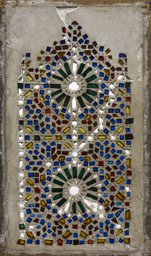
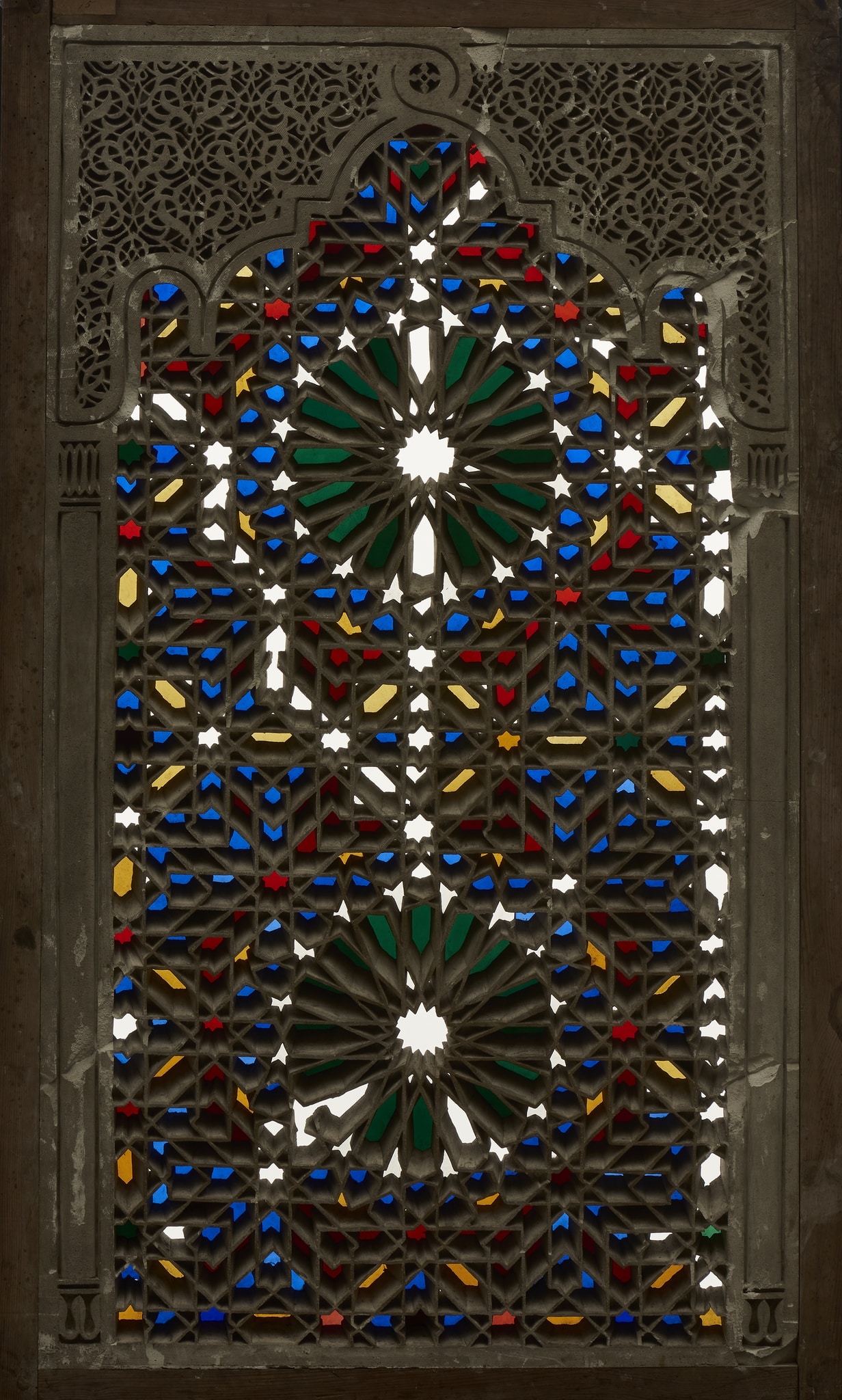
Rectangular stucco and glass window with geometric ornamentation composed of regularly placed eight- and sixteen-pointed stars. The stars form an interlaced grid. The main field is framed by a lambrequin arch ending in a knot at its apex and supported by two columns. The spandrels above the arch are filled with a continuous floral ornament composed of stylized split palmettes. The columns, the arch, and the spandrels are – unlike the star pattern – not perforated and therefore not backed with coloured glass.
The window is held in a wooden frame composed of four slats fixed with nails at the corners.
Iconclass Code
48A981 · Ornament aus geometrischen Motiven
48A9815 · sternförmiges Ornament
48A983 · Ornamente, die von pflanzlichen Formen abgeleitet sind
48A9878 · Flechtwerk (Ornament)
48A9815 · sternförmiges Ornament
48A983 · Ornamente, die von pflanzlichen Formen abgeleitet sind
48A9878 · Flechtwerk (Ornament)
Iconclass Stichworte
Inschrift
Paper label top left (written upside down): Fenster 15