Forschung
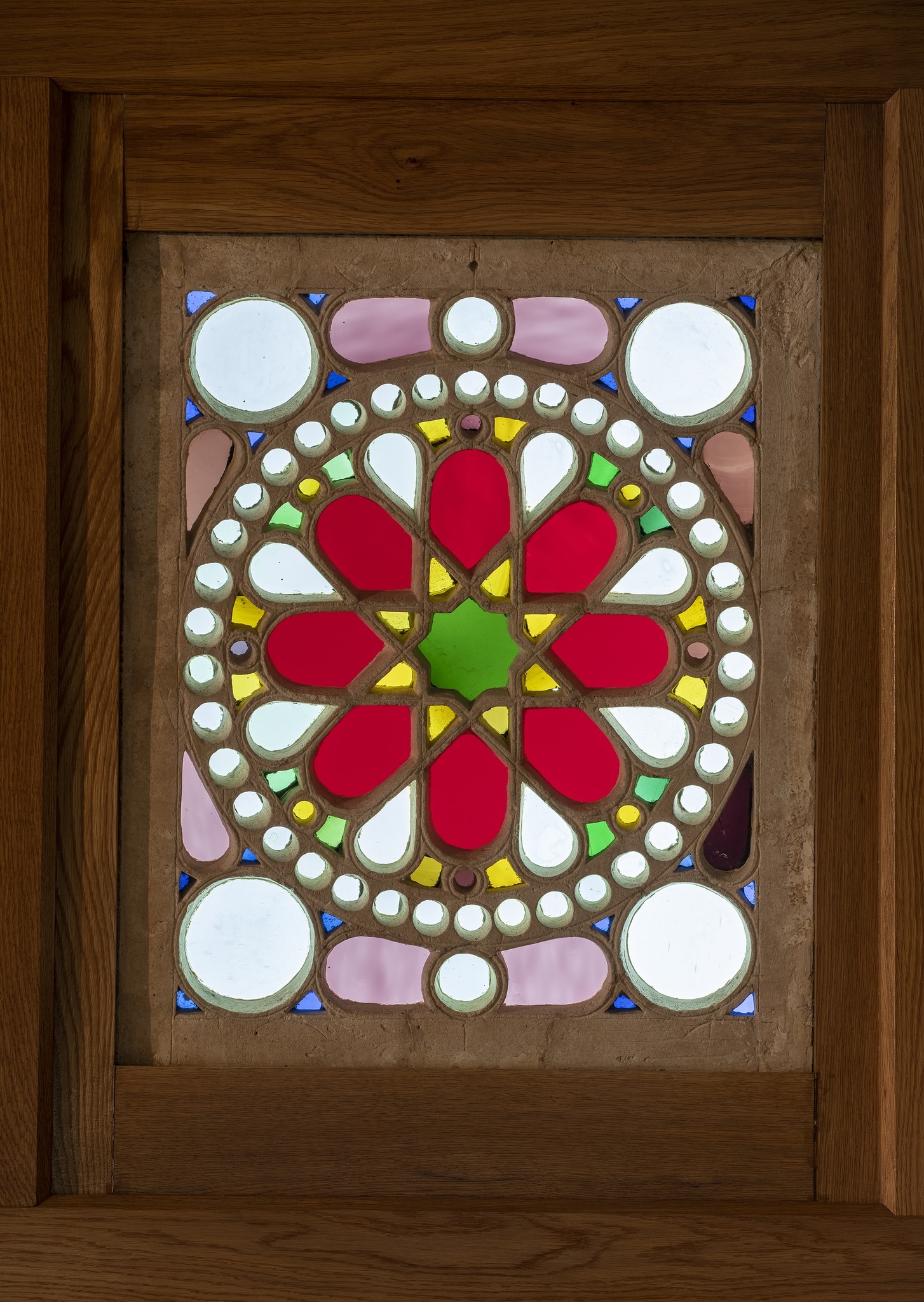
This stucco and glass window is a standard type of qamariyya widespread in Egypt during the Ottoman period. Windows showing comparable designs are held at The Metropolitan Museum of Art in New York (IG_186) and the Medelhavsmuseet (Museum of Mediterranean and Near Eastern Antiquities) in Stockholm (IG_166). This latter example, however, shows an eight-petalled flower in its centre, instead of an eight-pointed star. Windows of this type are also illustrated in Gustave le Bon’s La civilisation des Arabes of 1884 (IG_192) and depicted in several sketches and paintings (see for instance IG_104, IG_118, IG_444).
From a technical point of view, it can be assumed that the window was made in an Egyptian workshop. Although the rear of the window was not accessible during our examination, it can be concluded from the restoration report of 2004 that the window was made according to the traditional technique used in the manufacture of qamariyyāt in North Africa to this day (see Technique).
According to the museum records, the window dates to the 16th or 17th century. However, there are some indications suggesting that the window was produced in the 19th century. On the one hand, the circles, drop-shaped forms and triangles filling the area between the circular inner frame and the rectangular outer frame of the stucco panel reflect a typical design of the late Ottoman period. On the other hand, the window was in a relatively good state of preservation before the restoration in 2003, despite the poor weather resistance of the stucco lattice. The pieces of glass show the characteristics of cylinder-blown sheet glass, a technique that was uncommon in the Islamic world and more commonly used in Europe. Interestingly, the Hungarian architect Max Herz (1856–1819) states in 1902 that sheet glass was imported to Egypt from Europe from the 19th century, because local sheet-glass production had come to a standstill (Herz, 1902, p. 53).
The Cairo-based, Cypriot art and antique dealer Phokion Tanos (1898–1972) donated this window – along with 12 other qamariyyāt (11049–11059, 20969, 20960, see IG_336–359) – to the Benaki Museum in Athens, probably in the 1940s.
In 2003, four replicas of this window were made. They are now on display in Room III of the Benaki Museum of Islamic Art, next to the window discussed here.
Datierung
early 13th–early 14th centuries AH / 19th century CE
Zeitraum
1800 – 1899
Frühere Standorte
Herstellungsort