Materialien
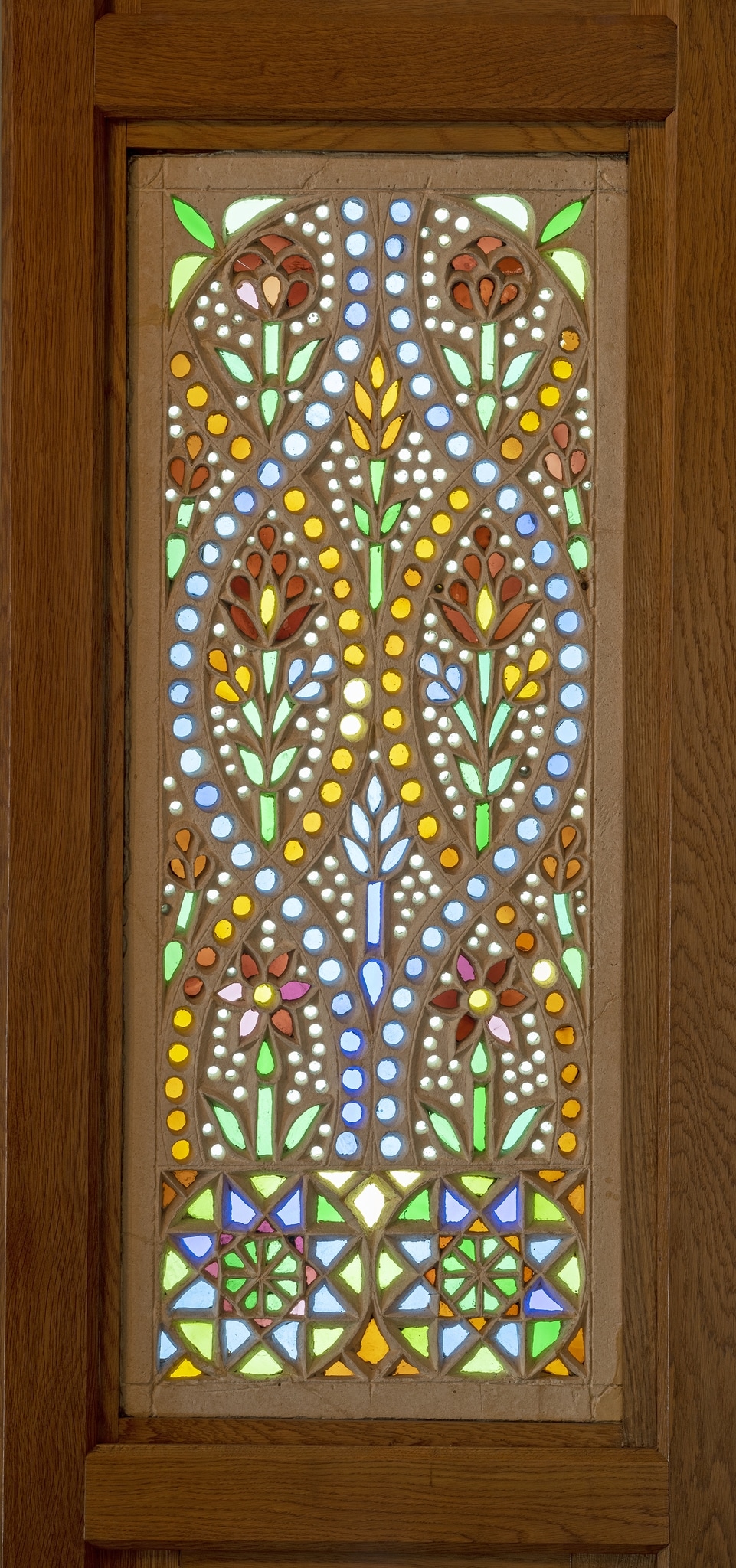
Coarse-grained gypsum plaster; colourless glass; coloured glass (several shades of green, two shades of blue, three shades of yellow, including orange and amber, three shades of red, including a brownish red, a purplish red, and pink)
Technik
Latticework carved into a rectangular stucco panel and inlaid with colourless and coloured sheet glass. The pieces of glass are fixed on the back of the lattice with a thin layer of gypsum plaster. The average thickness of the stucco panel is 18–25mm. The stucco panel has been cast into the wooden frame.
The design of the latticework has two levels: the main motif (level 0) has been carved out of the stucco panel with sharp, knife-like tools following a template incised in the surface of the panel. Traces of the incisions are still visible in some places on the front. The second level (level –1), which lies approximately 6mm below level 0, shows irregularly spaced, conical perforations, which were pierced with a metal or wooden pin in the stucco before it was fully set. The holes are 12–15mm in diameter and slightly tapered towards the back. The distance between the holes is 4–10mm. All holes are backed with colourless glass. The main design and the perforations have been worked in such a way that the incident light is directed downwards into the room.
The glass is either colourless or coloured in the mass. Some of the red tones might consist of red-flashed glass. Elongated parallel bubbles indicate that the glass sheets were mouth-blown, possibly using the broad-sheet or cylinder-blowing method.
Erhaltungszustand und Restaurierungen
The window is well preserved and was thoroughly restored in 2003. During this intervention, earlier repairs were largely removed. Among other things, the 2–3mm thick coat of paint on the front of the stucco grille was removed with a scalpel. The restoration measures included cleaning the surface of the stucco lattice (laser cleaning, density: 1.5 J/cm2 at 1064nm), bonding cracks with acrylic resin, and filling lacunae in the stucco lattice with acrylic filler. The repairs were retouched with pigmented acrylic emulsion. In addition, fragile areas were strengthened with gauze and acrylic resin. The original wooden frame was cleaned with solvent and reinforced by adding an aluminium frame.
At the time of restoration, around 80% of the original pieces of glass were preserved. Missing pieces were replaced with new ones, which were attached with cellulose nitrate.