Forschung
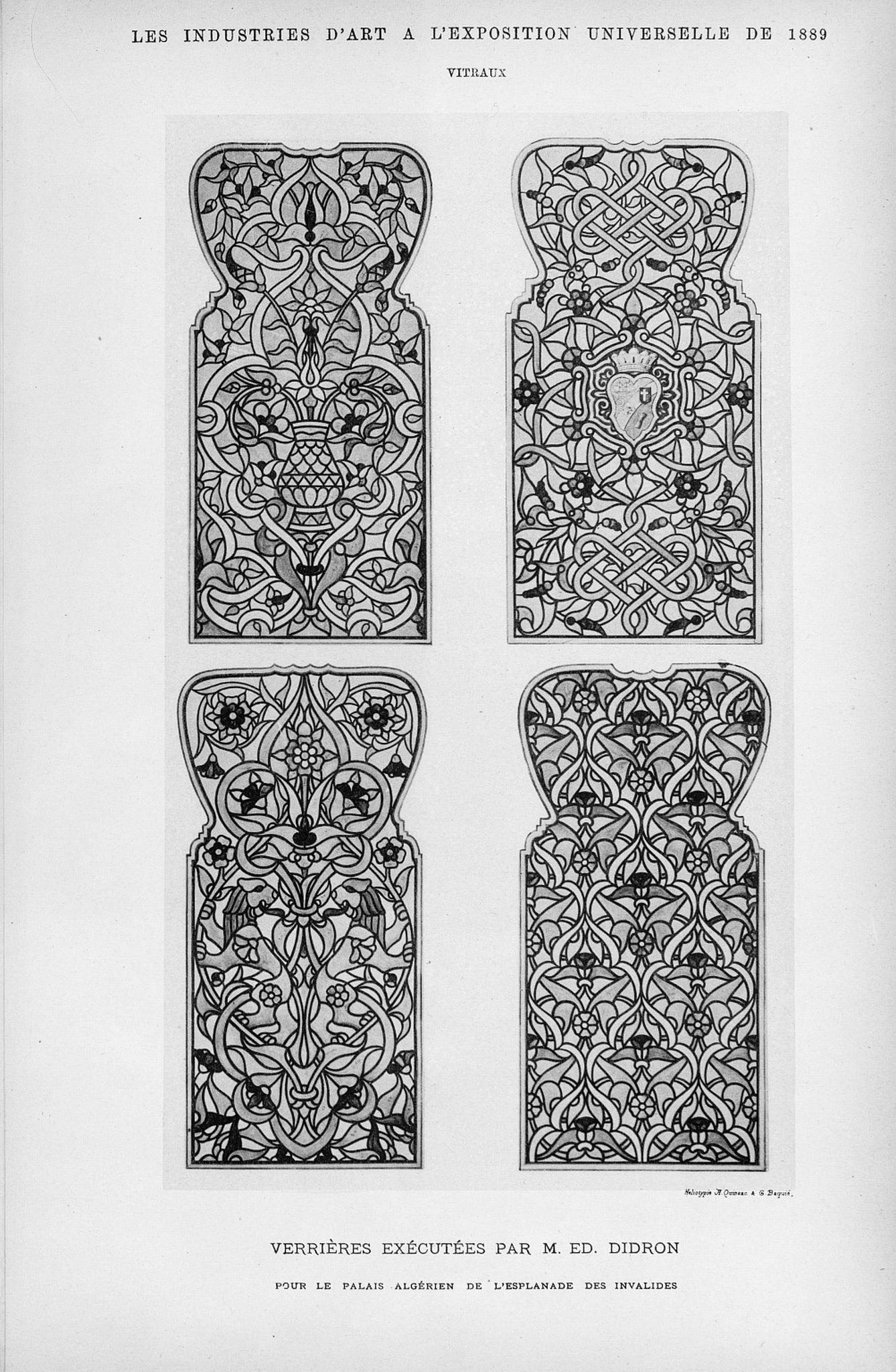
A book illustration in Victor Champier’s Les Industries d’art à l’Exposition Universelle de 1889 (Revue des Arts décoratifs) shows a black and white plate with four stained glass windows designed and executed by the French glass painter Edouard Didron (1836–1902) for the Algerian pavilion of the world’s fair of 1889 in Paris. In the previous volume of the Revue des Arts décoratifs 1889 (pp. 151–152), Didron wrote an article about the stained glass production of the last 100 years and its presentation at the world’s fair of 1889. He also comments on the windows he made for the Algerian pavilion: he explains that, having already worked as a stained glass artist for thirty-six years, he had attempted to produce stained glass without painting the glass. This was to lend decorative stained glass simplicity once more, as in earlier times: ‘pour attribuer au vitrail de décoration pure le caractère de simplicité dans les moyens mis en oeuvre qu’il dut avoir aux temps primitifs.’ He describes his method as follows: coloured, detailed foliage is set against a yellow or white background, such that the drawing only emerges through the lead cames. Didron created such windows, for example, for the ceiling of the salle publique of the Comptoir d’Escompte in Paris in 1880 and – ‘avec d’extraordinaires complications’ – for the Algerian pavilion. In his words, these were very colourful, on a white and yellow background, and in Arabic style. As far as is known, they did not survive.
In 1863, Didron had written a history of stained glass in Europe (Annales archéologiques, XXIII, pp. 45–60, 201–224) and dedicated a part of it to Ottoman stucco and glass windows. He describes the ones in the Süleymaniye Mosque in Constantinople, as well as those in the Dome of the Rock in Jerusalem, referring to Melchior de Vogüé’s documentation for his publication (see IG_71, IG_72, IG_73). Despite his knowledge of the history and technique of stucco and glass windows in the Islamic world, Didron decided to make stained glass windows set in lead for the windows of the Algerian pavilion. Only their design and their motifs can be retraced to Islamic sources. Thus their outlines, which are very unusual for both European or Islamic windows but typical for Algerian architecture (see Golvin, 1988, p. 54), correspond to architectonic arches, such as those of the niches of the Dar Khdaouedj al-ʿAmyaʾ (Musée national des arts et traditions populaires) in Algiers. This private house of the 10th and 13th centuries AH / 16th and 19th CE also displays Ottoman stucco and glass windows of the type that was widespread in Egypt (see Golvin, 1988, p. 59).
The foliage of Didron’s windows is very different from the designs of the Ottoman stucco and glass windows seen in Egypt or Algeria. However, Melchior de Vogüé’s colour plates of the windows of the Dome of the Rock in Jerusalem, to which Didron (1863, p. 203) referred in his publication, may have played a decisive role in the designs. Pl. XXIV (IG_71) shows very similar interlaced tendrils interspersed with flowers.
Datierung
1889
Verknüpfte Standorte
Herstellungsort