Beschreibung
Pascal Coste’s pioneering publication contains a total of 70 plates, preceded by a 52 pages of text, consisting of a preface, a historical introduction, and a detailed explanation of the plates.

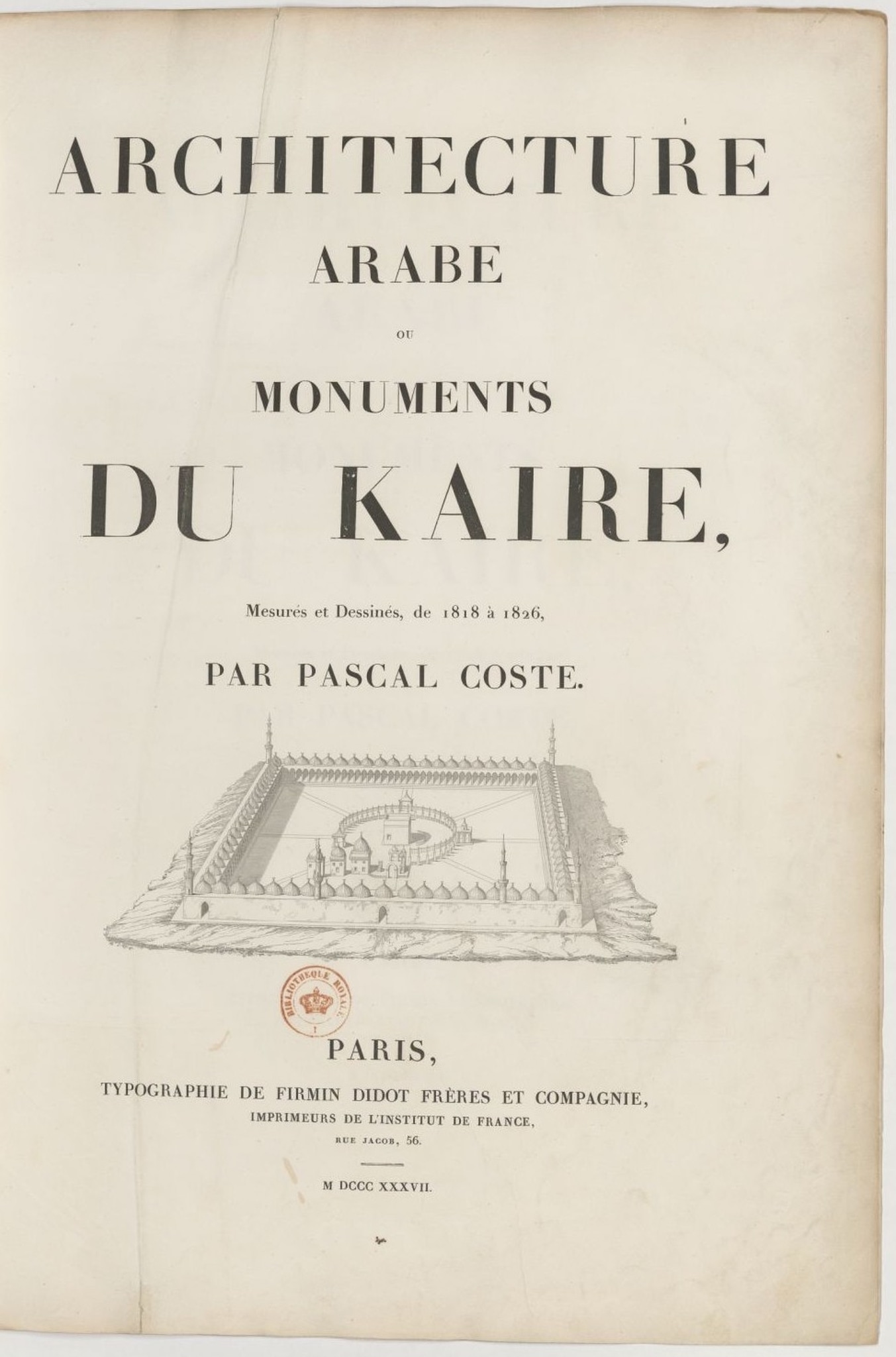
Pascal Coste’s pioneering publication contains a total of 70 plates, preceded by a 52 pages of text, consisting of a preface, a historical introduction, and a detailed explanation of the plates.
The architect and engineer Pascal Coste published his book after two long stays in Egypt between 1817 and 1827, during which he created countless drawings that served as the basis for his work. In 1822, he had received a permit from the governor of Egypt, Muhammad ʿAli, to enter and study religious buildings as well (Coste, 1878, p. 30).
Some of the first plates of his Architecture arabe were published in 1834. In the spring of 1837, the first three issues, accompanied by a frontispiece, came off the presses of the lithographer Louis Letronne in Paris. These notebooks in folio format each included five leaves with engravings, some of which appeared simultaneously in simple line versions, coloured versions, and shaded versions. Twelve further issues followed at regular intervals over the next two years, published by Firmin-Didot in Paris (Volait, 1998, pp. [3, 11]; Coste, 1878, vol. 1, p. 104).
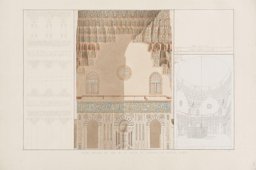
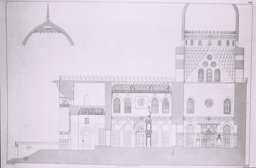
Coste only briefly mentioned stucco and glass windows in the explanations to his plates. However, several plates do display stucco and glass windows in their original settings in private houses and in mosques: a line drawing of the façade of a residential building in Cairo with eighteen stucco and glass windows with typical floral motifs (pl. XLVII, IG_69); a line drawing of the Mosque-Madrasa of Sultan Hasan and its windows (pl. XXII, IG_202), which also exists as coloured drawing (Victoria and Albert Museum, SD.272:14, IG_130); coloured plates of several Cairo façades (pl. XLIX) and of the Sultan al-Muʾayyad Shaykh Mosque (pl. XXX; IG_159); and three views, one of them coloured, of the Mosque of Sultan Qaytbay (pls XXXIII, XXXIV, XXXV; IG_188).
These are the oldest known published images that show stucco and glass windows in detail.
In his Mémoires (p. 104), Coste stated in 1878 that the edition was out of print after a few years. The number of copies, however, is not known. As Volait pointed out (1998, p. [19]), the Egyptian governor Muhammad ʿAli ordered 10 copies, and the Administration des Beaux-Arts ordered 103 copies, 23 of them coloured, for the public libraries of France. The author himself bequeathed one copy with original line drawings to the library of his hometown Marseille (Bibliothèque de l’Alcázar, Marseille, RES52347).
Coste, P. (1837). Architecture arabe ou Monuments du Kaire, mesurés et dessinés, de 1818 à 1826. Paris: Typographie de Firmin Didot Frères et Compagnie, Imprimeurs de l'Institut de France.
Coste, P. (1878). Mémoires d'un artiste, Notes et souvenirs de voyages (1817- 1877). Marseille: Cayer.
Volait, M. (1998). “Les monuments de l’architecture arabe” vus par Pascal Coste (pp. 97–131). Jacobi, D. (dir.), Pascal Coste, toutes les Egypte. Marseille: Parenthèses/Bibliothèque municipale de Marseille. https://shs.hal.science/halshs-00957011