Forschung
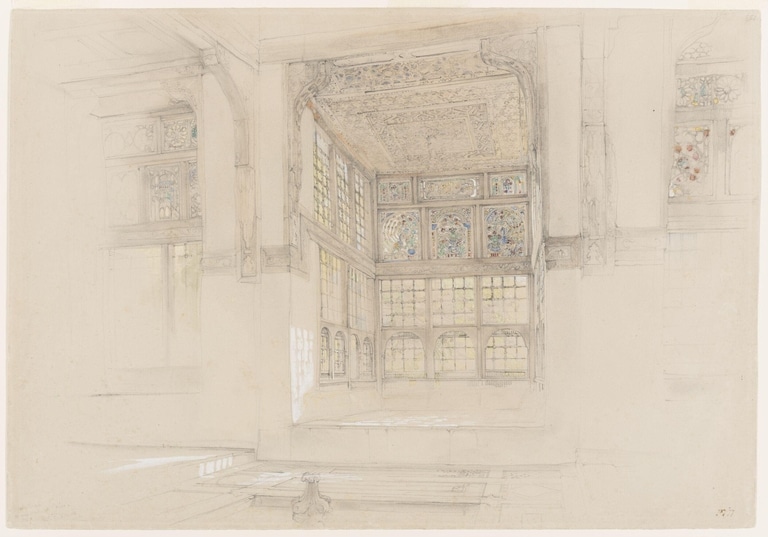
During his sojourn in Cairo between 1841 and 1851, Lewis collected a vast amount of material for pictures and depicted his own house in the Azbakeya quarter of the city, on the inside and outside, in several careful drawings and watercolours (Weeks, 2014, pp. 40–43). One such watercolour is Mendurah in my House in Cairo, which shows a traditional Cairene house. The watercolour may have been used later in England as reference for some of Lewis’s Orientalist paintings, such as A Lady Receiving Visitors (IG_118) (Tromans, 2008, p. 133 and Llewellyn 1998, p. 153). A more detailed comparison however of the watercolour (painted around 1843 in Egypt) and the windows in the oil painting (of 1873, IG_118) highlights significant differences in the representation of architectural details. The stucco and glass windows in the side recesses are not identical in the two works: the upper row of windows on the left side in the central bay in the oil painting is totally absent from the watercolour; and on the left side of the watercolour, the motif indicated by Lewis for the central window of the lower row is stylized architecture, instead of the geometric pattern in the oil painting.
A section of the interior drawn by the British architect James William Wild (1814–1892) (IG_449), in which the windows closely correspond in their motifs and arrangement to Lewis’s watercolour, also shows a central window with stylized architecture. A window with geometric design can however be seen in the recess on the right side of Lewis’s and Wild’s watercolours. In a pencil note on his watercolour drawing, Wild confirms that the interior represents the Cairene house in which Lewis lived by himself during his sojourn in Egypt for almost ten years (Weeks, 2014, 40–43). The discrepancies regarding the windows in Lewis’s and Wild’s watercolours, done in Egypt, compared with Lewis’s oil painting, done after his return to Britain in 1851, suggest that the latter is not a totally authentic and accurate rendering of the Cairene house in which Lewis lived during in the 1840s, the period during which the watercolours were produced (Tromans, 2008, pp. 129–132).
Datierung
c. 1843
Verknüpfte Standorte